If your patio door is drafty, stuck, foggy, or just plain worn out, you have more options than you might think: repair it, upgrade it with new hardware or weatherstripping, repurpose the panel, sell or donate it, recycle the materials, or dispose of it properly through a transfer station. Which path makes sense depends on the door's age, damage type, and how much you want to spend. This guide walks you through the full decision, then gives you the step-by-step DIY procedures for the two most common repairs: fixing a stuck sliding door with a dirty or damaged track, and replacing worn rollers that make the door hard to move or wobbly on its track.
What to Do with Old Patio Doors: Repair, Reuse, Recycle Safely

Jamie Archer
22 Jul 2026
Who this guide is for
This is for homeowners who already have an old or failing sliding glass door and need to figure out the smartest next move. Maybe the door drags and grind-stops halfway. Maybe the glass is fogged up between the panes. Maybe you just replaced it and now have the old door sitting in your garage. Whether you want to fix it, give it away, or get rid of it entirely, this guide covers each option with real cost estimates, the right tools, and honest guidance on what you can DIY versus when to call someone.
Quick decision checklist: six paths for an old patio door
Run through this checklist before committing to anything. It only takes a few minutes and saves you from doing unnecessary work or throwing away a door that has real value.
- Repair it yourself: door is less than 20 years old, glass is clear (no fogging between panes), frame is straight, and the issue is mechanical (rollers, track, lock, weatherstripping).
- Retrofit or upgrade it: door works but leaks air, lets in too much light, or has a weak lock. Add new weatherstripping, window film, blinds, or a multi-point lock without replacing the whole door.
- Repurpose the panel: intact glass and frame can become a greenhouse wall, room divider, cold frame, or decorative garden feature.
- Sell or donate it: door is structurally sound, glass is not fogged, and hardware is complete. List on Facebook Marketplace or Craigslist, or contact your local Habitat for Humanity ReStore.
- Recycle the materials: aluminum framing can be sold to a scrap yard for roughly $0.40–$0.90 per pound (mid-2026 rates). Glass from insulated units (IGUs) is harder to recycle and usually goes to a C&D transfer station.
- Dispose of it properly: fogged, broken, or laminated glass and failed IGUs cannot go in curbside recycling. Many municipalities, including Santa Fe County and Sunnyvale, CA, explicitly prohibit window and tempered glass from household recycling bins. Use a C&D drop-off or transfer station.
Repair vs. replace vs. repurpose: how to decide
The honest framework is this: if the glass is failing or the frame is bent, no amount of DIY repair fixes the real problem. But if the glass is clear and the frame is square, almost every mechanical issue on a sliding patio door is fixable by a careful homeowner in a few hours.
Age and overall condition
A door that is 10–15 years old with a single mechanical problem is almost always worth repairing. A door that is 25-plus years old with multiple issues, fogged glass, a warped frame, and cracked weatherstripping is probably at the end of its useful life. Replacement gets you better energy performance anyway. The tipping point for most homeowners is when the repair cost exceeds roughly 30–40% of what a comparable replacement door costs installed.
Glass condition: the clearest signal
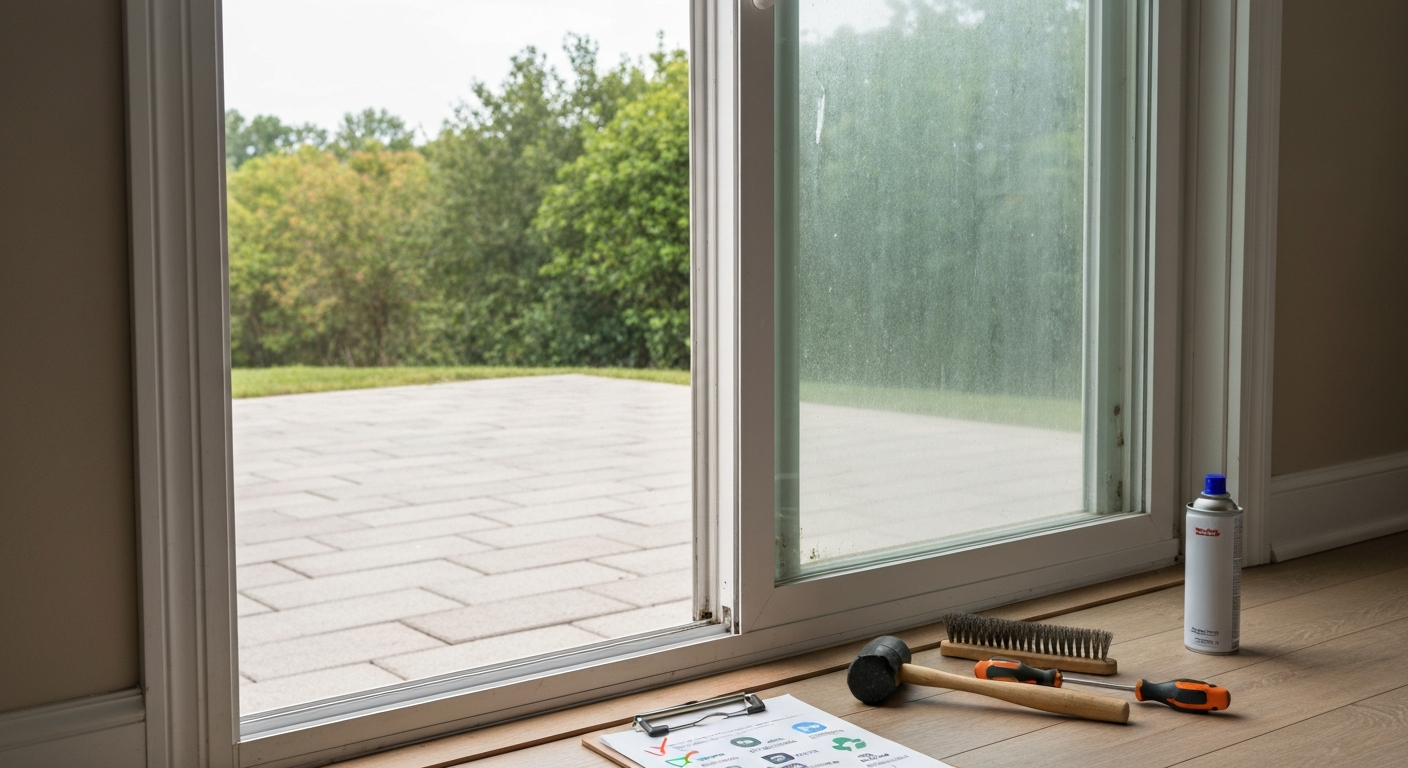
Hold a flashlight against the glass on a dry day. If you see foggy haze or moisture between the two panes of an insulated glass unit (IGU), the seal has failed. You cannot clear that fog by cleaning the outside surface. The IGU needs replacement, which means either a reglazing job (possible but often costly) or a new door. A fogged IGU also eliminates most donation and resale options since ReStores and buyers generally will not accept failed units.
Energy loss and drafts
Hold your hand along the door edges on a cold or windy day. A draft at the perimeter usually means the weatherstripping is compressed or torn, which is a cheap, easy fix. A draft coming from the center of the glass means the IGU seal has failed and the door is no longer performing thermally. Continuing to run an HVAC system against a failed IGU costs real money month after month.
Safety considerations
Cracked tempered glass, a door that can be lifted out of its track from outside, or a lock that no longer latches properly are safety and security failures, not just nuisances. A door you cannot fully lock is a liability. If the frame is bent enough that the lock strike plate no longer aligns, that is often a structural problem that goes beyond DIY adjustment. For privacy and blackout upgrade options that avoid full replacement, those topics are covered in separate guides on this site.
Decision criteria at a glance
| Condition | Recommended action |
|---|---|
| Door drags, grinds, or sticks | Clean track and replace rollers (DIY) |
| Lock won't align or latch | Adjust roller height to realign, or replace strike plate (DIY) |
| Weatherstripping torn or compressed | Replace weatherstripping (DIY, under $30) |
| Glass fogged between panes | Reglaze or replace the door |
| Frame bent or out of square | Professional assessment; likely full replacement |
| Door is functional but older, energy-inefficient | Retrofit with film or new weatherstripping, or replace for long-term savings |
| Door is intact and you don't need it | Sell, donate, or repurpose |
Realistic costs and time estimates
One thing I want to be straight about: the time estimates below assume you have done basic home repair before. If this is your first time removing a sliding door panel, add 30–60 minutes for the learning curve and for any stuck hardware.
| Task | DIY cost | DIY time | Pro cost (installed) | Pro time |
|---|---|---|---|---|
| Track cleaning | $0–$10 (cleaner, rags) | 30–45 min | N/A (usually done as part of larger repair) | — |
| Weatherstripping replacement | $15–$40 (materials) | 1–2 hours | $100–$200 labor + materials | 1 hour |
| Roller replacement (both rollers) | $20–$60 per pair | 2–3 hours | $150–$300 labor + parts | 1–1.5 hours |
| Lock/latch replacement | $25–$80 | 1 hour | $100–$200 | 30–60 min |
| IGU reglazing (seal failure) | $200–$500+ per pane | Not recommended DIY | $300–$700+ installed | Half day |
| Full door removal and disposal haul | $0–$50 (dump fees) | 2–4 hours with help | $200–$600 (removal + haul) | 2–3 hours |
| Full door replacement (materials + labor) | $800–$3,000+ | Not beginner DIY | $1,500–$4,500 installed | 1–2 days |
The DIY savings on roller replacement and track work are real and significant. A professional will charge $150–$300 for a job you can do yourself in an afternoon for under $60 in parts. The math changes when you get to IGU failure or frame work, where mistakes are expensive and the skills required are more specialized.
Tools, materials, and safety gear you need before you start
Get everything on this list together before you touch the door. Stopping mid-job to run to the hardware store with a 150-pound glass panel sitting on sawhorses is not a great situation.
Tools
- Flathead and Phillips screwdrivers (multiple sizes)
- Cordless drill or driver
- Needle-nose pliers
- Pry bar or small flat bar (for stop molding removal)
- Tape measure
- Utility knife
- Wire brush or old toothbrush (track cleaning)
- Vacuum with a crevice attachment
- Sawhorses (two, rated for the door's weight)
- Rubber mallet
- Putty knife or stiff plastic scraper
Materials
- Replacement rollers (match to your door brand and model — Andersen, Pella, Milgard, JELD-WEN each have model-specific part numbers)
- Silicone-based track lubricant or dry PTFE spray (not WD-40, which attracts dirt)
- Replacement weatherstripping (measure your existing profile before buying)
- Rubbing alcohol or degreaser for track cleaning
- Clean rags
Safety precautions and PPE
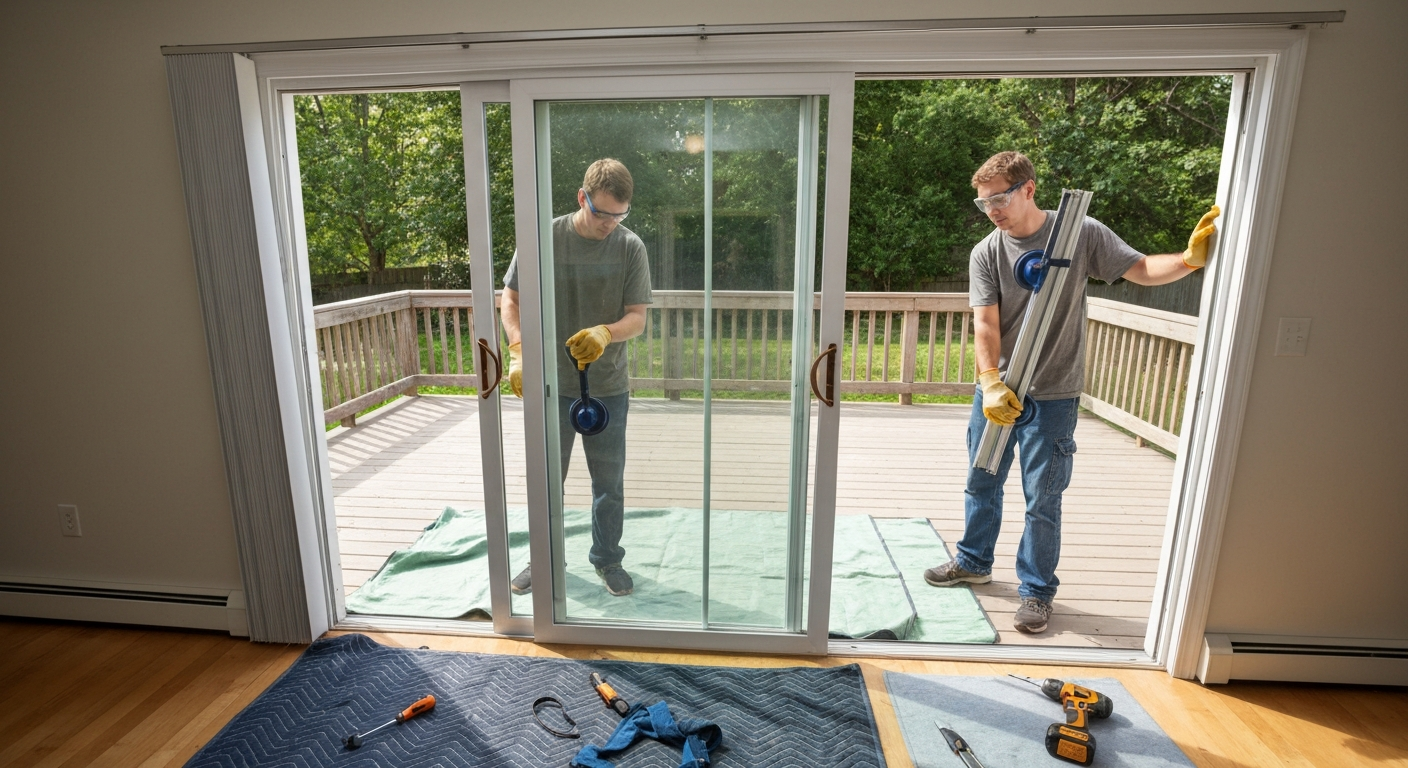
Sliding glass door panels are heavy, typically 60–150 pounds depending on size and glass type, and the glass edge can cut without warning. OSHA guidance on PPE hazard assessment specifically requires impact-rated safety glasses (ANSI Z87.1 rated) and cut-resistant gloves when handling glazing or working where glass breakage is a risk. Wear both, every time. Add long sleeves. Keep children and pets out of the work area. Always use a second person when lifting a full panel out of or into its frame. NIOSH's lifting guidelines make clear that panels in this weight range require coordinated two-person lifts to avoid back injury and drop risk. Never prop a panel against a wall unsupported; lay it flat on sawhorses.
- ANSI Z87.1-rated impact safety glasses, worn the entire time
- Cut-resistant work gloves (not thin cloth gloves)
- Long sleeves
- Closed-toe shoes (steel-toe preferred)
- A second person for any panel removal or reinstallation
- Two sawhorses rated for the panel's weight
Common sliding patio door problems: what you can fix yourself
Most sliding door complaints fall into a handful of categories. Here is how to identify the actual problem before you start taking things apart.
| Symptom | Likely cause | DIY-fixable? |
|---|---|---|
| Door drags or sticks | Dirty/damaged track or worn rollers | Yes |
| Door is hard to open but glides smoothly once moving | Rollers are partially seized or flat-spotted | Yes |
| Door wobbles or tilts while sliding | Roller height out of adjustment or one roller broken | Yes |
| Door lifts out of track easily from outside | Roller height too low, no anti-lift block, or missing track stop | Yes — add anti-lift blocks or adjust roller height |
| Lock won't align with strike plate | Door riding too low or too high due to roller wear | Usually yes — adjust rollers first |
| Draft at the door edges | Worn or compressed weatherstripping | Yes |
| Fogging or moisture between glass panes | IGU seal failure | No — needs professional reglazing or replacement |
| Frame visibly bowed or out of square | Structural settlement or impact damage | No — call a pro |
| Cracked glass | Impact damage | No — tempered glass must be replaced by a glazier |
The two most impactful repairs you can do yourself are also the most common: cleaning and restoring the track, and replacing the rollers. Both are covered step by step below.
Fix a stuck sliding door: clean and repair the track
Before you pull rollers or lift panels, always start with the track. About half the time, a thorough track cleaning is all that is needed to get a sluggish door moving freely again. This job takes 30–45 minutes and costs almost nothing.
What you need
- Vacuum with crevice tool
- Wire brush or stiff toothbrush
- Degreaser or rubbing alcohol
- Clean rags
- Silicone spray or dry PTFE lubricant
- Flathead screwdriver (to clear weep holes)
- Safety glasses and gloves
Step-by-step
- Put on your safety glasses and gloves before you start.
- Slide the door fully open and vacuum the bottom track channel from end to end. Get the crevice tool into the corners where debris compacts.
- Use the wire brush to scrub out compacted dirt, dried lubricant, and grit from the track channel. Old silicone grease traps dirt and becomes a grinding paste over time — remove it completely.
- Check the weep holes (small slots or holes at the bottom of the exterior track frame). These drain rainwater out. Probe each one with a flathead screwdriver to clear any blockage. Blocked weep holes cause standing water that rusts steel tracks or swells wood frames.
- Wipe the entire track channel with a rag dampened with degreaser or rubbing alcohol. Let it dry fully.
- Inspect the track channel for visible dents, bends, or raised sections. Minor dents can sometimes be carefully tapped back with a rubber mallet and a block of wood. Severe damage means the track needs replacement.
- Apply a thin, even coat of silicone spray or dry PTFE lubricant to the track. Do not use WD-40, petroleum jelly, or cooking spray — they attract and hold dirt, making the problem worse within weeks.
- Slide the door back and forth several times to work the lubricant in.
- If the door still sticks or grinds after the track is clean and lubricated, the problem is in the rollers. Move on to the roller replacement steps below.
Track damage you cannot fix with cleaning
If the track channel is bent more than a few millimeters, has a significant raised section that catches rollers, or is badly corroded, cleaning will not help. Replacement track sections are available from door manufacturers and from specialty glazing suppliers. Fitting a new track section is a moderate DIY job, but it does require removing the door panel first, which means you may as well do the roller inspection at the same time.
Replace bent or broken rollers and adjust door alignment
Rollers are the most commonly worn part on a sliding door, and replacing them is the single repair that makes the biggest difference in how a door feels and operates. Manufacturers including Andersen, Pella, Milgard, and JELD-WEN all publish homeowner-level service instructions for this procedure, and it is explicitly designed to be done without a contractor. Andersen’s Gliding Patio Door service guide (Service Guide 9069167) gives model-specific roller replacement procedures and explicitly instructs removing the operable panel to access and replace rollers; it lists part numbers and adjustment access locations for Andersen 200/400-series gliding doors Andersen’s Gliding Patio Door service guide (Service Guide 9069167) gives model-specific roller replacement procedures and explicitly instructs removing the operable panel to access and replace rollers; it lists part numbers and adjustment access locations for Andersen 200/400-series gliding doors.. The key is getting the right replacement rollers before you start.
Find your replacement rollers before you start
Rollers are not universal. Andersen, Pella, Milgard, and JELD-WEN each make model-specific roller assemblies with their own part numbers. Look for a label on the door edge or frame stile (often inside the jamb edge or on the frame header) that gives the series name and model number. Then look up the part number in the manufacturer's service guide before ordering. Using the wrong roller assembly means the door will not sit at the right height or run smoothly in its track. Order at least one complete replacement pair, and consider buying a spare set while you have the door out.
Full tools list for roller replacement
- Phillips and flathead screwdrivers
- Cordless drill or driver
- Needle-nose pliers
- Small pry bar or flat bar
- Rubber mallet
- Sawhorses (two, rated for door weight)
- Tape measure
- ANSI Z87.1 safety glasses
- Cut-resistant gloves
- A second person for panel removal and reinstallation
Step-by-step roller replacement
- Put on safety glasses and gloves. Confirm your second helper is present before you go any further.
- Remove the screen door first if there is one. Screens typically lift straight up and tilt out of the bottom track. Set it aside flat.
- Locate the roller adjustment screws. On most sliding doors these are on the bottom rail of the operating panel, accessible through small holes or slots at each bottom corner. Some models (including certain JELD-WEN doors) have side-access adjustment points. Check your manufacturer's instructions for your specific model.
- Turn the adjustment screws counterclockwise to retract the rollers fully up into the panel. This lowers the panel onto the track so it can be lifted free.
- Remove the interior stop molding — the narrow trim strip on the interior side of the door frame that holds the panel in its channel. Use a flathead screwdriver or small pry bar. Work carefully along its length to avoid splitting it, since you will reinstall it. Set aside the screws.
- With your helper, grip the panel on both sides and lift it straight up until the bottom clears the lower track, then tilt the bottom toward you and guide it out of the upper track. Carry it directly to the sawhorses. Do not lean it against a wall.
- Lay the panel horizontally on the sawhorses. Now you have clear, safe access to both roller assemblies on the bottom rail.
- Remove the roller assemblies. Most slide or snap out once the retaining screw is removed. On some models (following Milgard's published procedure) you first push the roller housing inward to compress it, then pivot it down and out. On Andersen 200/400-series doors the roller is accessed by removing a cover cap and a retaining screw. Refer to your model's service guide for the exact sequence.
- Compare the old rollers to the replacements. The wheel diameter, housing width, and mounting configuration should match exactly. If they do not, stop and order the correct part.
- Install the new roller assemblies by reversing the removal steps. Make sure each roller clicks or locks fully into its housing before you reinstall the panel.
- With your helper, lift the panel back to the frame opening, guide the top rail into the upper channel first, then lower the bottom onto the track. The retracted rollers will allow the panel to sit down into the track.
- Reinstall the interior stop molding and secure with its screws.
- Turn the adjustment screws clockwise on both rollers equally to raise the panel until there is about 1/4 inch (6 mm) clearance between the bottom rail and the track. The door should glide smoothly with even resistance.
- Check that the door is plumb and square in its frame. Look at the gap between the door and the fixed panel or door frame along the full height — it should be even, not tapered. If it is tapered, raise the roller on the high side slightly or lower the roller on the low side.
- Test the lock. The lock bolt or latch should align with the strike plate without forcing. If it is off by a few millimeters, fine-tune the roller heights until the alignment is correct.
- Reinstall the screen door, apply a light coat of silicone lubricant to the track, and slide the door through its full range of motion several times.
Troubleshooting after roller replacement
- Door still drags at one end: the rollers are not adjusted evenly. Raise the dragging end by a quarter-turn on that side's adjustment screw.
- Door gap tapers from top to bottom on the latch side: raise the latch-side roller slightly.
- Lock still doesn't align after roller adjustment: the strike plate on the frame can sometimes be shimmed or repositioned slightly with a screwdriver. If the misalignment is more than about 3/8 inch, something else is off — check that the panel is fully seated in both tracks.
- Panel is hard to lift back in during reinstallation: confirm rollers are fully retracted (fully counterclockwise on adjustment screws) before attempting reinstall.
- New rollers make a clicking noise: the roller housing may not be fully seated. Remove the panel again and confirm both assemblies are locked in place.
- Door can be easily lifted out of its track from outside after adjustment: the rollers may be adjusted too high. Lower both sides equally until the door cannot be lifted free, then recheck the 1/4-inch bottom clearance.
Selling, donating, repurposing, and recycling an old door
If you have replaced the door and the old unit is sitting in your garage, here is what you can realistically do with it. The EPA recommends prioritizing reuse and recycling over landfill disposal for construction and demolition materials, and patio doors with intact glass and hardware have genuine reuse value.
Selling or donating
An intact sliding door with clear (not fogged) glass can sell on Facebook Marketplace or Craigslist for $50–$300 depending on size, brand, and condition. Be honest in the listing about the door's age, any roller wear, and whether the weatherstripping has been replaced. Habitat for Humanity ReStores commonly accept gently used doors and windows, but policies vary significantly by location. Many ReStores accept double-pane vinyl or aluminum doors in good condition but will refuse fogged IGUs, broken glass, or oversized commercial units. Always call your local ReStore before hauling the door over, and ask whether they want hardware removed and bagged separately. Getting rid of old patio doors and understanding exactly where to take them for disposal or donation is covered in detail in companion guides on this site.
Repurposing the door panel
An intact sliding door panel with clear glass makes an excellent cold frame lid, greenhouse wall section, or garden room divider. For tips on privacy options and treatments for patio doors, see our guide on how to make patio doors private. The aluminum frame and tempered glass hold up outdoors. The limitation is weight: a full panel is heavy enough that any structure it rests on needs to be built to support it properly. This is a genuinely useful second life for a door that is too worn for resale but still structurally sound.
Recycling and disposal
The aluminum framing is the most recyclable part. Scrap yards in mid-2026 are buying aluminum at roughly $0.40–$0.90 per pound depending on alloy grade and region. A standard sliding door frame will yield 15–30 pounds of aluminum, which is $6–$27 at current rates. You will need to separate the aluminum from the glass, sealants, and any plastic components before the yard will accept it, call ahead and ask what preparation they require.
The glass is harder. Insulated glass units (IGUs) contain sealants, Low-E coatings, inert gas fills, and sometimes laminated interlayers, which means most glass recyclers will not accept them. Peer‑reviewed research (Towards a quality protocol for enabling the reuse of post‑consumer flat glass, Glass Struct. & Eng. (2023)) documents viable reuse and remanufacture pathways for post‑consumer flat architectural glass and recommends manual disassembly and quality‑grading protocols, concluding that reuse should be pursued over recycling where feasible blank" rel="noopener noreferrer">Towards a quality protocol for enabling the reuse of post‑consumer flat glass — Glass Struct. & Eng. (2023). Tempered and laminated glass are also excluded from standard flat-glass recycling streams. Do not put either in your curbside bin. Many municipalities explicitly prohibit it, Santa Fe County and Sunnyvale, CA are examples of jurisdictions that list window and tempered glass as not accepted curbside. Take glass panels to a C&D (construction and demolition) transfer station or municipal drop-off. Check with your local facility first, because acceptance rules vary. The dedicated guide on where to dispose of old patio doors on this site covers this by region and facility type in more detail.
When to stop DIYing and call a pro
Most track and roller work is genuinely DIY-friendly if you follow the steps above. But there are specific situations where calling a professional is the right call, not because the job is too hard, but because the cost of a mistake is too high.
- The frame is visibly bowed, twisted, or out of square — this usually means the rough opening has shifted and the fix involves structural adjustment.
- The glass is cracked — tempered glass shatters into small pieces when it fails during handling. A glazier has the tools and training to remove it safely.
- The IGU has failed (fogged glass) — reglazing an IGU requires sourcing the correct replacement unit and handling large, heavy glass panels with proper equipment.
- The door is a very large or heavy commercial-style unit — panels over 100–120 pounds really benefit from professional equipment for safe removal.
- You adjusted the rollers but the lock still won't align properly and the gap in the frame is clearly uneven — this suggests the frame itself needs adjustment, not just the rollers.
- The bottom track is severely corroded or damaged and needs replacement — this involves partial frame disassembly that can go wrong quickly without experience.
FAQ
How do I decide whether to repair, retrofit, repurpose, sell/donate, recycle, or dispose of an old patio door?
Start with a quick condition checklist: intact glass (no cracks), IGU clear (no fogging), operable sash moves smoothly, rollers adjustable, frame not warped/rotten, locks functional, and weatherstripping in good shape. If major structural damage, severe seal failure (fogged IGU), or heavy corrosion exists, replacement or recycling/disposal is likely. If the door mostly needs tune‑up (rollers, track cleaning, new weatherstripping, lock adjustment), repair. If the door is sound but you want better privacy, security, or insulation, retrofit (films, blinds, new hardware, or secondary glazing). If the door is intact and usable but you’re removing it, consider selling or donating. If frame is aluminum/steel with separated, cleanable glass, salvage metal and glass recycling may be possible. Use cost, time, and reuse value to choose: repairs and retrofits are lowest cost; resale/donation can recover value; recycling/disposal may have fees and local rules.
What safety gear and handling rules should I follow before working on or removing a patio door?
Wear impact‑rated safety glasses, cut‑resistant gloves, long sleeves, and sturdy footwear. Use a dust mask when cutting or prying sealants. Plan heavy lifts: get at least one helper or use mechanical aids; consult a lifting calculator for safe loads. Disconnect adjacent trim slowly and watch for stored tension. For glass handling, use suction lifters and protect edges with soft padding. When cutting or breaking down frames, ventilate and avoid inhaling sealant fumes. Follow local disposal rules for hazardous items.
Step‑by‑step: how do I diagnose and fix a sliding patio door that’s hard to open or sticks?
1) Inspect track and remove debris; vacuum and clean with a brush and mild detergent. 2) Clear weep holes with a thin nonmetallic tool. 3) Check rollers: locate bottom adjustment screws (bottom or edge access). 4) Retract or lower rollers per the manufacturer, lift sash with a helper, and remove panel if needed. 5) Inspect rollers for chips/wear; replace assemblies if damaged. 6) Reinstall sash, adjust roller height so sash glides with slight lift and no wobble. 7) Lubricate rollers lightly with a silicone spray (not petroleum). 8) Replace torn weatherstripping. Typical time: 1–3 hours; parts $10–$80 each depending on brand. If rollers are inaccessible or sash is heavy/laminated, call a pro.
How do I repair common issues: broken rollers, faulty locks, and drafts?
Broken rollers: access bottom adjustment screws, retract rollers, lift out sash, replace roller assembly with manufacturer‑specific part, then adjust. Faulty locks: check strike alignment and tighten/adjust screws; replace lockset if mechanism fails. Drafts: inspect and replace weatherstripping, check sill condition and threshold height, install door sweep, or add adhesive foam seal where gaps appear. Use manufacturer manuals or model parts to avoid warranty voids. If IGU seal failure (fogging) is present, the glass unit usually must be replaced by a pro or the whole door replaced.
How do I safely remove and transport a sliding or screen patio door for resale or donation?
Gather tools: screwdriver, pry bar, utility knife, suction cup glass lifters, moving straps, blanket/padding, and a helper. Remove screen first, then remove interior stop molding if needed. Retract rollers and lift the operable panel straight up and out with two people, place it on padded sawhorses or blankets upright, and secure with straps. Remove hardware and bag separately. Protect glass edges with foam or cardboard and wrap the frame. Transport upright in a vehicle designed for tall loads; secure to prevent shifting. Get measurements and photos for listings and confirm donor acceptance rules before loading.
Where can I sell or donate an old patio door, and what prep is required?
Check local resale channels: online marketplaces, local classifieds, and community exchange apps. For donations, contact local Habitat for Humanity ReStore or similar centers to confirm acceptance (they often require intact, undamaged doors and may refuse fogged IGUs or oversized units). Prep: clean door, remove loose hardware and bag it, take clear photos, provide dimensions, note manufacturer/model if known, and be prepared to transport or schedule pickup per the organization's rules.
Next Article
How to Get Rid of Old Patio Doors: Removal, Salvage, Recycle
How to get rid of old patio doors: DIY removal, safe glass handling, recycling, selling, or hiring pros.