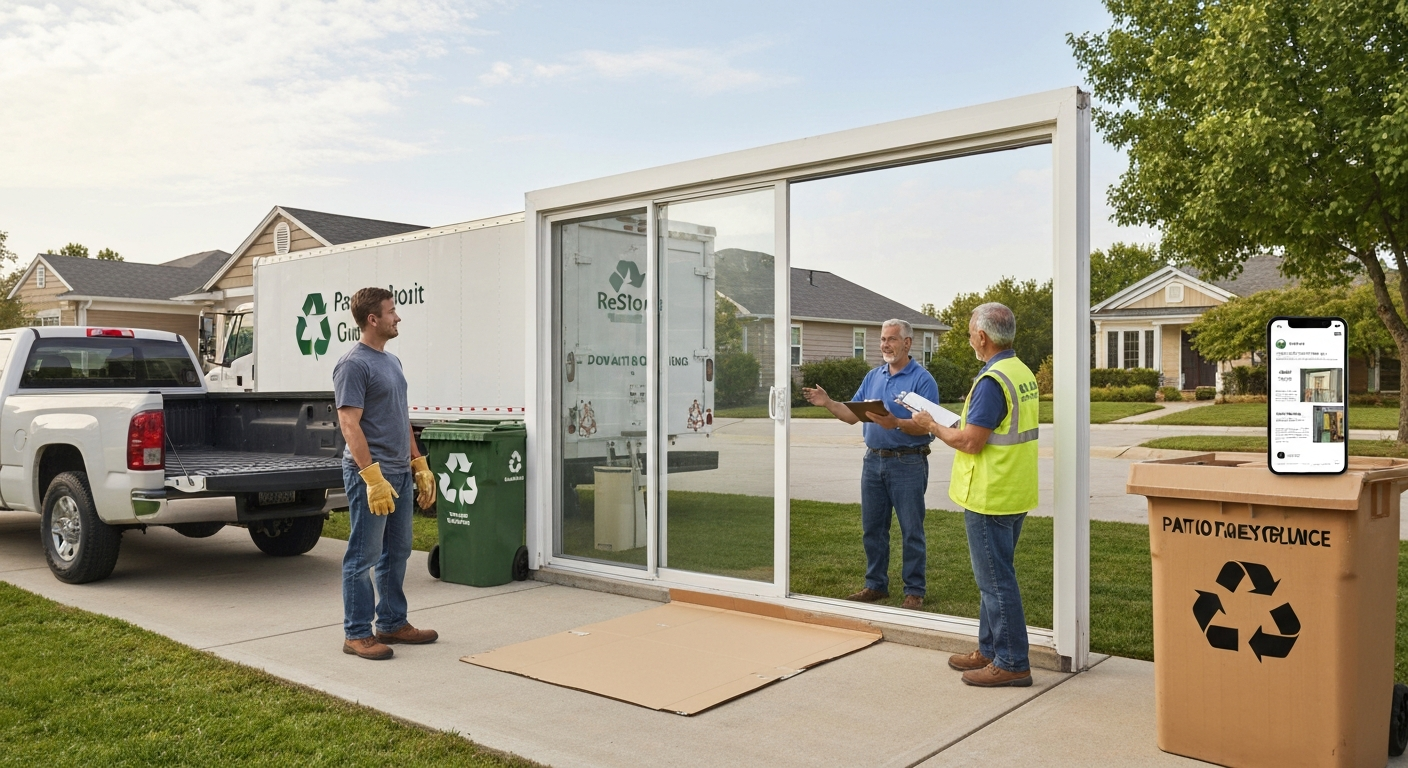
You have a few solid options: donate the door to a Habitat for Humanity ReStore or local salvage center, list it for free or cheap on Facebook Marketplace or Craigslist, haul the glass to a specialty flat-glass recycler and the frame to a scrap-metal yard, or schedule a bulky-item pickup with your city's solid-waste program. Which path makes sense depends on the door's condition, your available time, and whether your area has the right facilities, so read through the checklist below before you load anything into a truck. For a quick overview of what to do with old patio doors, see this guide for options and next steps. For practical disposal options and step-by-step advice on how to get rid of old patio doors, see our detailed guide.
Where to Dispose of Old Patio Doors: Donate, Recycle, Trash

Jamie Archer
14 Jul 2026
What this guide covers
This article covers both sliding glass patio doors and screen door panels, the full units most homeowners are staring at when a replacement is scheduled. You'll find a quick repair-vs-dispose checklist, a condition assessment walkthrough, donation and resale logistics, step-by-step prep for transport, recycling routes for glass and frame materials, municipal disposal options, and privacy or blackout alternatives that might let you keep the door longer. Whether you're doing a full replacement yourself or just handling cleanup after a pro installs a new unit, this guide gives you a clear path forward.
Repair, reuse, donate, recycle, or landfill? A quick decision checklist
Before you move the door anywhere, spend two minutes running through these questions. The answers almost always point to the right category.
- Is the glass intact with no cracks, chips, or fogging between panes? Yes: donation or resale is realistic. No chips but fogging: recyclable or landfill material.
- Is the frame straight — no warping, rot, or bent corners? A bowed vinyl or aluminum frame usually can't be donated and may not be worth separating for scrap.
- Do the rollers, latch, and lock still function, even roughly? Working hardware makes the door far more attractive for resale or donation.
- Is the door more than 15–20 years old with multiple seal failures, drafts, or hard operation? U.S. Department of Energy guidance suggests replacement rather than further repair at that point — disposal is likely the right call.
- Has your city's bulky-item program covered doors before? Check your local solid-waste website first. Many programs allow one free scheduled pickup per quarter but have restrictions on glass panels.
- Do you have a vehicle or help to move it? A full sliding glass door panel typically weighs 50–100 lbs depending on size and glass type. You'll need at least two people and a vehicle rated for the load.
- Do you want a potential tax deduction? If the door is in good condition and you donate it to a qualifying nonprofit like Habitat ReStore, donations over $500 in claimed value require IRS Form 8283.
- Is this purely a matter of privacy or energy loss — not structural damage? If so, skip disposal entirely and check the privacy and blackout alternatives section below before committing to removal.
Check the door's condition before you do anything else
A thorough condition check takes about 15 minutes and tells you whether you have a donation-worthy door, scrap material, or something in between. Go through each of these areas systematically.
Glass panels
Look at the glass at an angle in bright daylight. Fogging or a hazy film between double-pane glass means the seal has failed, the insulating gas is gone and the unit is essentially single-pane. A ReStore will likely refuse it, and most buyers will pass too. Single-pane glass with no cracks is still recyclable at a specialty flat-glass processor. Tempered glass (standard in patio doors) cannot go into your curbside recycling bin, it contaminates the glass stream and most municipal MRFs reject it outright.
Frame
Check all four corners for straightness. Aluminum frames can be bent back slightly, but badly bowed ones won't fit a rough opening and most donors won't accept them. Vinyl frames crack under UV stress over time, run your fingers along the corners and check for hairline fractures. Wood-clad frames may have rot at the sill or bottom corners; probe with a screwdriver to check. Measure the overall frame dimensions (width x height to the nearest 1/8 inch) and write them down. Buyers and ReStores need exact measurements.
Rollers and hardware
Slide the panel back and forth. Stiff or grinding rollers are usually replaceable with parts costing $10–$30, which is worth noting in any listing. A working latch and lock add real value. Missing or broken hardware drops resale appeal but doesn't disqualify a door from donation if the frame and glass are intact.
Seals and weatherstripping
Peel back or press on the door's perimeter weatherstripping. If it's crumbling, brittle, or missing in sections, factor that into your condition rating. Failed weatherstripping alone is a cheap fix (typically $15–$40 in materials), it shouldn't automatically send a door to disposal.
Screen door
Screen panels are usually the easiest to donate or repurpose. Check the frame for bends and the screen mesh for tears. A torn screen is a $5–$15 re-screening job, most ReStores still accept them, and buyers on Marketplace often expect to re-screen anyway.
When a repair beats disposal
A lot of patio doors get discarded when they're genuinely repairable at low cost. Here are the most common fixable problems and what they typically run as a DIY project.
| Problem | DIY Fix | Typical Parts Cost | Difficulty |
|---|---|---|---|
| Door hard to slide or jumps the track | Replace bottom rollers (2-pack) | $10–$30 | Easy |
| Draft around door edges | Replace perimeter weatherstripping | $15–$40 | Easy |
| Latch won't catch or lock is stiff | Adjust strike plate or replace latch assembly | $15–$35 | Easy–Moderate |
| Foggy double-pane glass | Replace glass unit (not whole door) | $100–$250 per panel | Moderate–Hard |
| Screen mesh torn | Re-screen with spline and mesh kit | $8–$20 | Easy |
| Bottom track damaged | Replace track section | $20–$60 | Moderate |
If you're dealing with a sticky track, grinding rollers, or a draft, those are cheap fixes that make disposal unnecessary. The line shifts when you have a failed double-pane seal on multiple panels, a warped frame that won't seal against the rough opening, or a door that's 15–20 years old with several simultaneous problems. At that point, the repair cost starts approaching replacement cost, and the energy performance argument for replacing becomes real.
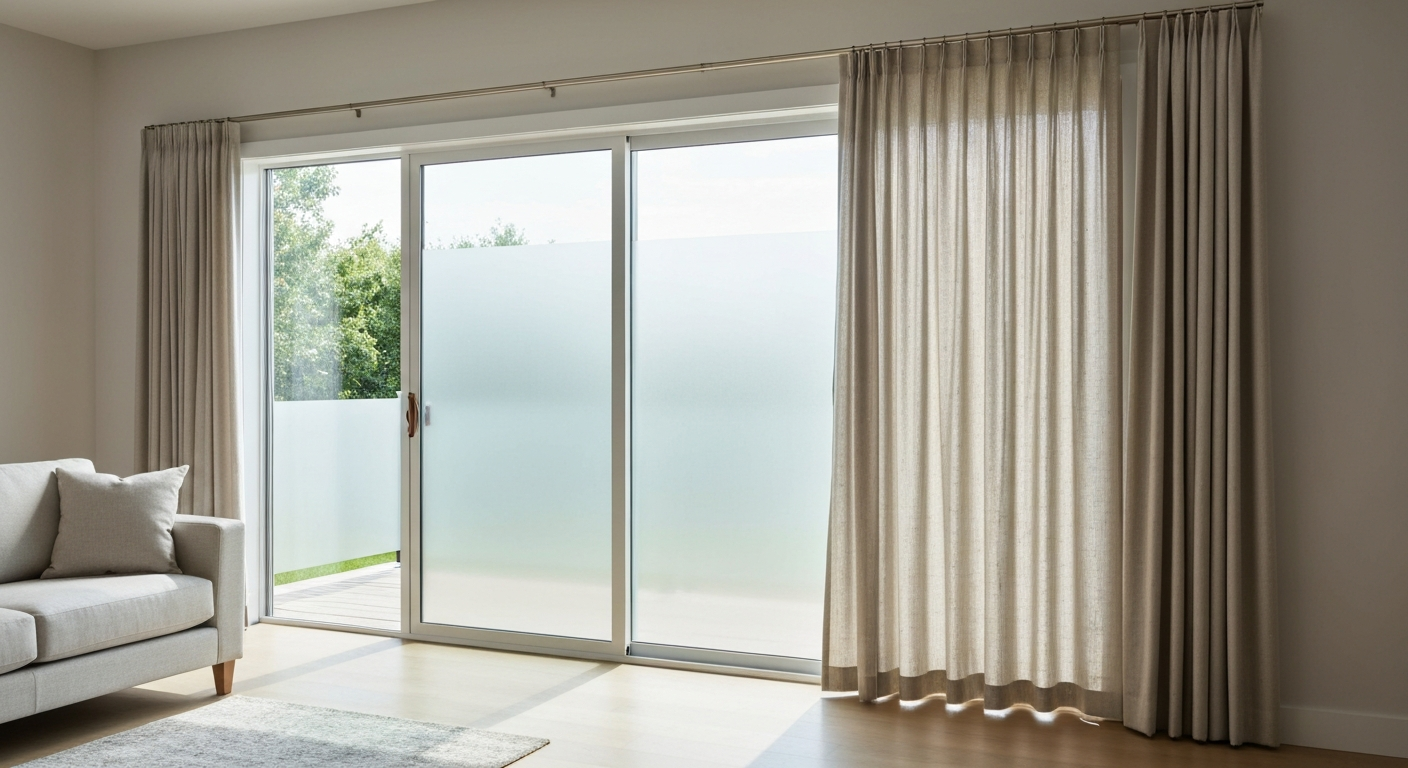
Privacy and blackout options that can defer disposal
If your main motivation for replacing the patio door is lack of privacy, poor light control, or heat gain rather than a structural or mechanical failure, you may be able to push disposal off by years with the right window treatment. For step-by-step privacy solutions, see our guide on how to make patio doors private. This matters if you're renting, if budget is tight, or if you're waiting to save up for a full replacement.
Blackout curtains and drapes
A quality blackout curtain panel for a standard 6- or 8-foot patio door opening runs $30–$80 per panel. Installed on a ceiling-mounted traverse rod, they block light almost completely, reduce heat gain noticeably, and add some insulation value. They're the fastest, cheapest privacy and blackout fix available.
Window films
One-way privacy film (also called solar or mirror film) lets you see out during the day while blocking the view from outside. It applies directly to the glass, costs $20–$60 for a patio door-sized sheet, and peels off cleanly without damaging the glass. Frosted or decorative films give full privacy in both directions at similar costs. Neither option provides blackout performance at night when interior lights are on, a curtain still handles that.
Cellular shades and roller shades
Cellular (honeycomb) shades add meaningful insulation on top of privacy. A blackout roller shade for a patio door opening runs $50–$150 depending on width. Cellular shades in the same size run $80–$200. Both mount inside or outside the door frame with minimal tools. If your main complaint about the existing door is energy loss in winter, a cellular shade can cut that noticeably while you plan the full replacement.
Temporary screen and security additions
If the screen door panel is missing or damaged and that's driving part of the replacement decision, a replacement screen panel or a tension-mounted screen kit ($25–$70) can restore function without a full door swap. For security concerns, a secondary lock bar or Charlie bar ($15–$35) buys time before a full replacement without requiring any disposal at all.
Selling or donating your patio door
A patio door in decent shape is worth listing before you haul it anywhere. Buyers exist, and donation programs actively want good-condition doors. Here's where to go and what works.
Where to list for sale
- Facebook Marketplace: the most active local market for used building materials. List with photos and exact measurements. Price intact sliding glass doors between $50–$200 depending on condition, brand, and glass quality. A name-brand door (Pella, Andersen, Milgard) in excellent condition can fetch $150–$300.
- Craigslist (building materials section): still active in most metros. Free to list. Add 'local pickup only' in the title to filter out time-wasters.
- OfferUp: photo-forward app with a local buyer focus. Works well for one-off large items.
- Nextdoor: good for giving away a door for free to a neighbor who might want it for a garage, shed, or sunroom project.
What to include in your listing
- Overall frame dimensions (width x height) and the rough opening size if you know it
- Frame material (aluminum, vinyl, wood-clad)
- Glass type (double-pane, tempered, low-E if labeled)
- Brand and model if visible on the frame label
- Condition of glass (clear, no fogging), rollers, latch, and weatherstripping
- Whether the screen panel is included
- Whether buyer needs to bring help and a truck — be upfront about the weight
- At least 4 photos: full door, close-up of glass condition, frame corners, and hardware
Donation options
Habitat for Humanity ReStore locations are the most consistent option nationwide. Most ReStores accept complete, intact exterior doors including sliding glass doors in good condition, meaning working hardware, intact glass without fogging, and a straight frame. Call your local ReStore before loading the truck because acceptance standards vary by location. Some locations refuse single-pane metal-frame sliders, older units with failed seals, or doors without functioning locks. Beyond ReStores, look for local architectural salvage shops (they often resell vintage or solid-wood-clad units), building materials nonprofits, and community reuse centers. A quick search for 'building material reuse' or 'architectural salvage' plus your city name usually turns up options most homeowners don't know about.
Tax deduction basics
If you donate to a qualifying nonprofit like Habitat ReStore, you may be able to claim a deduction. For donations with a claimed value over $250, you need a written acknowledgment from the organization. Over $500, you file IRS Form 8283. Over $5,000, you generally need a qualified appraisal. The deduction is based on fair market value, not what you paid, a used sliding glass door in good condition might be valued at $75–$200. Get the receipt at drop-off and keep your photos as supporting documentation.
How to prepare a door for sale or donation
A well-prepped door sells faster and gets accepted by donation centers without the awkward 'we'll need to call you back' conversation. This prep work takes about an hour.
- Clean the glass: Use a glass cleaner and a microfiber cloth on both sides of each panel. Dirty glass photographs badly and makes buyers assume worse condition than exists.
- Clean the frame and track: Wipe down the frame with an all-purpose cleaner. Clear debris from the bottom track. Lubricate rollers with silicone spray if they're stiff — it costs almost nothing and makes the door slide smoothly during any inspection.
- Measure precisely: Measure overall frame width and height to the nearest 1/8 inch. Also measure the rough opening if you can, or note the nominal size (e.g., 6-0 x 6-8 is a very common standard). Write measurements clearly on a piece of tape on the frame.
- Photograph systematically: Take photos in good daylight. Shot list: full door from 6 feet back, each glass panel close-up at a low angle to catch any fogging, all four frame corners, the latch and lock hardware, the bottom track and rollers, and any label with brand/model info.
- Document hardware: Note whether the screen panel, hardware, and any manufacturer documentation are included. Buyers want to know if they're getting the complete set.
- Protect the glass for transport: If the door will be moved before pickup, tape cardboard over each glass panel with painter's tape. Do not use packing tape directly on the glass.
- Coordinate pickup logistics: Tell buyers or donation centers the exact dimensions so they know what vehicle to bring. A standard 6-foot sliding glass door requires at minimum a pickup truck or cargo van. Confirm help: at least two people should always be present for moving the panel.
Getting someone to pick it up
Moving a full sliding glass door is the part most people underestimate. A single panel on a standard 6-foot door typically weighs 50–100 lbs, and the full frame assembly with both panels is heavier. NIOSH manual lifting guidance is clear that loads over roughly 50 lbs for a single person in an awkward position require either team lifts or mechanical assistance. Don't try to move a full door frame solo.
Habitat ReStore pickup
Many Habitat ReStore locations offer home pickup for large donations, sometimes free and sometimes for a small fee depending on the service area. Check your local ReStore's website or call directly, the pickup option isn't always advertised. Pickup is usually scheduled 1–3 weeks out. The door needs to be accessible (ground floor, clear path to a truck) and in the condition they agreed to accept. They'll typically send two people with a truck.
Nonprofit and charity pickups
Some local building-materials nonprofits and community reuse organizations also offer pickup, especially for larger donations. Calling ahead is essential, their capacity varies, and they prioritize items in demand. Have your measurements and photos ready when you call so they can confirm acceptance before scheduling.
Buyer pickup (Marketplace and Craigslist)
For sales, make buyer pickup a firm requirement. State it clearly in the listing: 'Buyer must bring help and a vehicle large enough to transport a [your dimensions] door frame.' This filters out buyers who'll show up in a sedan expecting you to figure it out. Have the door accessible, cleared from the wall, and cardboard-protected on the glass before the buyer arrives.
Municipal bulky-item pickup
If donation and resale don't pan out, most U.S. cities have a bulky-item or large-item pickup program. Rules vary significantly by city, some offer one or two free scheduled pickups per year, others charge per item (typically $20–$75), and some require you to separate glass from frames. Check your city's solid-waste or public works website, or search for your city name plus 'bulk item pickup.' A few things to know: many programs will not take loose glass panels for liability reasons, so you may need to contain the glass in the frame or wrap it. If your city's program excludes construction debris (which some do), a transfer station drop-off is the fallback.
Recycling the door by material
If the door can't be donated or sold and landfill feels wasteful, you can often recycle most of it by separating the materials. This takes some time but keeps a large item out of the landfill.
Glass panels
This is the part with the most confusion. Tempered glass from patio doors is architectural or flat glass, it is not the same as container glass (bottles and jars) and should not go in your curbside recycling bin. It contaminates the glass stream at most MRFs and many haulers explicitly list window and tempered glass as non-acceptable. You need a specialty flat-glass or architectural glass recycler. Search for 'flat glass recycler' or 'window glass drop-off' in your area, or call local glass shops, many have relationships with processors who accept old glass panels. Some transfer stations have a designated area for flat glass. Call before you haul.
Aluminum frames
Aluminum extrusions from door frames are valuable scrap metal, aluminum recycling is well-established and most scrap yards accept it. The key is to remove the glass and strip off non-metal components (plastic glazing beads, rubber gaskets, vinyl sweeps) before taking it in. A 'dirty' aluminum load mixed with glass or heavy plastic gets downgraded at most yards, meaning lower payout or outright rejection. Clean aluminum extrusion scrap typically fetches $0.30–$0.60 per pound at current rates, though scrap prices fluctuate. A standard aluminum patio door frame might yield 8–15 lbs of aluminum after stripping, so expect $3–$9, it's not a windfall, but it's better than the landfill.
Vinyl (uPVC) frames
Vinyl frame recycling is less straightforward in the U.S. than aluminum. Specialized reclaimed plastics processors and some manufacturers accept clean uPVC window and door frames, but these programs are regional and not as widely available as metal scrap yards. Search for 'vinyl window frame recycling' or 'uPVC recycling' in your area, or contact the door's manufacturer directly, some have take-back or recycling partnerships. If no local option exists, a transfer station or landfill is the fallback for the vinyl frame components.
Hardware and rollers
Working rollers, locks, handles, and hinges can be sold individually on eBay or in a Marketplace listing (search for your brand and part number to see if there's demand). Scrap steel hardware can go to a mixed-metal bin at most scrap yards.
Safe removal before you move anything
If you're handling removal yourself rather than a pro, the sequence matters. Manufacturer removal manuals from brands like Pella, Andersen, and Milgard follow a consistent order: remove the screen panel first, then the vent (operable) panel, then the fixed panel, then the frame if you're doing a full removal. Don't try to cut out or pry out a frame before the glass panels are out, you risk cracking the glass under stress. Check your door's brand and look up the model-specific removal instructions if they're available. See the Andersen patio door installation manual (example product series) for model-specific removal steps, roller/sash handling, and rough‑opening measurements before you begin. The steps below are a general sequence for a typical sliding glass door.
- Gather tools and PPE first: heavy-duty cut-resistant gloves (glass edges are sharp even on intact panels), safety glasses, steel-toe boots, a flat pry bar, a utility knife, a drill with the right bits for your frame screws, and a two-wheel dolly if you have one.
- Remove the screen panel: Lift the screen panel up into the upper track, then swing the bottom out. Most screen panels lift free with no tools.
- Remove the sliding (vent) glass panel: Lift the panel into the upper track to clear the lower track, then angle the bottom out. Have a second person stabilize the panel as you pull it free. Set it immediately on its edge against a wall — never flat on the ground.
- Remove the fixed panel: This usually requires removing a glazing bead or retaining strip along the interior edge. Use a flat pry bar carefully. The panel may be shimmed in place — remove shims before trying to pull the panel.
- Remove the frame if needed: For a full frame-out removal, cut any exterior caulk with a utility knife, remove interior trim, and unscrew the frame from the rough opening. Some frames have a nail fin hidden under siding — do not simply yank the frame without checking.
- Transport panels upright: Glass panels must travel on edge, not flat. Use a padded dolly or purpose-made glass suction cups for moving. Secure panels upright in a truck bed with padding between the panel and truck walls.
Two-person rule for glass panels
OSHA ergonomics guidance and NIOSH lifting recommendations both point the same direction: large glass panels need two people minimum. The weight alone often crosses single-person safe-lift limits, but the real risk is the awkward grip and the consequence of dropping tempered glass at knee height. Tempered glass shatters explosively into hundreds of small pieces. Always have a second person in position before the panel leaves the track.
Comparing your disposal options side by side
| Option | Best for | Cost to you | Effort | Environmental impact |
|---|---|---|---|---|
| Habitat ReStore donation | Intact door in good condition | Free (possible pickup fee) | Low–Medium | Best: door reused |
| Local salvage/architectural reuse | Older or distinctive doors | Free | Low–Medium | Best: door reused |
| Facebook Marketplace/Craigslist sale | Good condition, all materials | Free to list | Medium | Good: door reused |
| Flat-glass recycler + scrap yard | Damaged door, intact frame | Free–small fee | High (disassembly) | Good: materials recycled |
| City bulky-item pickup | Damaged door, no other option | Free–$75 fee | Low | Poor–Fair: likely landfill |
| Transfer station drop-off | Any condition, immediate need | $20–$60 typical | Medium | Fair: varies by facility |
| Landfill | Last resort only | $20–$60+ | Medium | Poor |
A note on doors with repurposing potential
Before any door goes to the curb, it's worth considering non-standard second lives. A sliding glass door panel makes a functional greenhouse wall, a cold frame cover, or a room divider in a garage workshop. A screen door panel can be converted into a garden gate or a ventilated cabinet door. If you're not in a rush, posting in a local gardening or woodworking Facebook group often finds someone who wants it. These options are especially worth exploring for doors with intact glass but failed seals, a buyer building a greenhouse doesn't care about insulating gas performance.
FAQ
What’s the first thing a DIY homeowner should do when deciding whether to dispose of an old patio (sliding glass or screen) door?
Start with an energy/condition decision checklist: (1) age — many sliding doors show diminished performance after 15–20 years; (2) visible damage — cracked/tempered glass, rotted/warped frame, rusted hardware; (3) operational problems — hard-to-slide sashes, broken rollers, failed locks; (4) sealed-unit failure — fogging or condensation between panes; (5) water infiltration or structural damage to the rough opening; (6) energy performance — persistent drafts or high heating/cooling bills despite weatherstripping. If issues are limited (failed weatherstripping, rollers, or hardware), repair. Replace/dispose when you have structural damage, multiple seal failures, repeated leaks, or poor overall thermal performance. Use manufacturer/service manuals or DOE/energy decision trees as guides for the repair-vs-replace choice.
If I decide to keep or repair the door, what are common DIY repairs to try first?
Common homeowner repairs: replace or add weatherstripping and thresholds to stop drafts, clean or replace rollers and track (adjust rollers per manufacturer instructions), replace broken locks/handle hardware, reglaze or reseal minor frame leaks, and replace broken screen mesh. For fogging between insulated panes the fix is usually replacement of the sealed unit — not a simple DIY reseal. Consult the door maker’s manual for parts and adjustment procedures to avoid damaging the unit.
What safety gear and lifting guidance should I follow when removing a patio door?
Use the hierarchy of controls: plan to use mechanical aids (panel lifter, dolly), get at least one helper for large panels, and avoid single-person lifts when panels are heavy. PPE: cut-resistant gloves, safety glasses, long sleeves, and safety-toe shoes. Follow NIOSH lifting recommendations (evaluate reach, frequency, weight) and OSHA ergonomics guidance: keep loads close to your body, bend at the knees, and use team lifts for heavy or awkward glazing. If glass is cracked or tempered, consider professional removal.
What is a safe step-by-step sequence to remove a sliding glass patio door for transport or donation?
General removal steps (confirm model-specific manual first): (1) Remove screens and removable vent panels. (2) Unlock and remove active sash per manufacturer: lift sash up, disengage bottom rollers, and tilt out; some units require removing stop/trim or lifting from a bottom track. (3) Remove fixed panel(s) — may need to unscrew glazing bead or interior stops. (4) If removing the frame, follow full-frame removal instructions: remove trim, cut sealant, unfasten screws or nails, and pry the frame from the rough opening carefully to avoid damaging surrounding walls. (5) Label pieces, clean off debris, and secure glass edges with cardboard or foam pads. (6) Protect the unit for transport: wrap in moving blankets, secure with straps on a furniture dolly or A-frame glass carrier. Always consult the door manufacturer’s removal/installation manual first.
How should I prepare a patio door for donation, resale, or transport?
Preparation checklist: (1) Clean the glass and frame so buyers/donors can inspect condition. (2) Remove and bag any detachable hardware (locks, handles, rollers) and label them. (3) Document measurements, model/brand, hand (left/right), and condition; take photos of seals, glass, and any damage. (4) Stabilize or remove loose glazing beads and secure glass edges with corner guards or cardboard. (5) If donating, check the recipient’s condition requirements (many ReStores require intact, functional units). (6) Arrange transport using an A-frame glass rack or furniture dolly and at least two people; consider professional pickup for fragile or heavy units.
Where can I take old patio doors for donation or resale?
Places to donate or resell: Habitat for Humanity ReStore locations (many accept intact exterior doors and usable windows), local building-material salvage stores, Craigslist/FB Marketplace/Nextdoor for private sale, specialty salvage yards, or local community nonprofits. Check each recipient’s donation guidelines — many ReStores require doors to be complete and in good condition; some offer pickup. Provide measurements, photos, and condition notes in listings or donation calls.
Next Article
How to Make Patio Doors Private: DIY Privacy & Security
How to make patio doors private: DIY options, step-by-step installs, costs, security, weatherproofing & when to call a