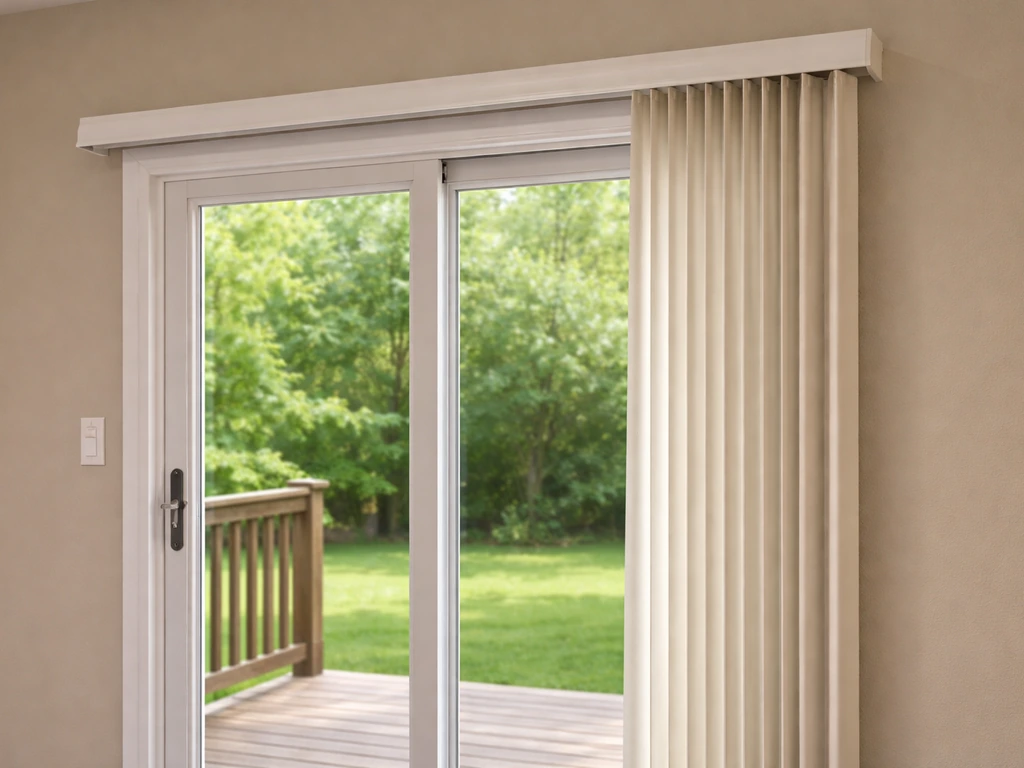
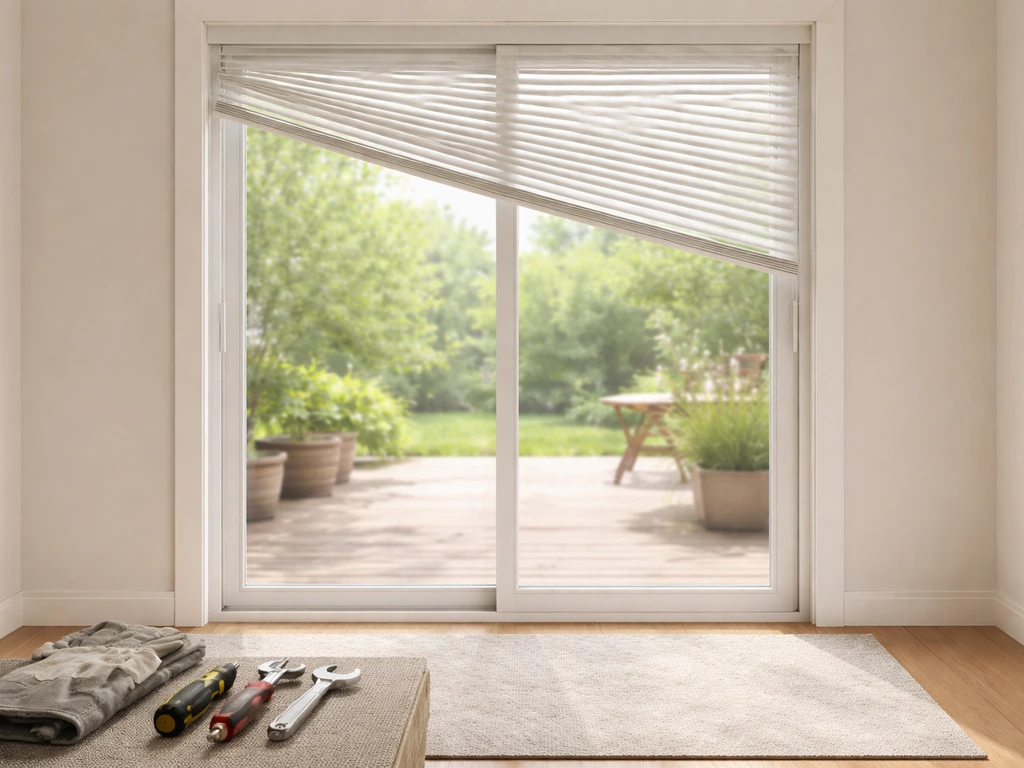
When your patio door blinds are stuck in a tilted position, the fix is almost always one of three things: a stem or carrier twisted out of alignment on the track, a broken or slipped lift cord or tilt wand mechanism, or a bracket that has shifted and is holding the whole blind crooked. In most cases you can un-jam and re-level the blinds in 15 to 30 minutes with a flathead screwdriver, needle-nose pliers, and a step stool. The key is identifying your blind type first, because the exact fix depends entirely on the mechanism.
Patio Door Blinds Stuck in Tilted Position: DIY Fix Steps

Jamie Archer
21 Jun 2026
Safety checks before you touch anything
Before you start pulling on cords or forcing the blinds back into position, take 60 seconds for these checks. They matter, especially if you have kids or pets nearby.
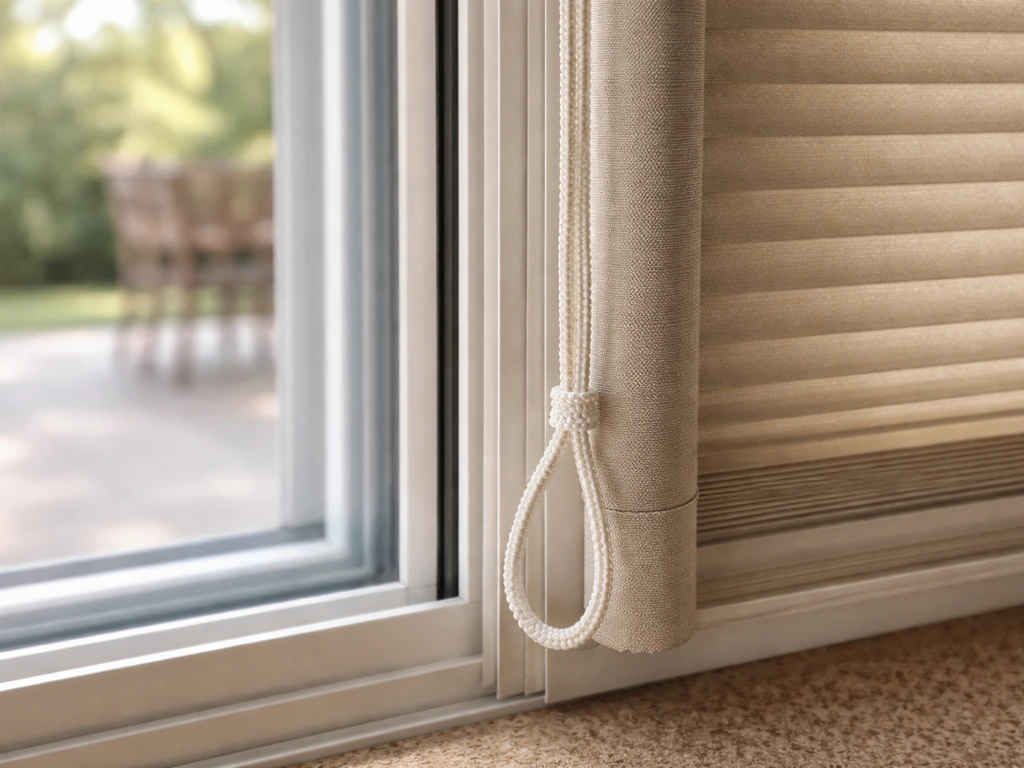
- Cord loops and dangling pull cords are a strangulation hazard. The CPSC is clear that corded window coverings require safety devices or retrofit kits, and that some retrofit kits do not fully address dangling pull cord hazards. If your lift cord has formed a loop, clip or tie it up out of reach before handling the blind.
- Check whether the blind is still attached to all its mounting brackets. A tilted blind that is partially unclipped from one bracket can fall toward you when you release tension on the other side.
- If the blind is inside a double-pane patio door unit (the sealed between-glass type), do not apply force to the glass panel itself. Work only through the access controls the door manufacturer built in.
- Use a stable step stool if the headrail is above shoulder height. Forcing a stuck blind from an awkward angle is how brackets break and how people get hurt.
- Relieve any spring or cord tension slowly. If you feel significant resistance when nudging a roller or spring-tensioned shade, stop and identify the source before pulling harder.
Once you have confirmed the blind is securely mounted and cords are safely managed, you are ready to diagnose.
Figure out what type of blind you have and how it is tilted
The tilt pattern tells you a lot about what broke. Here is how to read it.
Vertical blinds (the most common on patio doors)
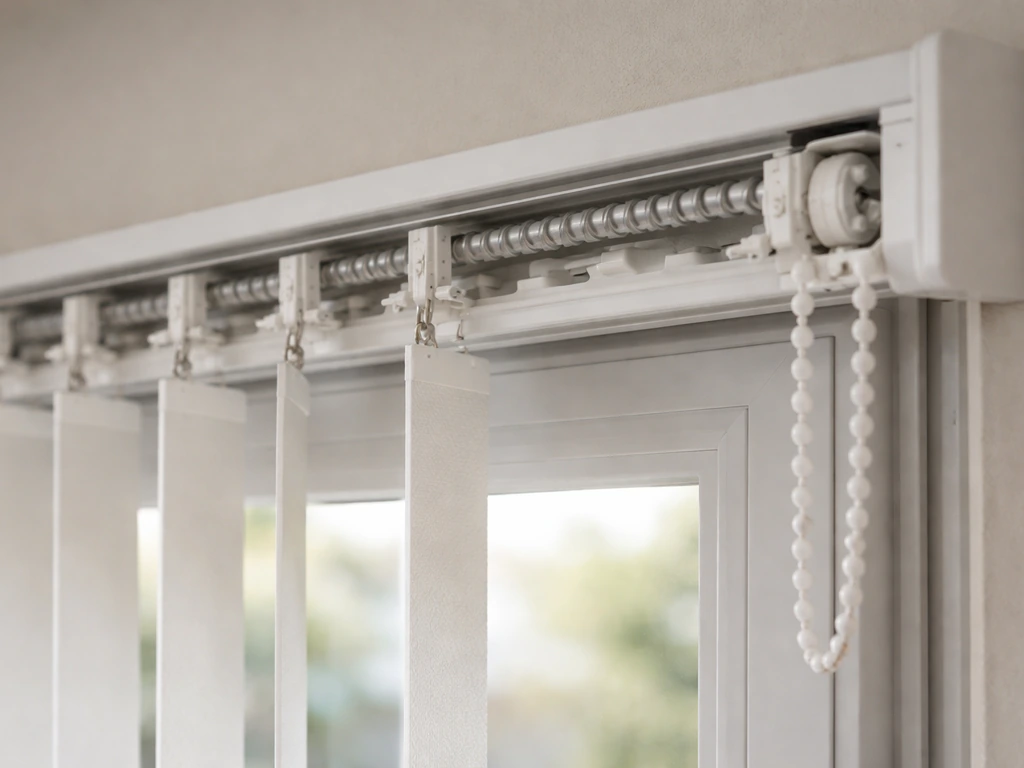
Vertical blinds are by far the most popular patio door window treatment, and they have a specific failure mode: one or more fabric or PVC vanes (louvers) twist sideways and stop rotating with the rest. This happens when a stem on the carrier inside the headrail twists out of place, preventing the vane from turning properly. You will notice that most of the vanes face one direction but one or two are rotated 90 degrees, or the whole set is stuck partially open and the wand or chain will not rotate them further.
Venetian / horizontal slat blinds
Venetian blinds tilt through a tilt rod (wand) or a separate tilt cord/ladder cord system. If they are stuck tilted, the tilt mechanism inside the headrail has usually jammed or the ladder cord has slipped off its drum. You will see the slats frozen at an angle you cannot change regardless of how you move the wand or cord.
Roller shades
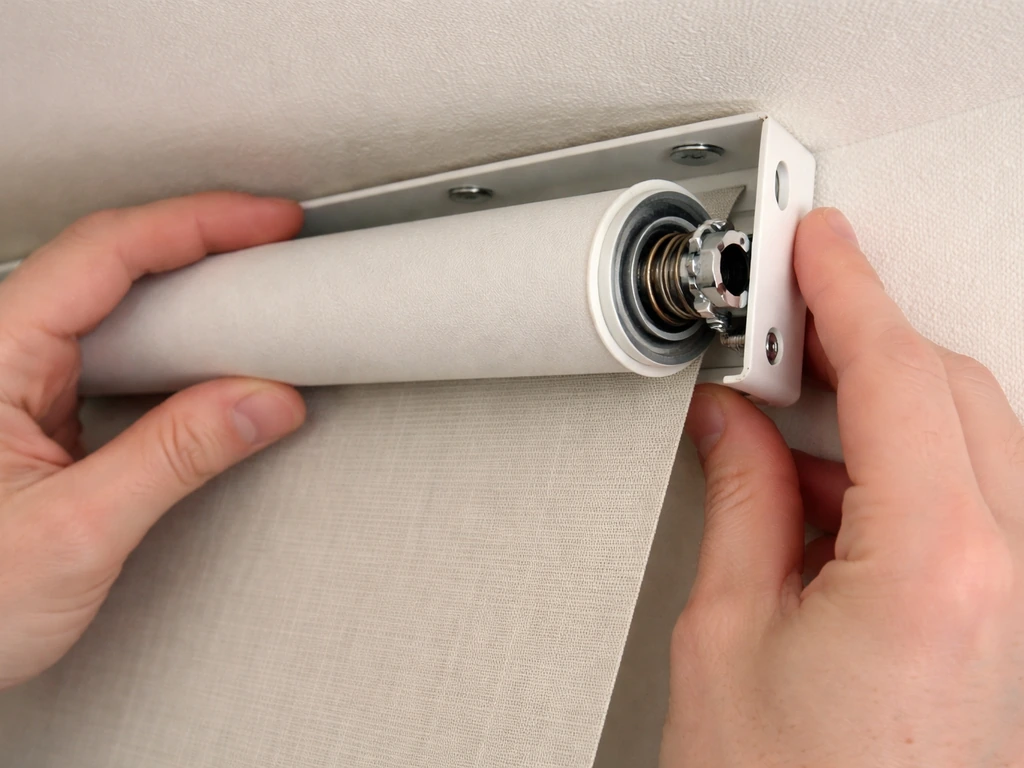
A roller shade does not tilt in the same sense, but it can hang at an angle (one side lower than the other) when the mounting brackets are not level or when the internal spring tension is uneven. If your roller shade looks tilted, the fix is almost always a bracket realignment or spring tension reset.
Cellular / pleated shades
These use a lift cord system to raise and lower. If they are stuck tilted, one lift cord is usually jammed, broken, or has jumped its pulley. You will notice one side sits higher than the other and will not equalize when you pull the lift cord.
Between-the-glass (integral) blinds
These are sealed inside the double-pane glass unit of the patio door itself. They are controlled by a small external slider or magnet control. If they are stuck tilted, the internal mechanism has failed and this is not a DIY repair. You will need to contact the door manufacturer or a glass door specialist for a sealed unit replacement.
Fast steps to un-jam the blinds right now
Try these in order before you open anything up. In a lot of cases, one of these will solve the problem entirely.
- Release all tension first. If there is a lift cord, gently lower the blind all the way to its lowest position. If it is a roller, lower it fully. Removing tension from the system often frees a jammed mechanism on its own.
- For vertical blinds: locate the vane or vanes that are out of alignment. Gently rotate each misaligned vane by hand in the direction the other vanes are facing. You should feel a small click when the stem drops back into the carrier groove. Do not force it if you feel resistance.
- For Venetian blinds: fully close the slats in one direction (tilt all the way), then slowly reverse. Sometimes the ladder cord just needs to cycle through its full range to re-seat on the drum.
- Check for a physical obstruction. Run your hand along the headrail and bottom rail. A small object wedged in the track, a twisted cord looped around a slat, or a vane that has bent and caught on the door frame is often the entire problem.
- Check the bottom rail. On vertical and Venetian blinds, a bottom rail or chain weight that has swung behind the blind panel is a common cause of the stuck-tilted look. Straighten it and try the tilt mechanism again.
- If you have a wand-tilt blind and the wand spins freely without moving the slats, the wand hook has likely disconnected from the tilt rod inside the headrail. Open the headrail end cap and reattach the wand hook to the rod gear.
- If the mechanism is still jammed after these steps, stop and move to the detailed inspection below.
Inspect the common failure points
If the quick steps above did not fully solve it, you need to look at the actual hardware. Here are the parts most likely to be causing the problem.
Brackets and mounting points
Patio doors vibrate and move every time they open and close. Over months and years, this loosens the screws holding the blind brackets to the door frame or header. A bracket that has rotated even a few degrees will hold the headrail at an angle and make the whole blind look tilted. Check every bracket: grab the headrail and try to rock it gently side to side. Any movement means a loose bracket screw.
Lift cords and tilt cords
Lift cords on Venetian and cellular shades run through small eyelets and over pulleys. When a cord frays, knots, or jumps its pulley, one side of the blind hangs lower than the other and the cord will not equalize tension when you pull it. Many corded window coverings have a dangling-pull-cord hazard, and the CPSC advises using cord safety devices or retrofit kits while noting that WCSC retrofit kits do not address the dangling-pull-cord hazard for many common blinds. Look inside the headrail (remove the end cap) to see whether any cord has jumped off its pulley wheel or drum. A broken cord is a part replacement, not a repair.
Tilt mechanism and wand
Inside every Venetian blind headrail is a small geared tilt mechanism, sometimes called a tilter. The tilt wand hooks into this mechanism and drives a series of drums that rotate the ladder cords and tilt the slats. Graber's own troubleshooting documentation points to the tilter as the primary suspect when slats are hard to tilt or will not tilt at all. If the wand turns freely with no resistance, the tilter is stripped or disconnected. If the wand is very stiff and hard to turn, the tilter is jammed or corroded.
Vertical blind carriers and stems
Each vertical vane hangs from a carrier that slides along the headrail track. Inside the carrier is a small stem that rotates when the traverse cord or wand drives the tilt rod. If that stem snaps (they are usually thin plastic), the vane connected to it will not rotate and will sit at a random angle. Inspect each carrier by sliding it out of the track: a broken stem is visible immediately.
Rails and tracks
A bent or warped headrail on a Venetian blind, or a bent track on a vertical blind, will cause persistent tilting and jamming that no amount of adjustment will cure. Run your eye along the length of the rail or track. Any visible bow, kink, or twist means the rail itself needs replacement.
Rollers and springs (roller shades)
On spring-loaded roller shades, the spring is inside the tube and connects to a pin at one end. If the pin has popped out of its bracket slot, the shade will hang askew. If the spring has lost tension from being repeatedly wound too tight, the shade will creep down on one side. Both are fixable without replacing the whole shade.
Fix or replace the specific part that failed
| Blind Type | Common Failure | DIY Fix | Replace Part? |
|---|---|---|---|
| Vertical | Broken or twisted carrier stem | Swap out the individual carrier; they slide out and in | Yes, buy matching carriers |
| Venetian | Stripped or jammed tilter mechanism | Remove end cap, unclip old tilter, clip in new one | Yes, tilters cost $5-$15 |
| Venetian | Cord jumped pulley | Re-seat cord on pulley inside headrail | Only if cord is frayed |
| Cellular/Pleated | Broken lift cord | Restring using manufacturer cord kit | Yes, cord and pulley set |
| Roller shade | Pin popped from bracket slot | Press pin back into slot and ensure bracket clamp is tight | Only if pin is bent |
| Roller shade | Spring lost tension | Roll shade up by hand 2-3 times, rehang, test | Only if spring is broken |
| Any type | Loose or rotated mounting bracket | Tighten or replace screws; use longer screws if holes are stripped | No, just hardware |
Replacing a vertical blind carrier
Remove the vane by unclipping it from the stem. Slide the damaged carrier along the track to one open end and remove it. Slide the new carrier in from the same end, position it in the correct spacing, and reattach the vane. Cycle the tilt rod to confirm the new stem rotates with the rest.
Replacing a Venetian tilter
Pry off the end cap on the side of the headrail where the wand attaches. The tilter is a small rectangular plastic box clipped into the rail. Note which way the ladder cords are threaded through it before removing it. Unthread the cords, unclip the tilter, clip in the replacement, rethread the cords in the same pattern, reattach the wand hook, and replace the end cap. The whole job takes about 20 minutes once you have the part.
Fixing stripped bracket screw holes
If the screw holes in the door frame are stripped and will not hold the bracket firm, do not just keep driving the same screw. Fill the hole with a wooden toothpick and wood glue, let it dry for an hour, then drive the original screw back in. For a more permanent fix, use a screw that is one size longer and one size wider in diameter. This gives you fresh material to bite into.
Realign, reinstall, and test for smooth operation
Once the failed part is fixed or replaced, go through this sequence before calling the job done. After you correct the tilt and reattach the parts, you can follow the steps for how to hang vertical blinds on patio door for a clean, straight installation.
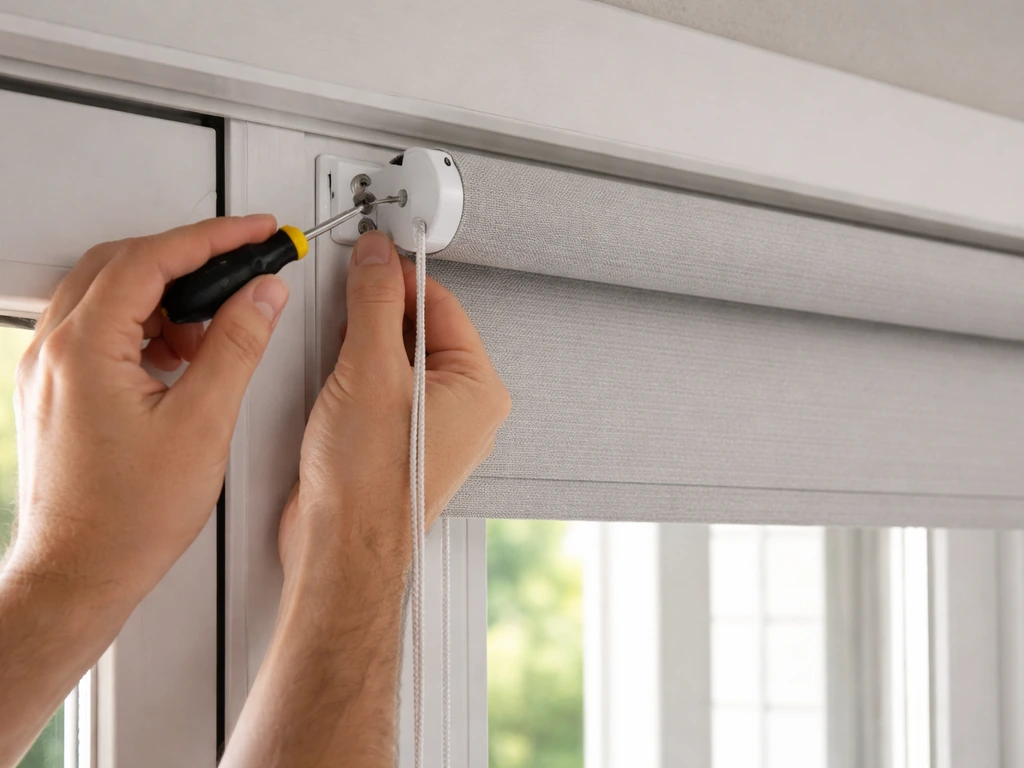
- Rehang the blind in all brackets and confirm each bracket clip or locking tab is fully engaged. Give the headrail a firm upward push to make sure it is seated.
- Use a small level on the headrail to confirm it is horizontally even. Even a 1/4-inch drop on one side will make Venetian slats look tilted. Adjust the bracket height if needed.
- For vertical blinds: manually confirm every carrier stem is vertical and in the same rotational position before connecting the vanes. Then drive the tilt from one end to the other to ensure all stems rotate together smoothly.
- For Venetian blinds: tilt slats to the full closed position in both directions. The slats should close completely flat with no gaps and no resistance at the end of travel.
- Raise and lower the blind three full cycles. The bottom rail should stay level throughout the entire range of travel. If one side lags behind, the lift cord is still uneven or not seated on its pulley properly.
- Open and close your patio door with the blind in its normal position. Watch for the blind to shift or rattle excessively. A small amount of movement is normal; a dramatic shift when the door closes suggests a bracket needs to be repositioned away from the door's closing path.
Stop it from happening again
Patio door blinds get more mechanical stress than window blinds because the door itself moves. Here is what actually prevents the stuck-tilted problem from coming back.
- Check bracket screws every six months. One turn of a screwdriver takes 30 seconds and prevents the most common cause of tilted and misaligned blinds.
- Never force a stuck tilt mechanism. If the wand or chain meets resistance, stop and find the obstruction rather than applying more force. Forcing it strips the tilter gears or snaps carrier stems, which are the repairs that actually cost money.
- Clean the headrail track on vertical blinds once a year. Dust and debris in the track cause carriers to drag and stems to twist. A dry microfiber cloth or a can of compressed air is all you need.
- On Venetian blinds, avoid repeatedly tilting to the fully closed position and then yanking the lift cord. This puts maximum stress on the ladder cord where it wraps the tilt drum. Always tilt to roughly open (flat, horizontal) before lifting.
- For corded blinds, inspect the lift cord and tilt cord for fraying once a year. A cord that is 80 percent frayed will snap under normal load. Replace it before it breaks rather than after.
- If your patio door is hard to open or closes with a heavy thud, fix the door hardware. A door that slams transfers vibration directly to the blind brackets every single time. Related door issues like misaligned rollers or a stiff frame accelerate hardware loosening on everything mounted to the door.
Most stuck-tilted patio door blinds come down to a single failed part or a loose bracket, and once you know which blind type you are dealing with, the fix is usually straightforward. If after working through this guide the blinds are still jammed, the problem is almost certainly a bent or warped headrail or track, which means replacement rather than repair. At that point, the related question of how to fix blinds inside patio doors or how to install a new set becomes the more practical path forward.
FAQ
How can I tell if the problem is the blind hardware or the patio door itself moving out of alignment?
Start with the tracks and brackets, then check the door. Open and close the patio door while watching the headrail. If the headrail angle changes in sync with door movement, the mounting surface or bracket locations may be off, even if the blind mechanism is fine.
My patio door blinds start tilted after I rotate the wand, not immediately. What does that suggest?
If they only drift after wand motion, the tilt mechanism is likely partially engaging, such as a ladder cord that is slipping on its drum or a tilter that is beginning to jam. Also look for one carrier that does not return to the same position after you stop moving the wand.
What should I do if forcing the wand or cords feels “almost” free but not quite, and I’m worried about breakage?
Do not keep applying force. If the wand turns with no resistance, the drive to the tilt mechanism is likely disconnected, while stiff turning usually indicates jam or corrosion. Back off, inspect for a loose end cap or misthreaded cord path before trying again.
Can I fix a snapped lift cord by retying it, or do I need replacement?
In most patio door lift systems, a frayed or jumped cord needs replacement rather than a knot. Knots can interfere with pulley alignment and create uneven tension, which keeps one side hanging lower.
Why do vertical blind vanes twist sideways only for certain sections?
That pattern often means one carrier stem is out of rotation alignment or broken on only that section. Slide the affected carriers along the track to verify whether the stem rotates and whether any vane returns to the same orientation as the rest.
What’s the safest way to inspect the headrail without fully disassembling the blind?
Use gentle checks first: rock the headrail by hand to detect loose bracket screws, look for visible cord jump points through any accessible openings, and remove only the end cap needed for that mechanism. Avoid removing multiple parts at once since cord threading patterns are easy to misremember.
Do I need to remove the blind to replace a bent headrail or track?
Usually yes. If you see a bow, kink, or persistent twist along the rail or track, adjustment typically will not correct the bind. Plan to replace the rail or track section, then reinstall and recheck the tilt cycle to confirm smooth, even movement.
How do I confirm that a bracket realignment actually solved it after tightening screws?
After tightening, grasp the headrail and rock it lightly side to side. There should be no movement. Then rotate or move the tilt control through a full cycle and confirm the vanes or slats return to the same level angle each time.
My roller shade hangs unevenly. How can I tell if it’s bracket level versus spring tension?
If one edge is lower consistently across repeated raises and lowers, the spring balance or pin alignment is likely. If the tilt changes when you slightly nudge the mounting area or after you loosen and re-level brackets, bracket alignment is the main cause.
When screws strip in the door frame, is the toothpick-and-glue method permanent enough?
It works well for many stripped screw holes because it restores bite into the wood, but let the glue fully cure before reinstalling. If the screw hole is in soft material or keeps stripping, switch to a screw that is one size longer and one size wider in diameter after the glue step.
What should I do if I replace a carrier or tilter but the tilt still won’t match the rest?
Re-run the tilt cycle slowly and watch for one vane or slat that does not synchronize. For lift and ladder cord systems, recheck cord threading and ensure it sits on the pulley drum correctly, since even a single cord misroute can recreate the tilted hang.
How can I prevent patio door blinds from getting stuck tilted again?
Reduce wear by keeping the door’s movement from shaking loose brackets (periodically check screw tightness), avoid hard stops when tilting, and keep the wand motion smooth. If the blind is repeatedly re-tilting, it is usually because a specific carrier, cord path, or rail alignment is still marginal.
Next Article
How to Hang Vertical Blinds on a Patio Door
Step-by-step DIY guide to hang vertical blinds on a patio door, including inside/outside mounting, alignment, and fixes.