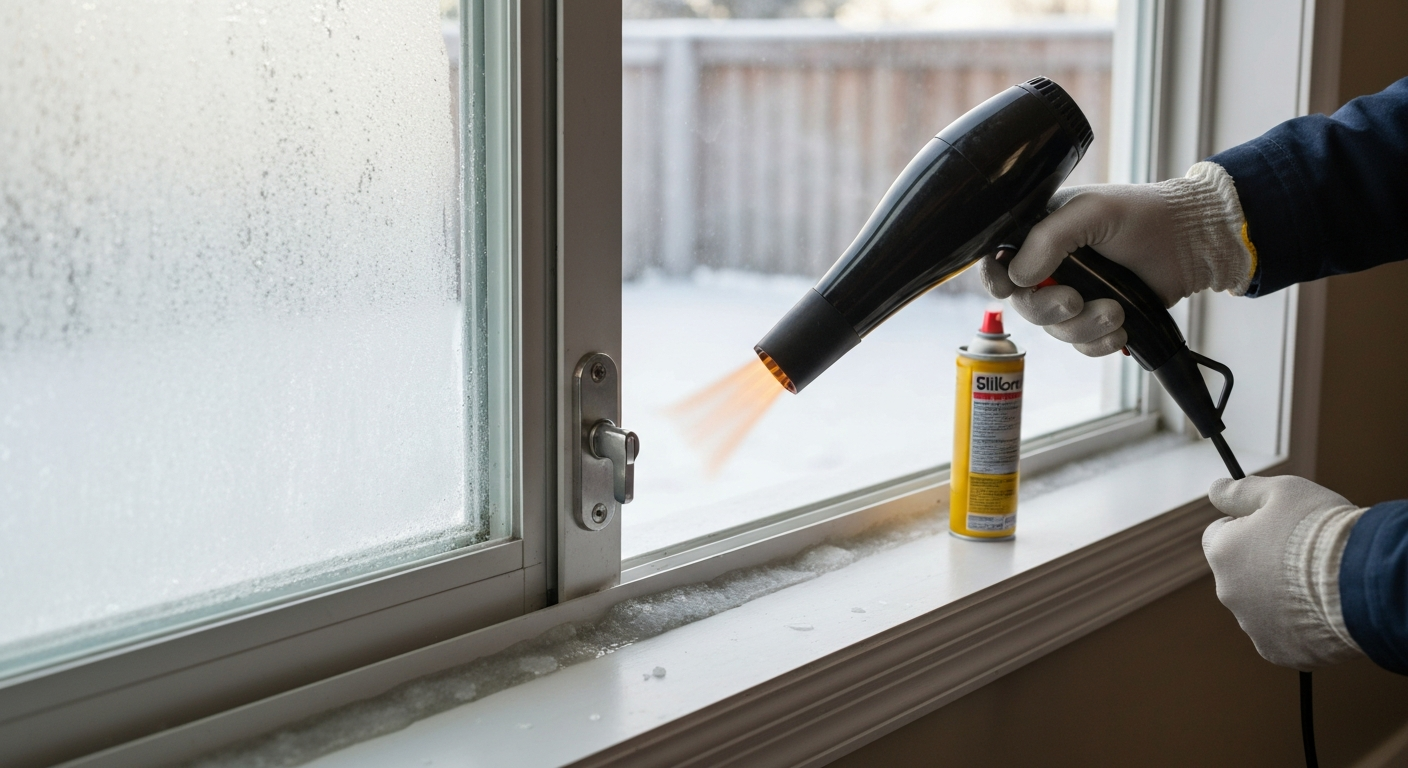
A frozen patio door usually comes down to ice or frost bonding the bottom track, the weatherstripping, or the door sweep to the frame, and in most cases you can free it in under 20 minutes with a hair dryer, some warm water, and a little patience. The fix is straightforward, but the way you go about it matters: a few common shortcuts (open flame, boiling water, rock salt) can crack glass, damage aluminum frames, or create a fire hazard. Here is the full process, from the emergency thaw through the preventive steps that keep it from happening again.
How to Unfreeze Patio Door: Safe DIY Steps & Winterproofing

Jamie Archer
29 Jul 2026
Why patio doors freeze and stick in the first place
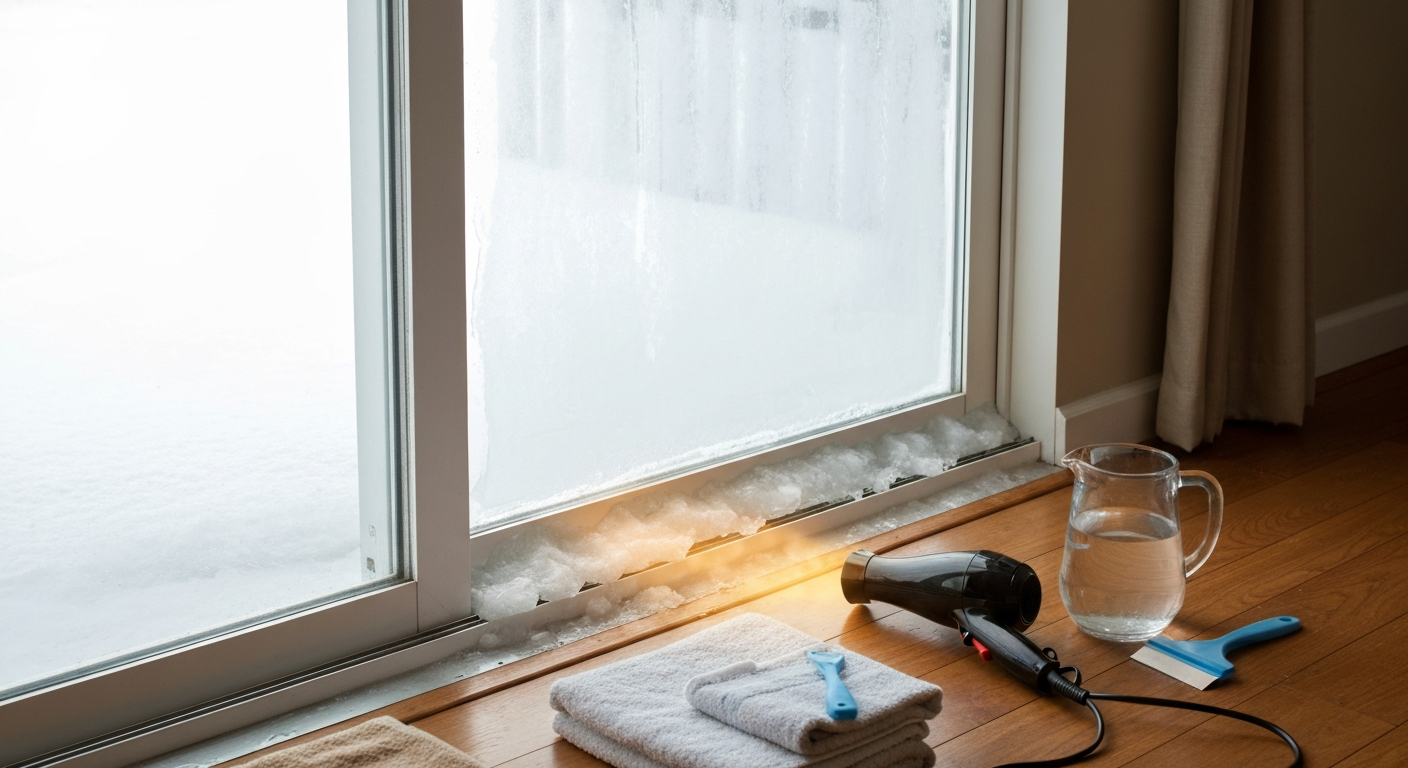
Most freeze-ups are not a single problem, they are usually two or three small issues that combine when temperatures drop. Understanding the cause helps you fix the right thing instead of just thawing the same door every winter morning.
Sliding glass doors
- Ice in the bottom track: meltwater, condensation, or rain sits in the channel and freezes overnight, locking the rollers in place.
- Frozen weatherstripping or door sweep: the rubber or vinyl seal bonds to the sill or frame when wet and then drops below freezing.
- Frost on the frame or glass: happens when indoor humidity condenses on a cold surface — common in older or poorly insulated doors.
- Worn or sunken rollers: a door riding too low sits heavier on the track, trapping moisture and making ice contact worse.
- Clogged or blocked drainage holes: most tracks have small weep holes at the ends; if they clog with debris, water has nowhere to go and freezes solid.
Screen doors
- Screen door frames are lighter aluminum or polymer — they deflect more with temperature changes and can bind against the main door frame.
- Polymer rollers on screen doors harden and shrink in the cold, causing the door to drop and drag against the sill.
- Ice can bridge the gap between the screen door's bottom rail and the threshold, essentially gluing the door in place.
- Screen mesh holds moisture, so frost often forms directly on the screen and at the frame corners, adding to the seal.
Tools and materials to have ready
Pull these together before you start. Getting halfway through a thaw and realizing you need something else is frustrating, and some of these items also double as your prevention toolkit once the door is open.
Emergency thawing
- Hair dryer (standard household model is fine — low or medium heat setting)
- Warm water in a pitcher or jug (not boiling — aim for around 40–50°C / 104–122°F, roughly hot-tap temperature)
- Old towels or rags
- Isopropyl alcohol (70% or 91%) or a purpose-made commercial lock de-icer
- Plastic scraper or old credit card (to gently chip loose ice from the track — not a metal blade)
Repairs and prevention
- Screwdriver set (Phillips and flathead, plus 1/4–3/8 in sockets for roller adjustment screws)
- Silicone-based dry spray lubricant (not WD-40 original, not petroleum grease)
- Powdered graphite (for lock cylinders and keyways only)
- Shop vacuum or stiff brush (for clearing the track before lubricating)
- Replacement roller assemblies if yours are worn — common sizes are 1-1/8 in to 1-1/4 in diameter ball-bearing units
- Replacement weatherstripping or door sweep if the existing seal is cracked or compressed
- Small putty knife or pry bar (for removing the door panel when replacing rollers)
- Vinyl-safe or foam weatherstrip adhesive
- Safety glasses and work gloves
Safety warnings before you do anything
These are not just legal disclaimers, each one covers a realistic way to make the situation worse or cause injury.
- No open flame, ever. Propane torches and lighters can ignite weatherstripping, wood framing, or nearby curtains, and they create thermal shock that can crack glazing. A hair dryer on low or medium is the correct tool.
- No boiling water on glass or vinyl. Hot water poured onto a cold glass panel or vinyl frame can stress door seals and in worst cases cause cracking. Use warm (hot-tap) water only.
- Avoid chloride-based de-icers (rock salt, calcium chloride, magnesium chloride) directly on aluminum tracks or frames. These salts accelerate pitting corrosion in aluminum alloys and can eat into finishes within one season. They are also environmentally harmful near drainage areas, per EPA guidance on road salts.
- Isopropyl alcohol is flammable. Its flash point is around 12°C (53°F), which means it can ignite near an open flame even at cold temperatures. Use it in a ventilated area, keep it away from the hair dryer, and let it fully evaporate before applying any heat source nearby.
- Two-person lift for removing the door panel. Sliding glass door panels typically weigh 50–150 lbs depending on size and glass type. Lifting one out of the track alone risks dropping it, which causes serious injury. Get a second person before you attempt any panel removal.
- Wear safety glasses and gloves when chipping ice from a track or handling glass edges.
First things first: what to do the moment you realize the door is frozen
Before you reach for the hair dryer, run through this quick checklist. It takes 60 seconds and prevents you from forcing anything that could cause damage.
- Check whether the lock or latch is also frozen. If the handle turns but nothing moves, the door is frozen in the track. If the handle will not move at all, the lock is frozen — deal with that first (see the lock de-icing section below) before applying any force to the door.
- Do not yank or kick the door. Forcing a frozen door can bend the track, snap the handle, crack the glass panel, or tear the weatherstripping off the frame.
- Assess which side is frozen. Run your hand along the bottom edge and the frame edges. If you can feel where the ice is bonded, you can target heat there instead of warming the whole assembly.
- If the door is the only exit from the home and it is frozen shut, call for help before attempting a solo repair — especially in an emergency evacuation scenario.
- Check the outside as well if you can reach it safely. Ice building up on the exterior threshold is often the main culprit, and warm water from outside is faster than heating from inside.
Emergency thawing methods that actually work
Hair dryer on low or medium heat
This is the safest and most controlled method. Set it to low or medium, you want gentle warmth, not a heat gun blast. Hold it 4–6 inches from the frozen area and move it slowly along the track, threshold, and weatherstripping. Work in passes rather than holding it in one spot. On a standard residential door, 5–10 minutes of steady hair-dryer heat is usually enough to free the bottom seal. Avoid pointing high heat directly at the corner seals of double-pane glass units, as prolonged concentrated heat can stress the insulated glass spacer.
Warm water
Hot-tap water poured slowly along the exterior threshold and track is fast and effective when you have outside access. Use a pitcher and pour in a steady stream rather than splashing. Immediately dry the area with towels afterward, if you leave standing water and the temperature drops again, you will have the same problem in a few hours. Warm water works best when combined with a hair dryer: water melts the main ice mass and the dryer handles the stubborn thin frost on seals.
Isopropyl alcohol
Rubbing alcohol lowers the freezing point of water on contact, making it useful for thin frost on the weatherstripping or frame edges. Apply it with a cloth or spray it directly onto the bonded seal. Let it work for 30–60 seconds, then try gently pressing and wiggling the door. Keep the bottle and the soaked cloth away from any heat source including the hair dryer. Ventilate the area, isopropyl fumes in a closed space are unpleasant and potentially harmful at higher concentrations.
Commercial de-icers
Products like de-icer sprays (typically propylene glycol or acetate-based rather than chloride-based) work well on door seals and tracks and are less corrosive than road salts. Read the label before you buy: avoid anything that lists sodium chloride, calcium chloride, or magnesium chloride as active ingredients if it is going anywhere near your door frame or aluminum track. Apply de-icer along the bonded edges, wait the recommended dwell time, then try the door.
De-icing locks and handles safely
A frozen lock is a separate problem from a frozen track. If the key will not turn or the handle is stuck, moisture has gotten into the lock cylinder and frozen. Do not force the key, you will break it off in the cylinder.
- Use a purpose-made lock de-icer spray (most contain low-flash-point alcohol or glycol). Insert the nozzle into the keyway, spray a short burst, and wait 30–60 seconds.
- Alternatively, warm the key with your hands for 30 seconds and then insert it gently. Repeat two or three times. The metal key conducts heat directly into the cylinder.
- You can also apply a small amount of isopropyl alcohol to the key before inserting it — the alcohol melts the ice on contact with the cylinder pins.
- Once the lock is free, apply a small amount of powdered graphite into the keyway. Graphite is the correct long-term lubricant for lock cylinders — it reduces friction without attracting dust or moisture the way petroleum or silicone-based products do.
- Do not spray silicone lubricant into a lock cylinder. Silicone is excellent for tracks but can gum up precision lock components over time.
- If the handle or lever is frozen externally (frost on the grip), a hair dryer on low aimed at the handle for a minute or two is all it takes.
How to close a stuck patio door step-by-step
Sometimes the problem runs in the opposite direction: the door is stuck partially open, or it was left open and ice has now formed around it. Either way, forcing it closed before clearing the obstruction will damage the rollers or the track. Here is how to do it correctly for both door types. For a step-by-step guide on how to close patio door that’s frozen or partially open, see how to close patio door.
Sliding glass door
- Clear the track first. Use a stiff brush or shop vacuum to remove debris, ice chips, and standing water from the full length of the bottom track. Ice packed in the corners of the channel is the most common reason a door will not close cleanly.
- Apply warm water or a hair dryer to any visible ice in the track. Make sure the channel is clear all the way to the fully-closed position — not just where the door currently sits.
- Lift and slide gently. Most sliding glass doors have a small amount of lift built into them. Slightly lifting the door as you slide it can help the rollers clear debris or ice that is below the wheel contact point.
- Check the latch strike plate alignment. If the door closes but will not latch, the strike plate on the frame may have shifted. Pella and other manufacturers provide adjustment procedures for lock strike plates — typically a couple of screws that allow the strike to slide up, down, or side-to-side to meet the latch.
- If the door still drags or binds near the closed position, check roller height (see the repair section below). A door riding too low will hit the track lip when you try to close it.
Screen door
- Check the bottom track for ice or compacted debris — screen door tracks are narrower and clog faster.
- Screen door frames are lightweight and can deflect when pushed at an angle. Push the door parallel to the track, not diagonally.
- If the screen door is catching on the main door frame, the screen door may have dropped on its rollers. There is usually a small adjustment screw on the bottom corner of the door — turn it clockwise to raise the door slightly off the track.
- If the catch or latch will not engage, check that the strike on the main door frame is aligned with the hook on the screen door. Small misalignments happen after temperature swings as the frame contracts and expands.
Freeing a frozen screen door and keeping it from re-freezing
Screen doors freeze differently from glass panels because the mesh itself holds moisture and frost forms across the entire surface, not just at the bottom track. The frame is also more vulnerable to distortion from ice because it is thinner and lighter.
Freeing the door right now
- Do not pull the screen door outward if frost is bonding the mesh to the main door frame — you risk tearing the screen.
- Apply isopropyl alcohol along the bonded edges where the screen frame meets the main door frame. Give it 30–60 seconds to penetrate.
- Use a hair dryer on low, working around the frame edges. Screen mesh is delicate — keep the dryer moving and avoid holding it on the mesh itself, as some mesh materials can distort under sustained direct heat.
- Once the bond breaks, slide the door gently. Screen doors typically only travel a short distance, so the movement needed to break full adhesion is small.
- After freeing, wipe down the frame and mesh to remove surface moisture before temperatures drop again.
Keeping the screen door from freezing shut again
- Lubricate the screen door track with a dry silicone spray after cleaning it — Andersen specifically recommends dry (non-oil) lubricants for insect screen tracks. Reapply every season, or every three months in coastal or industrial environments.
- Apply a thin film of silicone spray or a purpose-made weatherstrip lubricant to the door frame edge that contacts the screen door frame. This prevents the two surfaces from bonding when wet and frozen.
- Check the roller height adjustment and raise the screen door slightly above its lowest position. A door that rides higher off the sill has less contact with pooled water.
- Install a door sweep or foam seal along the screen door's bottom rail if it currently has none — a proper seal prevents water ingress into the frame corners where ice tends to build.
- Consider removing the screen door entirely for the winter months if your climate sees repeated hard freezes. Screen doors are designed to be removed and stored, and most detach from the track in under five minutes.
Fixing the root cause: track, rollers, weatherstripping, and drainage
Thawing the door gets you through today. Fixing the underlying issue means you are not doing this again next week. The most common root causes are a dirty or damaged track, worn rollers that let the door ride too low, and weatherstripping that no longer creates a proper seal.
Cleaning the track properly
- Remove as much debris as possible with a stiff brush and shop vacuum. Get into the corners of the channel.
- Wipe the track with a damp cloth, then dry it completely.
- Apply a light coat of dry silicone spray (not WD-40 original, not petroleum grease). WD-40 original formulation is a solvent and water displacer — it evaporates and leaves residue that attracts dirt and accelerates the freeze problem. Silicone spray leaves a slippery film that repels moisture.
- Check the weep holes at the track ends (usually small slots or holes). Clear them with a toothpick or thin wire if they are packed with debris. These holes exist specifically to drain water that collects in the channel.
Adjusting roller height
Most sliding glass door rollers have an adjustment screw accessible from the door edge (look at the bottom side rail of the door, there will be a small hole or slot, sometimes covered by a plastic plug). Turning the screw clockwise raises the door; counterclockwise lowers it. You want the door riding high enough that it clears the track bottom cleanly, but not so high that it gaps at the top. If your door swings open or won't stay put, see our short guide on how to stop patio door swinging open for fixes like adjusting top guides, adding an anti-swing latch, or installing a keeper. Make quarter-turn adjustments and test the slide after each. If the door drags on one side or will not latch, the rollers are at different heights, adjust them one side at a time.
Replacing worn rollers
If adjusting the height no longer helps, or if the adjustment screw spins freely without raising the door, the roller assemblies themselves are worn. Common replacement sizes are 1-1/8 in to 1-1/4 in diameter ball-bearing units. Milgard and other manufacturers publish step-by-step roller replacement guides. Milgard, How To: Install a Vinyl Sliding Patio Door Roller (video & how‑to) provides step‑by‑step roller replacement instructions, OEM part references, and a how‑to video Milgard — How To: Install a Vinyl Sliding Patio Door Roller (video & how‑to). The basic process is: remove the door panel (two-person lift), flip it on a padded surface, unscrew the old roller assemblies from the bottom rail, press or screw in the new ones, reinstall the panel, and adjust height. Budget 45–90 minutes for a first-timer. OEM parts are sold directly by manufacturers; aftermarket options from Prime-Line and Truth Hardware are widely available at hardware retailers.
Replacing weatherstripping and door sweeps
Cracked, compressed, or torn weatherstripping allows cold air and water to reach the threshold and freeze. Replacement weatherstripping is sold by the foot and by door-specific kits. Peel off the old strip, clean the surface with isopropyl alcohol, and press the new strip firmly into the channel. Door sweeps along the bottom are even more important for freeze prevention, they bridge the gap between the door and the sill, blocking the meltwater that causes overnight freeze-up. Make sure the sweep makes consistent contact with the sill across the full door width.
Troubleshooting by symptom
| Symptom | Most likely cause | Fix |
|---|---|---|
| Door will not slide at all in the morning | Ice in track or frozen door sweep | Hair dryer + warm water on track and sill; clear weep holes afterward |
| Key will not turn | Frozen lock cylinder | Lock de-icer spray or warmed key; follow with powdered graphite |
| Handle turns but door barely moves | Ice bonding door sweep or weatherstrip to sill | Isopropyl alcohol along seal edges; hair dryer on low |
| Door slides but will not latch | Misaligned strike plate (can shift in cold) | Adjust strike plate screws; check roller height so door sits at correct height |
| Door drags on one side | One roller worn or at wrong height | Adjust roller height screw; replace roller if adjustment no longer holds |
| Frost builds on interior frame | Failed weatherstripping or seal allowing humid air contact | Replace weatherstripping; check threshold seal |
| Screen door sticks to main door frame | Frost bonding mesh or frame edge to main door frame | Isopropyl alcohol on contact edges; silicone film after drying |
| Track fills with water repeatedly | Blocked weep holes or drainage gap | Clear weep holes; check that threshold slopes slightly outward |
Preventive winterizing so this does not happen again
The best time to do this is in late autumn before the first hard freeze, but even a mid-winter maintenance pass will reduce repeat freeze-ups for the rest of the season. For related preventive tips, see our short guide on how to keep a patio door open in wind, which covers door stops, weighted options, and simple hardware installs to prevent wind-driven slams. For step-by-step preventive measures, see how to keep patio door from freezing shut. For tips on keeping a patio door open safely during maintenance, see how to keep a patio door open.
- Deep-clean and lubricate the track with dry silicone spray. Do not skip the weep holes.
- Inspect and replace any weatherstripping that is compressed, cracked, or no longer springs back when pressed. Pay particular attention to the bottom sweep.
- Adjust roller height so the door rides at the correct position — you should be able to slide it with two fingers of moderate pressure.
- Apply a silicone-based weatherstrip conditioner or lubricant to the rubber seals. This keeps them pliable and prevents them from bonding to the frame in freezing conditions.
- Apply a thin coat of petroleum jelly or silicone grease (not in the track, just on the door's bottom edge and sill contact surfaces) as a release agent. This gives ice something slick to form on instead of bonding to the weatherstrip.
- Check drainage around the exterior threshold. If the sill retains water after rain, add a slight outward pitch with caulk or a threshold insert.
- If you live in a climate with consistent hard freezes, consider a low-wattage threshold heater cable (similar to pipe-freeze cables) run along the bottom track. These draw minimal power and keep the track just above freezing.
- For areas with significant wind-driven precipitation, look at adding a door sweep with a drip edge and a storm-door panel if the door is exposed.
Security check while you are at it
A door that has frozen and been forced, or one whose lock was iced and wiggled aggressively, should get a quick security check before you call the job done. Verify that the latch engages fully with the strike plate without requiring extra force. Check that the anti-lift pin or security bar (if your door has one) still seats correctly. If the lock cylinder was frozen repeatedly over a season, consider having a locksmith inspect it, ice cycling can wear cylinder pins prematurely. Also check that the door panel itself cannot be lifted out of the track from the outside; the top guide pin should be set so there is minimal lift clearance while still allowing normal operation.
Quick fixes vs. repairs that actually last
| Situation | Quick fix (today) | Durable fix (this week) | DIY difficulty |
|---|---|---|---|
| Frozen track, door bonded to sill | Hair dryer + warm water | Clean weep holes, apply silicone spray, replace door sweep | Easy |
| Frozen lock cylinder | Lock de-icer, warm key | Powdered graphite application; cylinder inspection if recurring | Easy |
| Door rides too low, trapping water | Adjust roller height screws | Replace worn rollers if adjustment does not hold | Moderate |
| Weatherstrip bonding to frame | Isopropyl alcohol; silicone film | Replace weatherstrip; apply silicone conditioner each fall | Easy |
| Bent or corroded track | Clear ice, use door carefully | Dress track with file; replace section if badly bent | Moderate–Hard |
| Cracked glass panel (from thermal shock) | None — secure the area | Full panel replacement by a glazing professional | Pro only |
| Screen door freezes repeatedly | Remove screen door for winter | Adjust rollers, add silicone film to contact edges, store door | Easy |
When to call a professional and what it should cost
Most freeze-related patio door repairs are genuinely DIY-friendly. Track cleaning, roller adjustment, weatherstrip replacement, and lock de-icing are all reasonable for a homeowner with basic tools and an hour of time. For local repair services and cost guidance, see Treasure Coast Sliding Door Repair, Sliding Door Repair Cost & Service Guidance For local repair services and cost guidance, see Treasure Coast Sliding Door Repair — Sliding Door Repair Cost & Service Guidance.. That said, there are situations where calling a pro is the right move.
- Cracked or broken glass panel: do not attempt this yourself. A double-pane insulated glass unit needs to be ordered to size and installed by a glazier. Expect $150–$400 for a standard panel depending on size and glass type, plus labor.
- Bent or badly corroded track: if the track has visible warping or deep pitting from corrosion, a section replacement is needed. A sliding door repair technician can often replace the track in a service call for $100–$250 depending on the door system.
- Frame damage from a forced frozen door: if someone forced the door before it was thawed and cracked or bent the frame, the repair scope expands significantly and requires professional assessment.
- Lock mechanism failure after repeated freeze-thaw cycling: if the lock no longer operates smoothly after de-icing and graphite treatment, a locksmith or door technician can replace the cylinder or full lock assembly. Typical lock replacement is $75–$150 in parts and labor.
- Full roller replacement if you are not comfortable with a two-person panel lift: a service technician will handle this for $100–$200 in most markets.
One honest note on timing: if you are calling a repair service in January in a cold climate, you may wait several days for a slot. That is why getting the track clean, the rollers adjusted, and the weatherstripping replaced in October matters, you avoid both the freeze-up and the scheduling crunch.
FAQ
What tools and materials should I have before attempting to unfreeze or repair a patio (sliding glass or screen) door?
Basic toolkit: adjustable screwdriver set (Phillips and flat), 1/4–3/8 in sockets/wrench, pry bar, putty knife, shop vacuum, towels, bucket, warm water source, hair dryer (low/medium heat), extension cord, flashlights. Repair parts & supplies: dry silicone spray or silicone-based track lubricant, powdered graphite for locks, replacement roller assemblies (measure existing roller diameter and stem), replacement weatherstripping/door sweep, small hacksaw/metal file (for minor track dressing), replacement lock strike plates, shop rags, rubbing alcohol (isopropyl) if needed with caution. Safety/consumables: work gloves, safety glasses, non-sparking pry tool, buckets for meltwater, small container for removed screws, and a phone for photos. Purchase OEM rollers/parts when possible and bring old parts to match.
What safety warnings should I follow when thawing or repairing a frozen patio door?
Never use open flames or propane torches — they can start fires and damage seals. Avoid pouring boiling water (use warm water) to prevent thermal shock to glass and vinyl. Treat isopropyl alcohol as flammable and ventilate when using; keep away from ignition. Use low/medium heat on hair dryers; keep them away from standing water. Protect finishes: avoid chloride road salts near aluminum frames (they corrode). Wear gloves/eye protection when prying or removing hardware. Support heavy glass panels properly—if unsure, stop and call a pro.
What are prioritized emergency steps to free a frozen patio door right now?
1) Ensure safety & security: close other doors/windows, block wind if possible, tell household. 2) Try the lock/latch: apply powdered graphite or spray lock deicer to thaw the cylinder so the panel can move. 3) Apply gentle heat: use a hair dryer on low/medium to warm the frozen edges, track and latch—work from inside/outside if safe. 4) Warm water for exterior ice only: pour warm (not boiling) water on exterior frozen areas and sweep melt away. 5) Work the panel: once slightly freed, rock the door gently back and forth—don’t force hard. 6) Dry and lubricate: towel dry tracks/edges and apply dry silicone spray to tracks and graphite to locks. If door won’t budge or glass flexes, stop and call a pro.
How do I safely thaw a frozen lock vs a frozen track or panel?
Locked cylinder: use powdered graphite in the keyway or a commercial lock de-icer; avoid liquid oils that attract dirt and avoid excessive isopropyl near ignition sources. For frozen latch/strike: gently warm with hair dryer and try to free the strike movement. Track/panel freeze: warm the track and edges with a hair dryer; if exterior ice is the problem, pour warm water and clear melt; keep warmers away from wet areas and electrical devices. Never force the key or lever when the mechanism is iced—apply heat and lubricant first.
Step-by-step: How do I unfreeze and repair the sliding door rollers and track?
1) Clean surface ice/meltwater and dry the track. 2) Remove the sliding panel per manufacturer instructions (usually lift up, pull bottom out, tilt and remove) to access rollers—take photos to aid reassembly. 3) Inspect track: vacuum debris and look for dents/corrosion. Lightly dress small burrs with a metal file. 4) Inspect rollers: check wheel condition and bearing play. If worn or chewed, replace with matching OEM or compatible adjustable roller assemblies. 5) Install new rollers or adjust existing height using the adjustment stem; ensure even contact and smooth travel. 6) Clean track and apply dry silicone spray to rails (avoid oily greases). 7) Reinstall panel, adjust roller height so the door glides without dragging and latch aligns. Test several cycles. If track is severely bent or corroded, replace track or call a pro.
How do I fix and maintain screen doors specifically?
Screen doors are lighter—remove panel by lifting and tilting out. Inspect plastic/nylon rollers and replace inexpensive screen roller assemblies if worn. Clean the narrow insect track with a brush and vacuum; lubricate with silicone spray sparingly. Check and replace screen door rollers/adjusters; these fixes are often doable in 15–60 minutes. For damaged screen frames or mesh, consider replacing the screen or the full panel.
Next Article
How to keep patio door from freezing shut, DIY guide
How to keep patio door from freezing shut: safe unfreeze methods, seasonal fixes, recommended de-icers and DIY tools.