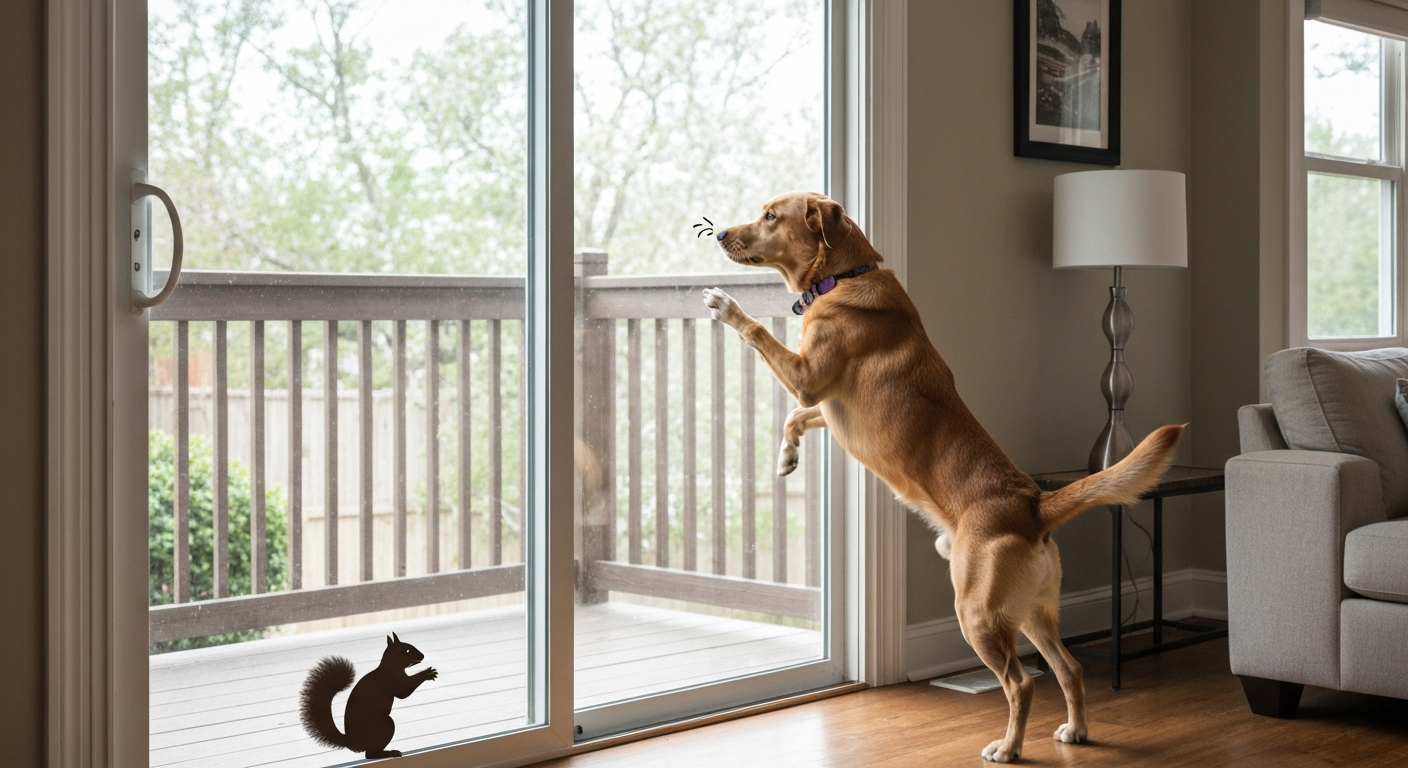
The fastest way to stop a dog from jumping on a patio door is to combine immediate physical management (a tall gate or exercise pen blocking door access) with consistent boundary training using a 'place' cue, then layer in permanent physical upgrades like pet-resistant screen mesh or a sliding panel pet insert once the training is underway. No single fix works on its own. The glass, the screen, and the dog all need to be addressed together, and this guide walks you through every step in the right order.
How to Stop Dog From Jumping on Patio Door: DIY Guide

Jamie Archer
24 Jul 2026
Who this guide is for and one quick safety note
This guide is written for homeowners dealing with a dog that paws, jumps at, scratches, or body-slams a sliding glass or hinged patio door. Whether your concern is cracked glass, shredded screen, or a dog that goes berserk every time a squirrel runs past, you are in the right place. The behavioral sections apply to any breed or age, though high-drive and large-breed dogs will need the physical reinforcements more urgently. One safety point before you start: most patio doors use tempered glass, which shatters into small fragments rather than large shards when it breaks. A large dog hitting a tempered pane hard enough can break it, and the result is an explosion of fragments at dog (and child) height. That is not a slow-moving risk. If your dog is already cracking or scratching the glass, get a physical barrier in place today before you do anything else.
Why your dog is doing this: a diagnosis checklist
Before picking a solution, it helps to know what is actually driving the behavior. Different causes need different primary fixes. Watch your dog for a few days and match what you see to the list below.
- Attention-seeking: The dog jumps at the door when you are nearby, then looks at you. The trigger is you, not what is outside. Inadvertent reinforcement (even negative attention) has made this a reliable strategy for getting a response.
- Territorial or reactive response: The dog spots a person, dog, or cyclist passing outside and erupts — barking, jumping, and pawing simultaneously. The behavior stops when the trigger disappears. This is stimulus-driven reactivity, not anxiety.
- Prey or visual drive: Squirrels, birds, and other fast-moving animals outside trigger a chase response. The dog may be otherwise calm but becomes fixated on motion through the glass.
- Separation-related arousal or anxiety: The jumping happens primarily when you are preparing to leave or have just left, or the dog redirects onto the door when confined away from you. This signals a separation concern and may need veterinary involvement.
- Boredom and under-exercise: A dog with unspent energy will bounce off any surface that seems worth bouncing off. If there is no specific external trigger and the behavior is spread throughout the day, energy management is the root fix.
- Pests or wildlife near the door: Raccoons, possums, or even insects at night can provoke a dog that would otherwise be calm. Check the exterior of the door for evidence of nightly visitors.
Why does this matter? A bored dog needs more exercise and enrichment. A reactive dog needs desensitization and management of visual access to triggers. An anxious dog may need a veterinary behaviorist. Treating the wrong cause wastes time and can make the problem worse. Identify the primary driver first, then apply the matching fix as the backbone of your plan.
Immediate safety fixes you can do today
These steps take under an hour and require no special tools. Their job is to stop the behavior from being rehearsed while you work on a longer-term solution. Immediate short-term management recommended by the ASPCA, Management and basic training recommendations (use of gates/management) includes physically blocking access (baby gate, exercise pen, or tether), reducing visual triggers by closing blinds or applying temporary film/decals, providing a high-value chew or puzzle at a pre-taught place, and preventing practice by not allowing repeated jumping episodes ASPCA — Management and basic training recommendations (use of gates/management). Every time a dog successfully jumps at the door and gets a response (from you, from the trigger outside, or from the satisfying sound of claws on glass), the behavior gets stronger. Cut off the rehearsal cycle now.
- Block physical access to the door. A tall freestanding baby gate (at least 30–36 inches for medium dogs, 42–48 inches for large breeds) set a few feet back from the glass prevents the approach run-up that makes jumping possible. For very determined dogs, an exercise pen clipped into a U-shape around the door area is more stable and harder to knock over.
- Close the blinds or curtains. This sounds obvious but it works. If the dog cannot see the squirrel, the squirrel cannot trigger the response. For doors without blinds, hang a flat bedsheet with tension rods or command strips as a same-day solution.
- Apply temporary frosted window film to the lower portion of the glass. Peel-and-stick frosted or opaque film applied to the bottom 18–24 inches of the glass panel blocks the dog's sightline without blocking your light. It peels off cleanly later.
- Remove hazards from the door area. Pick up anything breakable on nearby shelves or tables, clear any furniture that the dog could use as a launch pad, and check that the door track is clear so the door cannot be accidentally forced open during a jumping episode.
- Provide a high-value alternative occupation. A frozen lick mat or stuffed Kong placed at a specific spot away from the door gives the dog something to do. This is not a permanent fix, but it interrupts the impulse while you set up the rest of the plan.
- Do not react. Shouting, pushing the dog off, or even eye contact can function as reward for an attention-seeking dog. If you cannot remove yourself from the room, turn your back and cross your arms until four paws are on the floor, then calmly redirect.
Tools, materials, and what it will cost you
Here is an honest rundown of what you will need across the full project. You do not have to buy everything at once. Start with the immediate safety items and add the training tools as you move into the behavioral plan. The long-term physical upgrades come last once you know which direction you are heading.
| Item | Purpose | Approx. cost (USD) | Where to get it |
|---|---|---|---|
| Tall freestanding baby gate (42–48 in.) | Immediate physical barrier | $40–$90 | Amazon, Walmart, pet stores |
| Exercise pen (24–30 in. panels, 6–8 panels) | Configurable door-area barrier | $50–$120 | Amazon, pet stores |
| Peel-and-stick frosted window film | Block visual triggers, protect glass | $15–$35 per roll | Home Depot, Amazon |
| High-contrast window decals | Reduce glass transparency and reflection | $10–$20 | Amazon, bird-conservation retailers |
| Clicker or marker word + high-value treats | Marker-based training | $5–$15 for clicker, treats vary | Pet stores |
| Non-slip training mat or place mat | Defined 'place' target for boundary training | $15–$40 | Amazon, pet stores |
| Phifer PetScreen mesh (pet-resistant) | Replace or reinforce door screen | $1.50–$2.50 per sq. ft. | Home Depot, Lowe's |
| Clear acrylic or polycarbonate panel (1/8–1/4 in.) | Temporary glass or screen shield | $20–$60 cut to size | Home Depot, TAP Plastics |
| Sliding panel pet door insert (e.g., PetSafe Freedom Patio Panel) | Lets dog self-exit, removes door-pawing motive | $80–$200 depending on size | PetSafe, Amazon, Chewy |
| 3M Safety & Security window film (8–14 mil) | Fragment retention after glass impact | $50–$150 DIY; $200–$600 professional | 3M dealers, window tint shops |
Time estimates: physical barriers and temporary film take 30–60 minutes to set up. Training to a reliable 'place' cue typically takes 2–4 weeks of daily 5-minute sessions for a motivated dog, longer for reactive or anxious dogs. Replacing a screen with PetScreen mesh is a 1–2 hour DIY job on a weekend. Installing a sliding panel pet door insert takes about 30 minutes. Professional safety film installation, if you go that route, is usually a half-day appointment.
Short-term physical deterrents that actually work
Visual markers and decals
Dogs have dichromatic vision weighted toward blue and yellow wavelengths, and their visual system is highly tuned for motion and contrast. High-contrast decals (white, yellow, or black patterns) applied to the glass at the dog's eye level are more perceptible to a dog than subtle frosting. The goal is to break up the dog's clear sightline to moving targets outside. Apply decals in a grid covering the full lower half of the pane, spacing them no more than 2 inches apart for best effect. The same principle used to prevent bird collisions applies here: spaced, high-contrast patterns on the glass reduce both the dog's visual lock-on to outside triggers and the risk of birds flying into the glass.
Temporary privacy films
Peel-and-stick frosted films are available in rolls from any home improvement store. Apply them to the bottom 18–24 inches of the sliding glass panel (roughly the dog's nose-to-shoulder height) to block the sightlines that matter most. These are renter-friendly, do not affect the glass, and peel off cleanly if you want to remove them later. For heavier visual blocking, opaque vinyl window films in white or reflective silver cost about the same and block more light while still letting the door function normally.
Floor mats and furniture placement
A textured or spiked deterrent mat (the kind sold for keeping cats off counters) laid flat in the approach zone in front of the door discourages the run-up without harming the dog. These mats are uncomfortable underfoot and most dogs learn to avoid them within a few days. Alternatively, a piece of furniture placed directly in front of the door, a bench, large planter, or side table, physically interrupts the jump approach and does double duty as home decor.
Freestanding barriers
Tall pressure-mounted or freestanding pet gates are the most renter-friendly option because they require no drilling. For a standard sliding patio door (typically 6–8 feet wide), a 48-inch walk-through gate works if the dog is not large enough to clear it. For larger dogs, an 8-panel exercise pen reconfigured into a rectangular enclosure in front of the door area is more stable and harder to knock over. These are not permanent solutions, but they buy you weeks of clean training time without rehearsed jumping episodes.
Step-by-step behavioral training plan
The behavioral approach recommended by veterinary behavior organizations like the AVSAB and referenced in the Merck Veterinary Manual centers on three things: preventing the problem behavior from being practiced, teaching a specific replacement behavior, and gradually desensitizing the dog to the triggers that set the jumping off. All three need to run at the same time. Here is how to do it.
Step 1: Establish a 'place' cue (Days 1–5)
- Choose a specific mat or bed at least 6–8 feet from the patio door. This becomes the dog's designated spot.
- Lure the dog onto the mat with a treat, then click or say 'yes' the moment all four paws touch the mat. Treat generously.
- Add the verbal cue 'place' just before the lure on Day 2, once the dog is reliably following the lure.
- Build duration in 5-second increments: ask for 'place,' click and treat at 5 seconds, then 10, then 15. Do not rush this. A shaky 10 seconds is more useful than a collapsed 30-second attempt.
- Practice 5 minutes twice a day. Keep sessions upbeat and short. End before the dog loses focus.
Step 2: Teach 'off' as an interrupter (Days 3–7)
- Practice 'off' separately from the door. Stand in front of the dog, wait for them to put paws on your legs, then say 'off' and take a step backward. The moment four paws hit the ground, click and treat.
- Do not push the dog down or knee them. That can be misread as play. The backward step removes the surface to jump on.
- Once the dog understands 'off' reliably (usually 3–5 sessions), you have a verbal interrupter ready for door situations.
Step 3: Combine 'off' and 'place' at the door (Days 7–14)
- With the physical barrier still in place, begin controlled door exposures. Walk toward the door with the dog on a loose leash.
- If the dog stays calm, click and treat before any jumping starts. This is the core principle: reward calm, not just the absence of bad behavior.
- If jumping or pawing starts, cue 'off' (do not repeat it more than once), wait for four paws, then immediately cue 'place' and reward heavily on the mat.
- Return to the door only after the dog is settled on the mat. Keep sessions to 5–10 repetitions.
Step 4: Desensitize to outside triggers (Weeks 2–4)
For reactive dogs triggered by people or animals outside, systematic desensitization is the evidence-based approach. Grisha Stewart, Behavior Adjustment Training (BAT) resources provides BAT-based protocols emphasizing identifying the dog's threshold distance, training below threshold using engage–disengage or LAT methods, controlled exposures, and combining management to prevent rehearsal of the reactive response Grisha Stewart — Behavior Adjustment Training (BAT) resources. The key concept is threshold: the distance at which the dog notices a trigger but stays under their arousal ceiling. Work below that threshold consistently, and the threshold gradually increases. Here is the practical process:
- Identify your dog's current threshold. If a person walking past the patio 20 feet away causes jumping, your starting threshold is greater than 20 feet. Start controlled exposure at 40 feet.
- With a helper walking past at 40 feet, mark and treat your dog for orienting toward the person and then looking back at you (this is the 'engage-disengage' pattern). Treat heavily for the look-back.
- Over multiple sessions, gradually reduce the distance in small increments — only if the dog stays below their arousal ceiling. If jumping or barking resumes, you moved too fast. Step back to a comfortable distance.
- Never force the dog closer than they can handle. Flooding (forced exposure at full intensity) does not work and can worsen reactivity.
- Combine desensitization sessions with a 'place' cue: ask the dog to settle on the mat while the trigger moves past at a comfortable distance. This builds the association between triggers and calm mat behavior.
Reinforcement schedule and what to expect
In the first two weeks, reward every correct response generously. This is the acquisition phase and skimping on treats here slows everything down. After two weeks, begin intermittent reinforcement: reward every other success, then every third, then randomly. Intermittent schedules make behaviors more durable. For the first month, keep high-value treats (real meat, cheese) specifically for door-related training. Use kibble for general manners work elsewhere. Expect improvement to plateau periodically. That is normal and addressed in the troubleshooting section below.
When training stalls: troubleshooting plateaus and setbacks
Most training plateaus happen for one of three reasons: the management failed and the dog got unsupervised practice, you moved through the steps too quickly, or the underlying cause (anxiety, reactivity) is stronger than behavior modification alone can address. Here is how to diagnose and correct each one.
| Symptom | Likely cause | What to try |
|---|---|---|
| Dog was improving but suddenly got worse | One or more unsupervised rehearsal episodes | Reset management to 100% and restart distraction-level desensitization from an easy distance |
| Dog performs 'place' inside but ignores it when triggered at the door | Distraction level too high too soon | Return to practicing 'place' with low-level triggers (e.g., door visible but blind closed) before progressing |
| Dog won't disengage from outside triggers at any distance | Arousal level is too high; may be over-threshold at baseline | Increase exercise before training sessions; consult a force-free trainer or vet behaviorist |
| Dog performs well for you but not for other family members | Cue is not generalized to other handlers | Involve all household members in short practice sessions consistently |
| Behavior is only during departures or when left alone | Separation anxiety, not a training issue | Consult a veterinarian; this often requires medication in combination with a behavior plan |
| No improvement after 4+ weeks of consistent work | Possible medical pain component or genuine anxiety disorder | Veterinary exam and referral to a certified veterinary behaviorist (DACVB) |
Measuring progress matters. Keep a simple log: date, duration of session, level of trigger, and whether the dog responded to 'place' within one cue. If you are not seeing consistent improvement at a given trigger level after 10 sessions, that level is still too hard. Drop back a step. Progress is not linear, but it should be directional over a month of consistent daily work.
The AVSAB is clear that persistent or risky problem behaviors warrant referral to a credentialed professional: a Certified Applied Animal Behaviorist (CAAB), a veterinary behaviorist (DACVB), or a Certified Professional Dog Trainer (CPDT-KA) who uses force-free methods. If your dog is leaving scratches in the glass, has broken a screen, or is showing signs of panic rather than excitement, this is worth a professional assessment. That is not a failure, it is the right call.
Long-term physical solutions and door upgrades
Pet-resistant screen mesh
If your screen door has already been scratched, torn, or bulged, replacing the mesh with Phifer PetScreen is the best permanent fix for that problem. PetScreen is a vinyl-coated polyester mesh that is noticeably thicker and stiffer than standard insect screen. It resists puncturing and tearing from claws far better than standard mesh. You can buy it by the foot at most Home Depot and Lowe's locations. Replacing a screen is a genuine DIY job: remove the spline, pull out the old mesh, cut new PetScreen to size with an inch of overlap, use a spline roller to press it into the channel, trim the excess, and reinstall. Budget about 90 minutes for a standard single-panel screen door and under $30 in materials.
Sliding panel pet door inserts
A sliding panel pet insert (PetSafe Freedom Patio Panel is the most widely available option) is one of the most practical long-term solutions for dogs that jump at the patio door because they want out. The insert slides into the track where your sliding door normally sits and includes a built-in pet flap. Installation is reversible (no cutting, no drilling in most cases) and takes about 30 minutes. The dog can come and go independently, which removes the primary motivation for pawing and jumping. Panels are available for standard and tall sliding door openings, and most include a locking slide-in panel so you can close the flap when needed. If you are already thinking about installing a dog flap in a patio door, this panel approach is almost always the easiest and least destructive route.
Protective acrylic or polycarbonate shields
Clear acrylic panels (1/8 inch for lighter protection, 1/4 inch for higher impact resistance) cut to fit over the lower portion of the glass give the existing pane a layer of physical protection against paw impact and scratching. Polycarbonate is tougher than acrylic at the same thickness and is the better choice for large, high-energy dogs. Both are available cut-to-size at Home Depot or online from suppliers like TAP Plastics. For a temporary installation, you can attach a polycarbonate panel to the door frame using removable adhesive hook-and-loop strips. For a more permanent installation, low-profile aluminum channel or Z-clips hold the panel flat against the glass. Either way, the glass itself is never touched.
Safety and security window film
Safety film does not prevent glass from breaking, but it holds the broken pieces together after impact, which dramatically reduces injury risk from flying fragments. Products like 3M Safety Series films come in 8 mil and 14 mil thicknesses. The thicker options are designed for forced-entry and storm protection and require professional installation with a frame anchoring system to perform at their rated level. For basic fragment retention from pet impact, a DIY-applied 8 mil film applied per the manufacturer's instructions is a meaningful upgrade over bare tempered glass. Clean the glass thoroughly, apply the film with a squeegee to remove bubbles, and trim cleanly at the edges. One standard patio door panel takes about an hour to film yourself. Expect to pay $50–$150 in materials for a single panel. If you want the full security-grade performance, budget $200–$600 for professional installation.
Laminated glass: the permanent upgrade
Tempered glass (which most sliding doors use) breaks into small fragments on a hard impact. Laminated glass has a plastic interlayer (typically PVB) that holds the fragments in place even after the glass breaks, similar to automotive windshields. Glazing industry standards from GANA and safety glazing codes (CPSC 16 CFR 1201, ANSI Z97.1) define impact performance requirements for architectural glass, and laminated units can meet those requirements while adding real fragment-retention protection. If you are replacing a patio door panel anyway, asking your glazier to spec laminated glass instead of standard tempered is worth the added cost (roughly $100–$300 more per panel depending on size). This is not a DIY glass replacement job, get a glazier.
Fixed barriers and permanent fencing
For persistent jumpers in households where training progress is slow, a permanent fixed barrier, a low knee wall, a built-in bench seat directly in front of the door, or a short section of indoor fence with a gate, removes the physical possibility of a running approach. This is a carpentry project, not a door project, but it is worth mentioning because it is the most permanent management solution short of rearranging the dog's living space entirely.
Maintenance, track protection, and keeping your door healthy
Repeated paw impacts on a sliding door do damage beyond the glass. Claws catch the screen frame, bend the screen track, and grind dirt and debris into the lower track channel where the rollers run. Here is how to keep the door functional while you work through the behavior plan:
- Clean the track monthly with a stiff brush and vacuum, especially if the dog is tracking in dirt or grass. Debris in the track wears rollers faster and makes the door harder to slide.
- Inspect the screen frame monthly for bent corners or pulled-out spline. Catch this early and you can press it back into place; leave it and the whole screen will need replacing.
- Check the glass for surface scratches every few months. Fine scratches from claws do not weaken the glass structurally but can be polished out with acrylic scratch remover on tempered glass; deep scratches in a pane that has been hit repeatedly are worth having a glazier assess.
- If the door is dragging or hard to slide, check the rollers and re-lubricate the track with silicone spray (not WD-40, which attracts dirt). A dog hitting a stiff door at full speed puts far more force on the glass than the same impact on a door that slides freely.
- Check weatherstripping at the base and sides of the door seasonally. Paw damage at the bottom of the door can pull weatherstripping loose, letting in drafts and water.
When to call a professional
Most of what is in this guide is genuinely DIY-friendly. But a few situations call for a professional, and it is worth being clear about which ones:
- The glass has visible cracks, stress fractures, or the edge seal on a double-pane unit is broken (look for fogging between panes). Cracked tempered glass can fail without warning. Call a glazier immediately, do not wait.
- The dog's behavior includes signs of panic, self-injury, destructive behavior when alone, or inability to settle even with maximum management in place. These are signs of separation anxiety or an anxiety disorder. A veterinarian and a certified veterinary behaviorist are the right next step, not more training drills.
- You want professional-grade safety film installation with a rated frame anchoring system. The DIY application is useful, but the full forced-entry or storm-rated performance of 3M Safety Series films requires professional installation and anchoring — the manufacturer is explicit about this.
- The sliding door frame or track has been structurally bent or the door no longer closes flush. A bent frame affects the door's ability to lock securely and seal properly. A patio door specialist or window and door contractor can assess whether it needs adjustment or replacement.
Other patio door issues worth tackling alongside this one
Sorting out your dog's jumping behavior is a good moment to address a few other patio door problems that tend to cluster together. If you are considering a pet flap as part of this solution, there are two directions worth exploring: installing a dog flap directly into a patio door panel (which involves cutting glass or replacing a lower section of the frame) or using a sliding panel insert that fits in the track without any modification. For specifics on whether you can put a cat flap in patio doors, see our guide on can you put a cat flap in patio doors. If your patio door also has issues with condensation, drafts, or glass that solarizes the room in summer, those are related repairs that make sense to tackle in sequence. If you’re dealing with condensation specifically, see how to stop condensation on patio doors for step-by-step fixes. For related fixes, see a short guide on how to block sun from patio door for simple film, awning, and shade options. Doors that slam shut on a windy day are also a particular hazard when a dog is near the threshold, and a door stop or adjustable closer is a straightforward fix that keeps both the dog and the door safer. For another relevant comparison, see how to stop patio doors slamming shut. For solutions, see how to stop patio doors blowing in the wind, which covers door stops, adjustable closers, and other weatherproofing fixes.
FAQ
Why is my dog jumping on or pawing at the patio door?
Common causes: attention-seeking (dog wants access/interaction), territorial/reactive responses to people/animals outside, prey/visual drive toward birds/squirrels, separation-related arousal or anxiety, boredom/insufficient exercise, or learned habit (jumping worked previously). Diagnose by observing context (who/what triggers it), time of day, whether barking accompanies pawing, and whether the behavior stops when rewarded. Different causes need different interventions (management vs training vs veterinary behavior support).
What immediate safety fixes can I use right now to protect my dog and the glass/screen?
Short-term steps: physically block access (tall freestanding baby gate, exercise pen, or tether dog away from door), close blinds/curtains or apply temporary removable window film/decals to reduce visibility, give a high-value chew/lick mat or puzzle toy in a separate area, and avoid allowing the dog to ‘practice’ the behavior. If glass is at risk of impact, temporarily mount a clear acrylic or polycarbonate sheet over the lower section or use heavy-duty pet screen to protect mesh. These are reversible and renter-friendly options.
What step-by-step behavior training plan should I follow to stop door-directed jumping?
Basic force‑free plan: 1) Identify triggers and the dog’s threshold (distance/intensity where reaction starts). 2) Teach an alternative behavior (go-to-place, settle, or sit) using shaping and marker reinforcement (clicker/marker + high-value treat). 3) Practice below threshold: present low-level trigger, reward for calm/alternative behavior; gradually increase intensity/duration (systematic desensitization + counterconditioning). 4) Teach an ‘engage–disengage’ or LAT (look at that) protocol so the dog learns to look at the trigger and return for reward. 5) Proof the behavior with varied times/lighting and add distance to the door. 6) Use management (gates, covers) to prevent rehearsal. If progress stalls or behavior is aggressive/anxiety-driven, consult a certified behavior professional. Follow short daily sessions (5–10 minutes, 2–4 times/day).
How do I teach a reliable ‘place’ or ‘mat’ behavior to use away from the door?
Steps: 1) Choose a mat/place with clear boundaries. 2) Lure or shape the dog onto the mat and mark (click/word) when all four paws are on it; reward immediately. 3) Increase duration gradually—reward intermittently for staying. 4) Add a cue word (’place’) once the dog reliably goes and stays. 5) Introduce mild distractions and only reward for calm. 6) Practice relocating the mat progressively farther from the door, then closer while maintaining calm. Use high-value treats initially and slowly increase duration before reducing reward frequency.
What physical, short-term modifications can reduce triggers and protect the glass or screen?
Options: apply high-contrast removable decals or frosted privacy film across the visible pane to block motion/visibility; install clear acrylic/ polycarbonate lower panels to protect glass; replace standard screen with pet‑resistant screen (Phifer PetScreen) or install a temporary metal mesh guard; use freestanding barrier (gate or exercise pen) to stop close approach. These are low-cost, renter-friendly, and reversible.
What long-term physical solutions should I consider (barriers, films, reinforced screens)?
Long-term options: install pet-resistant mesh screens (Phifer PetScreen) or replace with metal or reinforced frames; add full-coverage safety/security window film (professionally applied) to hold shards; fit acrylic/polycarbonate panels over the lower glass; install a permanent pet door/panel insert for sliding doors (PetSafe-style insert) to reduce pawing; install a heavier-duty storm/impact glazing or laminated glass if safety is a concern. Choose solutions based on frequency of attempts, dog strength, and owner permanence preferences.
Next Article
How to Protect Patio Door from Rain: DIY Fixes, Steps & Costs
How to protect patio door from rain: step-by-step DIY fixes, tests, tools, seasonal tips, and when to call a pro.