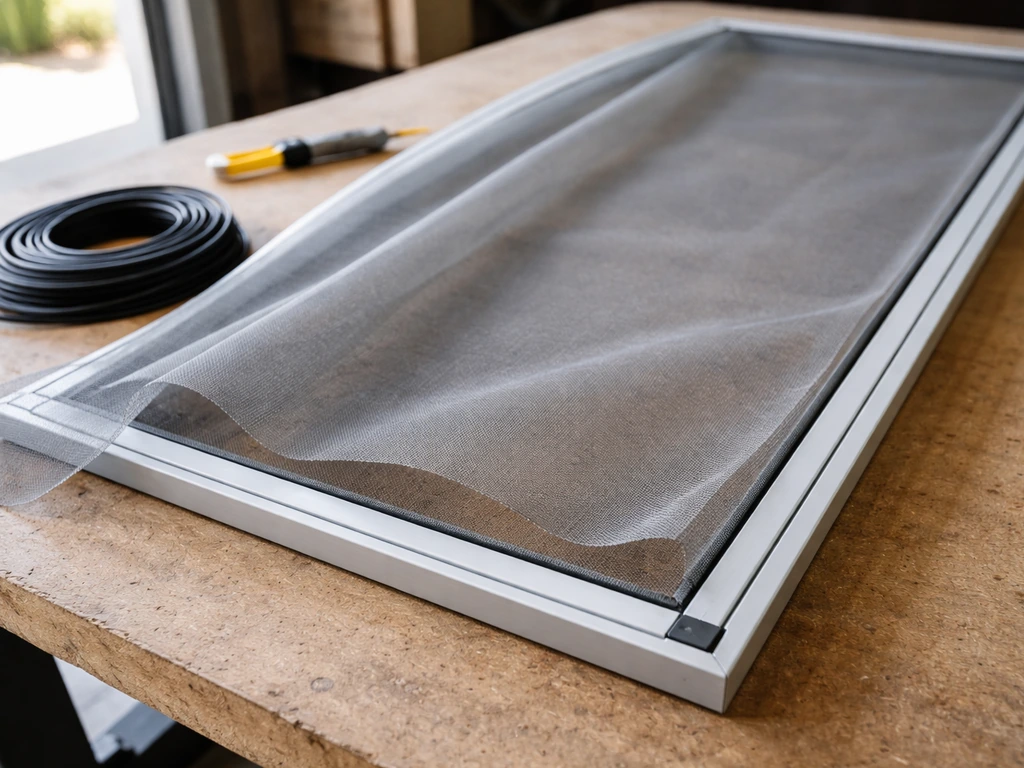
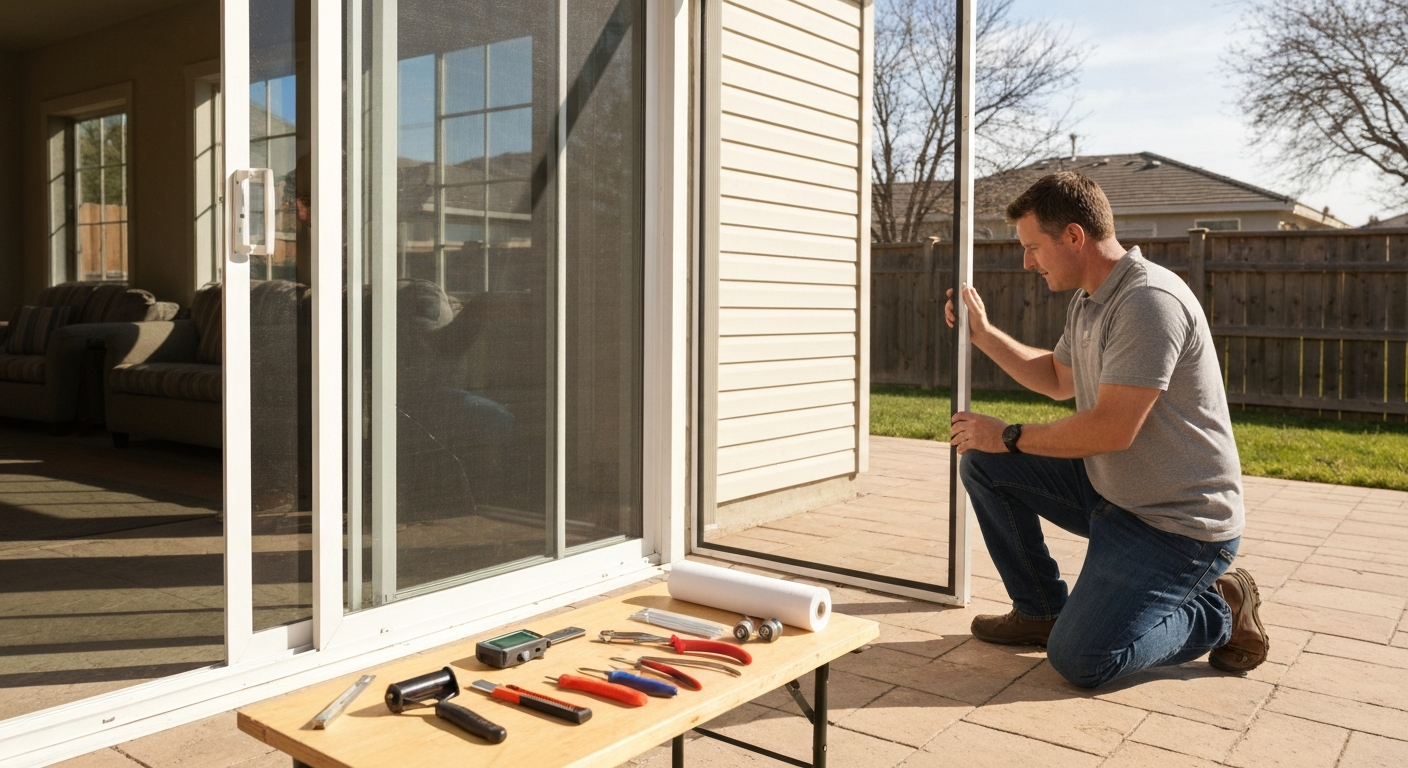
You have three solid options for repairing a patio screen door: fix it yourself in an afternoon using parts from a hardware store, drop it off at a local screen or window shop, or call a mobile screen service that comes to you. Most repairs, torn mesh, worn rollers, a sticky track, are genuinely DIY-friendly and cost $10–$40 in parts. If the frame is bent, the door is delaminating, or the parts for your brand are discontinued, a professional repair or full replacement makes more sense.
Where to Repair Patio Screen Door: DIY, Pros & Costs

Jamie Archer
11 Aug 2026
Common patio screen door problems worth knowing
Before you decide where to take the door or whether to tackle it yourself, it helps to name what you're actually dealing with. Most screen door problems fall into a handful of categories, and each one points toward a different fix.
- Torn or damaged mesh: The most frequent complaint. Fiberglass mesh tears easily; pet-resistant mesh like Phifer TuffScreen holds up better but still gets holes. A full rescreen is the correct fix — patching rarely lasts.
- Broken or worn rollers: Sliding screen doors ride on small plastic or nylon wheels housed in the bottom (and sometimes top) rail. When they crack or flatten, the door drags, skips, or derails entirely. Andersen and Pella both publish roller replacement guides specific to their door series.
- Stuck or dirty tracks: Grit, pet hair, and debris pack into the track channel and grind rollers down. Often a thorough cleaning and silicone lubricant restores smooth operation before you even need new parts.
- Faulty or missing latch: Screen door latches take a lot of finger pressure over years. The strike plate shifts, the hook corrodes, or the latch body cracks. Most latches are inexpensive to swap out.
- Drafts and poor seals: A sliding screen door that lets in insects despite being closed usually has a bent frame, compressed pile weatherstrip, or a track misalignment. Hinged screen doors develop drafts when the closer spring weakens or the frame warps.
- Bent or damaged frame: Corner keys loosen or the aluminum frame gets dented. Mild bends can be straightened; a severely distorted frame usually means replacing the whole panel.
Quick inspection checklist before you decide anything
Spend five minutes with the door before ordering parts or calling anyone. Lay the screen panel flat on a workbench or the floor to get a proper look. If you need step-by-step guidance, see our guide on how to replace a patio screen door mesh for tools, measurements, and installation tips. How to Repair a Screen Door, Hunker (how‑to guide) outlines the standard rescreening sequence pros follow, remove the door, pull old spline and mesh, clean the groove, lay new mesh with a 2"–3" overlap, seat spline with a spline roller, trim excess, and rehang, and lists essential tools (spline roller, spline, utility knife, flat screwdriver, pliers, measuring tape) and typical DIY time (30–90 minutes per panel) How to Repair a Screen Door — Hunker (how‑to guide).
- Check the frame corners: push each corner gently. If the corner key is loose and the frame flexes, the frame is separating. Note whether all four corners feel solid.
- Inspect the frame rails for bends or dents: sight down each rail the way you'd sight down a board. A visible bow or dent usually means the frame won't hold new mesh under tension.
- Pull the old spline out of one section: if it crumbles or is missing entirely, the mesh will have been pulling free. Check the groove is clean and not cracked.
- Rock the rollers by hand (sliding doors): remove the door from the track first (lift up, then angle the bottom out). Spin each roller with your finger. A good roller spins freely and quietly; a bad one wobbles, grinds, or is frozen solid.
- Check mesh for tears, holes, and bulging: note whether the damage is isolated (one hole, one corner) or widespread. Widespread sagging with no holes often means the mesh has simply stretched out over years.
- Slide the door on its track or swing the hinged door: note if it catches, requires force, or makes noise. Resistance despite clean tracks points to roller or alignment issues.
- Test the latch: does it engage the strike cleanly? Is the strike plate loose? Does the latch return when released?
- Look at weatherstrip and pile seals along the door edges: compressed or torn pile will let insects through even with the door properly closed.
Repair or replace? A practical decision flow
This doesn't need to be complicated. Walk through these questions in order and you'll land on the right call.
- Is the frame square and straight? If yes, keep going. If the frame is significantly bent or two or more corners are loose, replacing the screen panel is almost always cheaper than trying to reframe it.
- Is only one type of thing wrong — mesh, rollers, or latch? If you have one isolated problem, repair it. If three or more things are failing at once on a door that's 15+ years old, the repair cost may approach the price of a new screen panel ($50–$150 at a home center).
- Are replacement parts available for your brand? Andersen, Pella, and most major manufacturers sell replacement rollers and mesh kits. If the door is an off-brand with an unusual frame profile, parts can be hard to source. Call the manufacturer's parts line before deciding.
- Is the mesh the only problem? If so, this is the clearest DIY repair there is. A rescreen on a standard sliding or hinged screen door takes 30–90 minutes and costs $15–$35 in materials.
- Are the rollers the only problem? Also a strong DIY candidate — the job takes under an hour with the right replacement wheels. Replacing rollers in matched pairs is important, and lubricating the track with silicone spray after installation is a must.
- Is the problem a stuck track with no part failure? Clean the track thoroughly with a stiff brush and vacuum, then wipe down with a damp cloth. Apply dry silicone lubricant (not WD-40, which attracts dirt). Retest before buying anything.
- Is it a faulty latch only? Straightforward swap. Bring the old latch to the hardware store to match the profile.
- If you've reached this step and the door still isn't working after targeted repairs, price out a replacement screen panel. For standard sizes, a new panel from a home center or online is often $60–$130 and installs in minutes.
What repairs actually cost, DIY and pro
These are honest, current ranges based on typical retail parts pricing and local service rates. Your costs will vary by region and door size, but these give you a baseline to judge quotes against.
| Repair Type | DIY Cost (Parts Only) | DIY Time | Pro / Mobile Service Cost |
|---|---|---|---|
| Rescreen single door panel (fiberglass mesh) | $10–$25 | 30–60 min | $50–$100 labor + parts |
| Rescreen with pet-resistant mesh (TuffScreen) | $20–$45 | 45–75 min | $75–$130 labor + parts |
| Replace one pair of rollers | $8–$20 | 30–60 min | $60–$120 labor + parts |
| Replace track section | $15–$35 | 45–90 min | $80–$150 labor + parts |
| Latch / lock replacement | $8–$25 | 15–30 min | $45–$90 labor + parts |
| Weatherstrip / pile seal replacement | $10–$20 | 20–40 min | $40–$80 labor + parts |
| Full new screen panel (standard size) | $50–$130 (panel) | 15–30 min to hang | $120–$250 installed |
Mobile screen repair services typically charge a service call fee of $25–$60 on top of parts and labor. If you're having two or more panels rescreened at once, that call fee gets spread across panels and the per-door cost drops. Local screen shops sometimes offer drop-off pricing that's 10–20% less than mobile service rates since they aren't driving to you.
Tools and parts you'll need
For rescreening (mesh replacement)
- Spline roller (dual-head: one convex side for seating, one concave side for pressing spline into groove)
- Utility knife or box cutter with fresh blades
- Flat-head screwdriver (for prying old spline and starting corners)
- Needle-nose pliers (pulling old spline from tight corners)
- Measuring tape
- Scissors or shears (cutting mesh to rough size before installation)
- Straightedge or clamps to hold mesh flat while working
- Replacement screen mesh (fiberglass, aluminum, pet-resistant, or solar — see mesh type guide below)
- Replacement spline in the correct diameter (most common: 3/32", 1/8", 3/16", or 1/4" — bring the old spline to the store to match it)
- Workbench, sawhorse, or flat floor space to lay the frame
For roller replacement
- Phillips and flat-head screwdrivers
- Digital caliper or vernier caliper (for measuring wheel diameter, face thickness, and housing dimensions accurately)
- Replacement roller assemblies matched to your door's wheel diameter (common sizes: 1", 1-1/4", 1-1/2")
- Silicone spray lubricant (dry formula — not WD-40)
- Stiff nylon brush or old toothbrush (track cleaning)
- Vacuum with crevice tool
For track, hinge, and latch work
- Replacement track section or full track kit (measure existing track length, width, and depth before ordering)
- Replacement door hinges (hinged screen doors — match screw spacing and leaf dimensions)
- Replacement latch assembly (bring the old one or photograph the profile and mounting hole pattern)
- Hacksaw or tin snips (cutting track to length)
- Pop rivet gun and rivets, or sheet metal screws (securing new track sections)
- Silicone or rubber mallet (seating track without denting aluminum)
Where to buy parts and supplies
You have more sourcing options than most people realize, and the right source depends on how specialized your need is.
Big-box home centers (Home Depot, Lowe's)
Home Depot and Lowe's both stock standard mesh rolls (Phifer fiberglass and TuffScreen in 48"x50 ft and 72"x100 ft rolls), common spline sizes, and off-the-shelf Prime-Line roller assemblies in 1", 1-1/4", and 1-1/2" sizes. They're the right first stop for routine repairs. The limitation: they carry a limited range of roller styles, and if your door has an unusual housing profile, you may not find an exact match.
Manufacturer parts channels
If you have an Andersen or Pella door, order directly from their parts stores. Andersen sells a dedicated Patio Door Rescreening Kit and replacement rollers specific to their gliding and hinged screen series. Pella operates its own online parts shop with replacement rollers, tracks, and latches organized by door model. Using manufacturer parts ensures correct fit, especially for proprietary roller housings and spline groove dimensions. Phantom Screens doors are a separate case: their limited lifetime warranty covers mechanical components and includes 24 months of labor warranty, and Phantom recommends against DIY mesh reinstallation if you want to preserve warranty coverage.
Specialty hardware suppliers (SWISCO and similar)
SWISCO is the most useful resource for roller matching. They publish dimensional diagrams for hundreds of door roller assemblies, categorize by wheel diameter and housing style, and let you submit photos of old parts to get a match recommendation. This is where to go when the big-box options don't fit your housing profile. Their product guides include exact installation steps and callout dimensions.
Local screen shops and window/door dealers
A dedicated screen shop will cut mesh to your dimensions, carry a wider variety of spline sizes, and often stock unusual rollers and frame hardware that big-box stores don't. Many also do same-day drop-off rescreening. Independent window and door dealers who stock Andersen, Pella, or Marvin products can also order manufacturer parts on your behalf if you can't access the parts portal directly.
Online specialty and Amazon
For mesh, Phifer sells TuffScreen, No-See-Um mesh (18x22 weave density for tiny insects), and solar mesh (SunTex family) in custom roll widths up to 132"–144" through authorized online retailers. This matters for oversized porch or double-door panels where standard 48" rolls won't span the opening. Amazon carries many Prime-Line roller kits, but the product photos and dimensions aren't always consistent, cross-reference the listed measurements against your caliper readings before ordering.
How to measure and order the right mesh and rollers
Getting measurements right before you order saves a second trip and prevents mid-project stalls. Here's how to do it correctly.
Measuring for replacement mesh
- Remove the screen panel from the door frame and lay it flat on a clean work surface.
- Pull out the old spline from the groove around the perimeter. Use a flat screwdriver at a corner to start, then pull with needle-nose pliers.
- Measure the frame opening from the inner edge of the spline groove to the inner edge on the opposite side — do this for both width and height. This is your mesh cut size.
- Add 2–3 inches to each dimension (width and height) for overlap and tensioning — this is how much mesh you actually need to order or cut.
- Measure the spline groove width and depth with a caliper. Bring the old spline to the store and match the diameter. Common sizes are 3/32", 1/8", 3/16", and 1/4".
- Choose your mesh type based on use: standard fiberglass for general use, Phifer TuffScreen (vinyl-coated polyester, 17x13 weave) where pets or heavy traffic are a factor, No-See-Um mesh (18x22 weave) where small insects are an issue, or SunTex solar mesh for glare and heat reduction.
- Record your measurements on paper and bring them to the store or use them to order online. For a standard single sliding screen door, one 48" roll of mesh is more than enough. For larger openings (porch panels, double doors), confirm your frame width doesn't exceed 48" before buying a standard roll.
Use this template to record your measurements before shopping:
| Measurement | What to Measure | Your Value |
|---|---|---|
| Frame opening width | Inner groove edge to inner groove edge (horizontal) | _____ inches |
| Frame opening height | Inner groove edge to inner groove edge (vertical) | _____ inches |
| Mesh cut width needed | Frame opening width + 3 inches | _____ inches |
| Mesh cut height needed | Frame opening height + 3 inches | _____ inches |
| Spline groove width | Groove channel width with caliper | _____ inches |
| Old spline diameter | Measure old spline or match to size chart | _____ inches |
| Mesh type needed | Fiberglass / pet-resistant / solar / No-See-Um | _____ |
Measuring for replacement rollers
- Remove the screen door from the track (lift upward into the top channel, then swing the bottom outward).
- Locate the roller assemblies. On sliding screen doors they are usually in the bottom corners of the frame rail, sometimes with an adjustment screw on the face of the rail. Some designs have top-hung rollers instead.
- Remove the roller housing by backing out the mounting screw. The housing will usually pull or pop out of the rail opening.
- Measure the wheel diameter with a caliper (typical range: 1" to 1-1/2" for screen door rollers).
- Measure the wheel face thickness (the width of the wheel itself).
- Measure the housing overall length and width.
- Measure the hole-to-hole fastener spacing if there are two mounting holes.
- Note the wheel material (nylon, steel ball bearing, plain plastic) and whether the housing has a spring-loaded or fixed design.
- Bring the old roller and your measurements to the store, or submit a photo to SWISCO's parts-matching service. Replace both rollers as a matched pair even if only one appears damaged.
- After installing new rollers, use the adjustment screw to set ride height so the door sits level in the track, then lubricate the track with dry silicone spray.
Use this template to record roller dimensions before ordering: For step-by-step instructions on how to replace wheels on a patio screen door, see our guide on how to replace wheels on patio screen door.
| Measurement | What to Measure | Your Value |
|---|---|---|
| Wheel diameter | Outer edge to outer edge of wheel | _____ inches |
| Wheel face thickness | Width of wheel tread | _____ inches |
| Housing overall length | End to end of housing body | _____ inches |
| Housing overall width | Side to side of housing body | _____ inches |
| Fastener hole spacing | Center of hole to center of hole | _____ inches |
| Roller position | Bottom rail / top rail / corner bracket | _____ |
| Wheel material | Nylon / steel ball bearing / plastic | _____ |
Mesh types compared
Choosing the right mesh for a patio screen door matters more than people expect. The wrong choice means repeating the job sooner or not solving the actual problem (bugs, heat, pets). Here's how the main options stack up.
| Mesh Type | Material | Best For | Durability | Approximate Cost (48"x25 ft roll) |
|---|---|---|---|---|
| Standard fiberglass | Fiberglass | General sliding and hinged doors, low traffic | Moderate — tears under pet claws | $10–$18 |
| Aluminum mesh | Aluminum wire | Higher rigidity, longer service life | Better than fiberglass, can dent/crease | $18–$30 |
| Pet-resistant (TuffScreen) | Vinyl-coated polyester (17x13) | Homes with cats or dogs, high-use doors | High — significantly stronger than fiberglass | $25–$45 |
| No-See-Um mesh | Fiberglass (18x22 tight weave) | Areas with tiny gnats, sand flies | Moderate — similar to standard fiberglass | $15–$28 |
| Solar screen (SunTex / SunScreen) | PVC-coated polyester | Heat, glare, and UV reduction | High — outdoor-rated | $30–$55 |
For most standard patio screen doors, pet-resistant TuffScreen is worth the extra few dollars over standard fiberglass. It rescreens the same way, takes the same spline, and you won't be doing the job again in two years. If solar heat is your main concern, SunTex is the right pick, but know that it significantly reduces visibility through the screen.
Where to find professional repair services
If you'd rather hand the job off, or the repair is beyond a basic DIY fix, here are the service types to look for and what to expect from each. If you’re wondering who fixes patio screen doors, look for mobile screen repair services, local screen shops, or window and door dealers.
Mobile screen repair services
Companies like Screenmobile and local independent mobile screen techs come to your home, rescreen panels on-site, and often handle rollers and latches in the same visit. For step-by-step guidance, see how to rescreen a patio screen door. They're convenient if you have multiple panels or a difficult-to-remove door. Expect a service call fee ($25–$60) plus per-panel pricing. Ask upfront whether they stock pet-resistant mesh and whether they carry your door's roller size.
Local screen shops and glass/window dealers
A dedicated screen shop offers drop-off service that's often 10–20% cheaper than mobile service, since you're doing the pickup and delivery yourself. They typically cut mesh to non-standard sizes, stock a wider variety of spline diameters and frame hardware, and can source rollers for older or less common door profiles. If you have a brand-name door (Andersen, Pella, Marvin), a dealer for that brand can order OEM parts and handle warranty-adjacent repairs properly.
Handymen and general contractors
A competent handyman can handle rescreening and roller replacement, but verify they've done screen door work specifically. Screen mesh installation done under poor tension looks terrible and won't last. Ask to see a recent example or check reviews that specifically mention screen or door work.
Big-box store installation services
Home Depot and Lowe's offer installation services for new screen door panels and occasionally for rescreening through third-party contractor networks. Pricing and quality vary by local contractor. This is a reasonable option if you're buying a new panel at the same time. For repair-only work, a dedicated screen shop will usually do better.
Questions to ask any service provider
- What mesh types do you stock, and can I specify pet-resistant or solar mesh?
- Do you carry replacement rollers on the truck/in shop, or will I need a second visit?
- What does your labor warranty cover and for how long?
- Can you source OEM parts if I have a brand-name Andersen or Pella door?
- Is your service call/trip fee applied toward the total repair cost?
Troubleshooting by symptom
| Symptom | Most Likely Cause | First Action |
|---|---|---|
| Door drags or won't slide | Worn/broken rollers or dirty track | Clean track; inspect and spin rollers by hand; replace rollers if worn |
| Door jumps off track | Rollers worn flat or roller height set too low | Adjust roller height screw; replace rollers if wheels are cracked or flat |
| Insects getting in despite closed door | Torn mesh, missing pile weatherstrip, or frame misalignment | Inspect mesh for holes; check pile seal along door edges; adjust door to align with frame |
| Mesh is sagging but intact | Spline loose or mesh stretched from age | Re-seat spline with spline roller; if groove is damaged, rescreen completely |
| Door rattles in wind | Loose latch, worn weatherstrip, or rollers not holding door against frame | Adjust latch strike plate; replace pile seal; adjust roller height |
| Latch won't catch or spring back | Worn latch body or misaligned strike plate | Adjust or shim strike plate first; replace latch if hook is broken |
| Door squeaks when sliding | Dry or dirty track | Clean track; apply dry silicone lubricant |
| Frame corners separating | Corner key failure from age or impact | Reassemble with new corner keys if frame rails are undamaged; otherwise replace panel |
Seasonal maintenance that prevents most repairs
Most patio screen door failures are slow-motion problems you can interrupt before they become repairs. Twice a year (spring and fall) spend ten minutes on the door and you'll rarely need to rescreen or replace rollers prematurely.
- Vacuum the track channel with a crevice attachment and scrub with a stiff brush to remove packed debris — this is the single most effective thing you can do for sliding screen doors.
- Apply dry silicone lubricant (not oil-based) to the track after cleaning. Oil lubricants attract and hold dirt, which accelerates roller wear.
- Inspect the mesh for small holes or loose corners where the spline is starting to pull out. A small tear patched immediately won't become a full rescreen job.
- Check the pile weatherstrip along the door edges. If it's flattened or missing in sections, replace it before winter to keep insects and drafts out.
- For hinged screen doors, check the door closer spring tension and the hinge screws. Loose hinge screws cause the door to sag and the latch to miss the strike.
- In climates with hard winters, consider removing sliding screen doors from the track and storing them indoors. Freeze-thaw cycles crack plastic rollers and degrade mesh faster than use does.
FAQ
Quick answer: Where can homeowners get a patio screen door repaired — DIY or hire a pro?
Quick answer: You can often fix common patio screen door problems yourself (torn mesh, sticky sliding, broken rollers, loose spline) using a rescreen kit and basic tools. For complex issues (damaged frames, proprietary retractable systems, warranty concerns, or if you prefer no-mess, guaranteed work), hire a local screen shop, window/door specialist, a reputable handyman service, manufacturer service (Andersen, Pella, Phantom) or a big‑box home‑services contractor. Choose DIY when the job is small, you have time and basic tools; hire a pro when parts are proprietary, the frame is bent, safety/security hardware is involved, or you want a warranty-backed repair.
Decision flow: How to decide quickly between DIY and hiring a pro?
Decision flow (short): 1) Identify fault (mesh tear, rollers, track, lock, bent frame, retractable system). 2) Check warranty/manufacturer advice — manufacturer service often required to keep warranty (e.g., Phantom instructions). 3) If fault = torn mesh, misaligned rollers, sticky track → DIY feasible. 4) If frame bent, broken glass, proprietary retractable unit, or you want guaranteed labor → hire a pro. 5) If unsure, get a local shop estimate (many offer free/low‑cost pickup/inspection).
What are the step‑by‑step DIY instructions for rescreening a hinged or sliding patio screen door?
Rescreening (general steps): 1) Remove screen door from frame and lay flat. 2) Remove spline: pry out old spline with flat screwdriver or spline tool and peel off old mesh. 3) Clean the channel and inspect frame for damage. 4) Cut new mesh with 2"–3" overlap around the frame. 5) Lay mesh over frame, center it, and use a concave spline roller to press spline into groove on one side to secure mesh. 6) Tension mesh evenly across frame, work opposite sides, then ends; avoid over‑stretching fiberglass mesh. 7) Trim excess mesh with a utility knife along outside of spline. 8) Reinstall door and test. Typical time: 30–90 minutes per panel depending on experience. (Procedure follows standard guides such as Andersen/Pella rescreen instructions and DIY how‑tos.)
How to replace torn mesh only (measure and order mesh)?
Replacing mesh only: 1) Measure internal frame opening while frame is flat (measure groove‑to‑groove or inside edge to inside edge). 2) Note spline diameter (save old spline or measure groove/spline). 3) Choose mesh type: fiberglass (general), aluminum (longer life), pet‑resistant (Phifer TuffScreen) or solar/sun screens. 4) Order mesh slightly larger than opening (add 2"–3" each side) from big‑box stores or specialists (Phifer products available at Home Depot/Lowe’s). 5) Follow rescreening steps to install. Common spline sizes: 3/32", 1/8", 3/16", 1/4" — match to groove.
Step‑by‑step: How to replace rollers/wheels on a sliding patio screen door?
Roller replacement (sliding screens): 1) Remove the screen panel (lift up and tip out, or remove top roller screw per manufacturer instructions). 2) Lay panel flat and locate roller housing fastener(s). 3) Remove retaining screw(s) and slide or pry out the old roller housing. 4) Measure wheel diameter, wheel thickness, housing length and fastener hole spacing (or bring old part). 5) Fit the replacement roller into the housing slot and secure with the screw. 6) Reinstall screen panel into track. 7) Adjust ride height using the roller adjustment screw until the panel runs smoothly and seals. Replace rollers in matched pairs for balanced operation. Typical wheel sizes: ~1.0"–1.5"; many retailers list size options and guides (Pella, SWISCO, Lowe’s, Home Depot).
Tools and parts checklist for DIY rescreen and roller replacement
Essential tools: spline roller (concave/convex), flat screwdriver, small Phillips/flat screwdrivers, pliers, utility knife, measuring tape, scissors, work gloves, vacuum/brush for cleaning, silicone lubricant. Parts: replacement mesh (type & size), correct spline diameter, replacement rollers/roller assemblies (measure or take old part), replacement screws/retainers if missing. Optional: digital caliper for exact part measurements, replacement corner keys for frame if needed. Many parts available from Home Depot, Lowe’s, SWISCO, or manufacturer parts shops (Andersen, Pella).
Next Article
How to Rescreen a Patio Screen Door Step by Step
Step-by-step DIY for rescreening a patio screen door, from removing the frame to tensioning and fixing drafts.