A gap under a patio door is almost always caused by one of four things: worn or misadjusted rollers letting the door sag, a failed or missing door sweep or threshold seal, debris packed into the track throwing off the door's sitting height, or a frame or installation problem that no amount of weatherstripping will fix on its own. If you are seeing patio door problems like persistent drafts, a sagging bottom edge, or a seal that fails after rain, the checks below help you pinpoint the cause. The good news is that most of these are weekend DIY repairs costing between $10 and $80 in parts.
How to Fill Gap Under Patio Door: DIY Fix Steps

Jamie Archer
5 Jul 2026
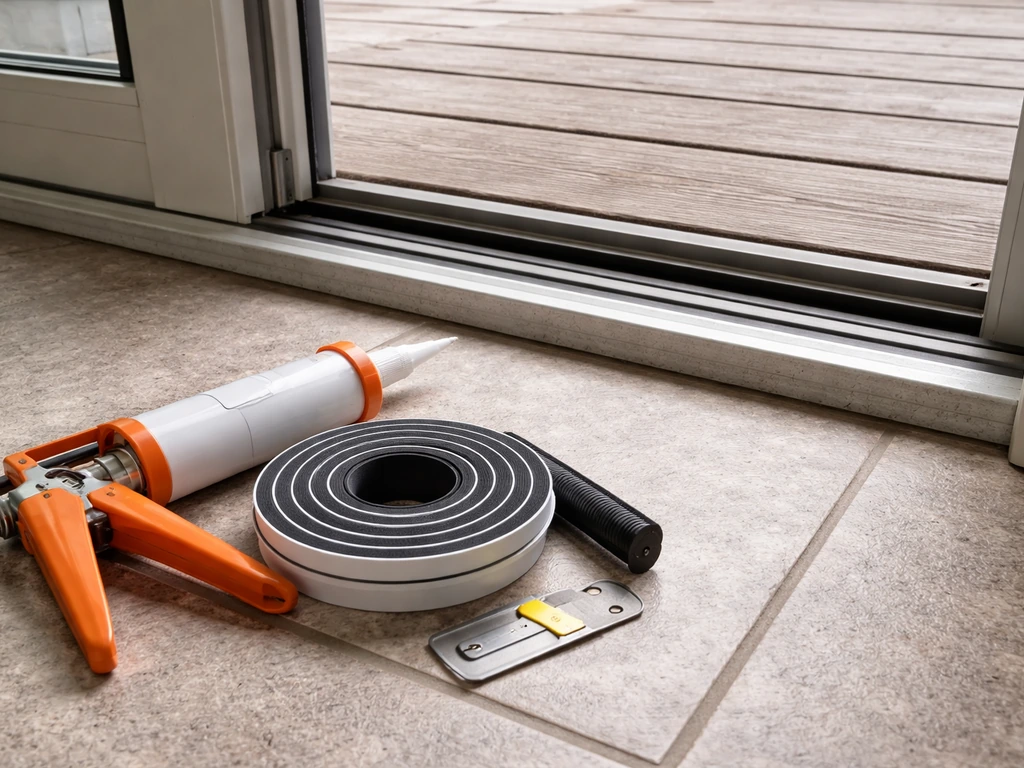
Figure out what kind of gap you're actually dealing with
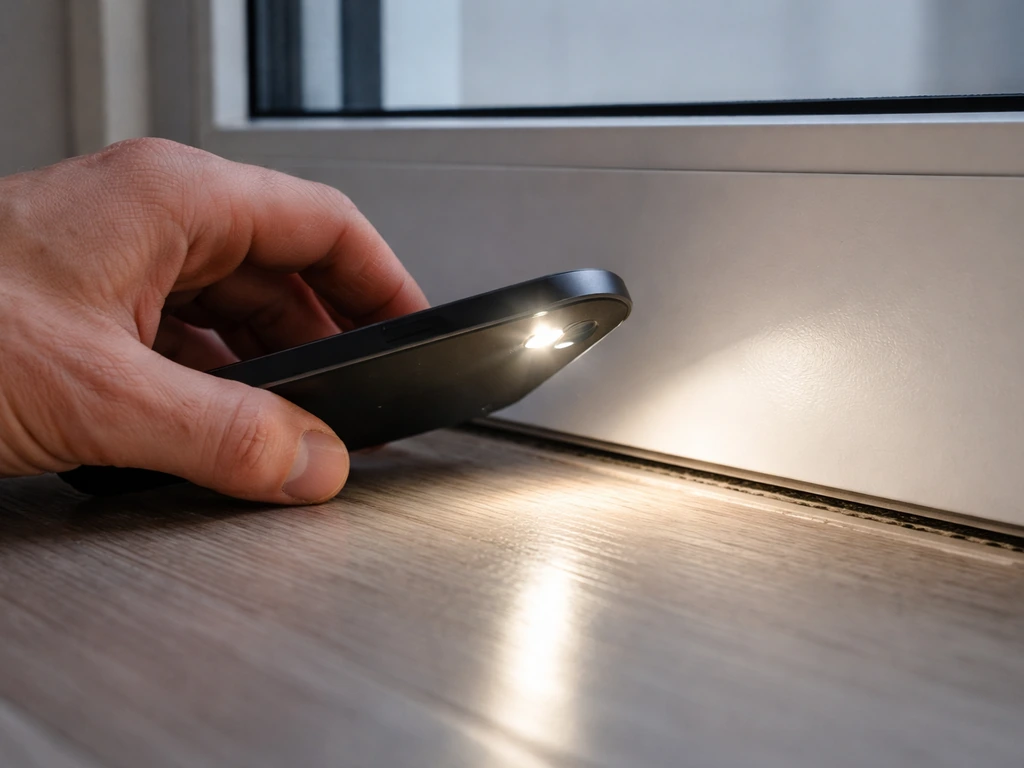
Before you buy anything or start adjusting screws, take five minutes to diagnose what's going on. Not all bottom gaps are the same problem, and fixing the wrong thing wastes time and money.
Start with the simplest test: on a bright day, turn off interior lights and look along the bottom of the closed door. If you can see a sliver of daylight, air is moving through that opening. For a less obvious leak, hold a lit stick of incense or a thin strip of tissue near the bottom edge and corners while the door is closed. If the smoke or tissue wavers or gets pulled toward the gap, you've found your air leak. This is the same smoke-draft method recommended by the U.S. Department of Energy for detecting air leaks around doors and windows.
Next, look at the gap's character. Is it even along the full bottom edge, or is it wider on one side than the other? A gap that's tighter at the top on one side and wider at the bottom on the opposite side is a classic sign the door panel is sitting unevenly on its rollers.
A gap that's even all the way across but still lets drafts through usually means the seal itself has failed rather than the door being out of position. A gap that only appears when it rains, or that lets in water at floor level, points toward a drainage or threshold problem.
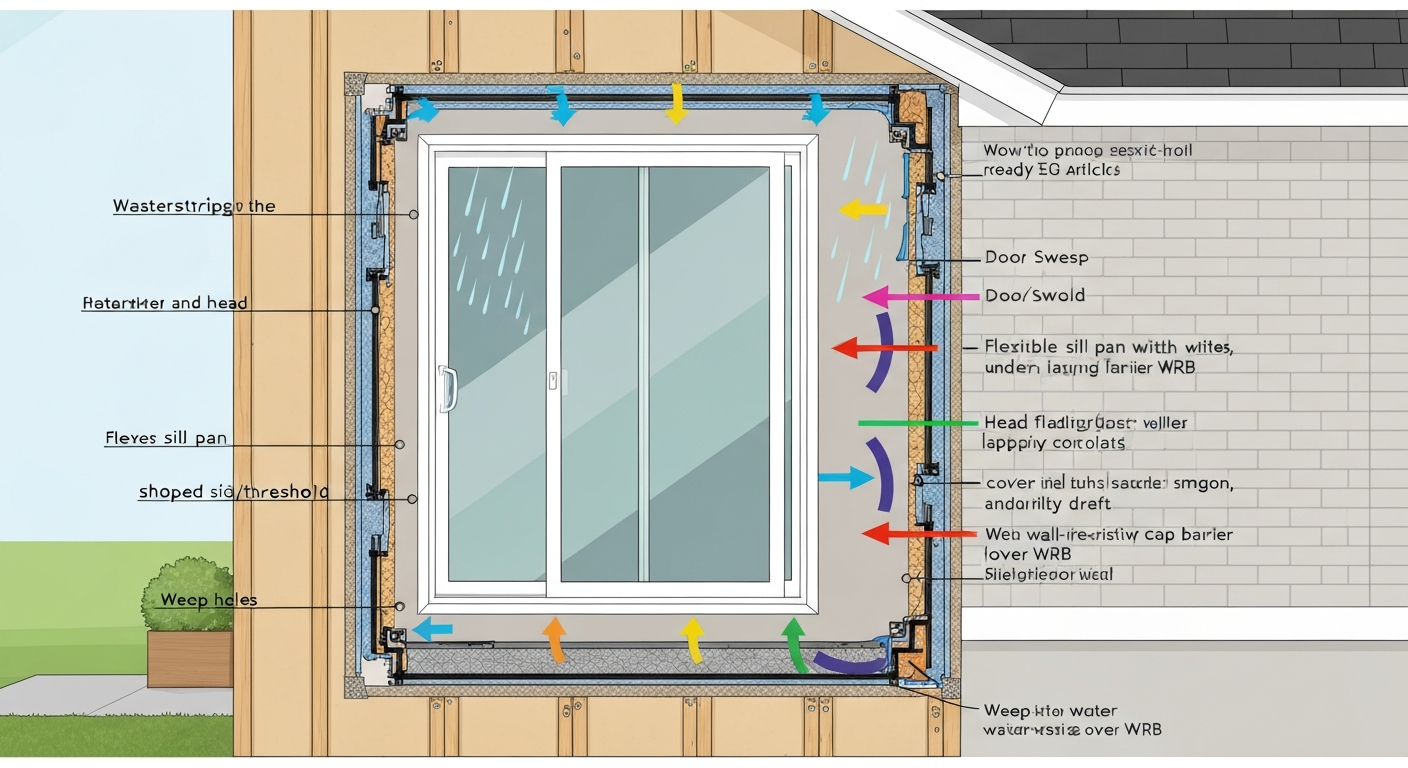
Window Zone notes that patio doors include drainage or weep holes at the bottom exterior frame edge so water can drain out of the track without reaching the interior side of the threshold drainage or threshold problem.
The four main gap sources at a glance
- Draft gap: The door sits correctly but the sweep or threshold seal is worn, torn, or missing entirely
- Height/alignment gap: Rollers (sliding door) or hinges (hinged door) have dropped or shifted, pulling the door out of square with the frame
- Latch-side gap: The door droops at the latch end, the strike plate is misaligned, and the lock won't fully engage — often caused by worn rollers or loose hinges
- Track and weep issues: Debris packed in the track raises or tilts the door, or blocked weep holes trap water in the sill and let it migrate inside
Quick checks: sliding vs. hinged patio doors
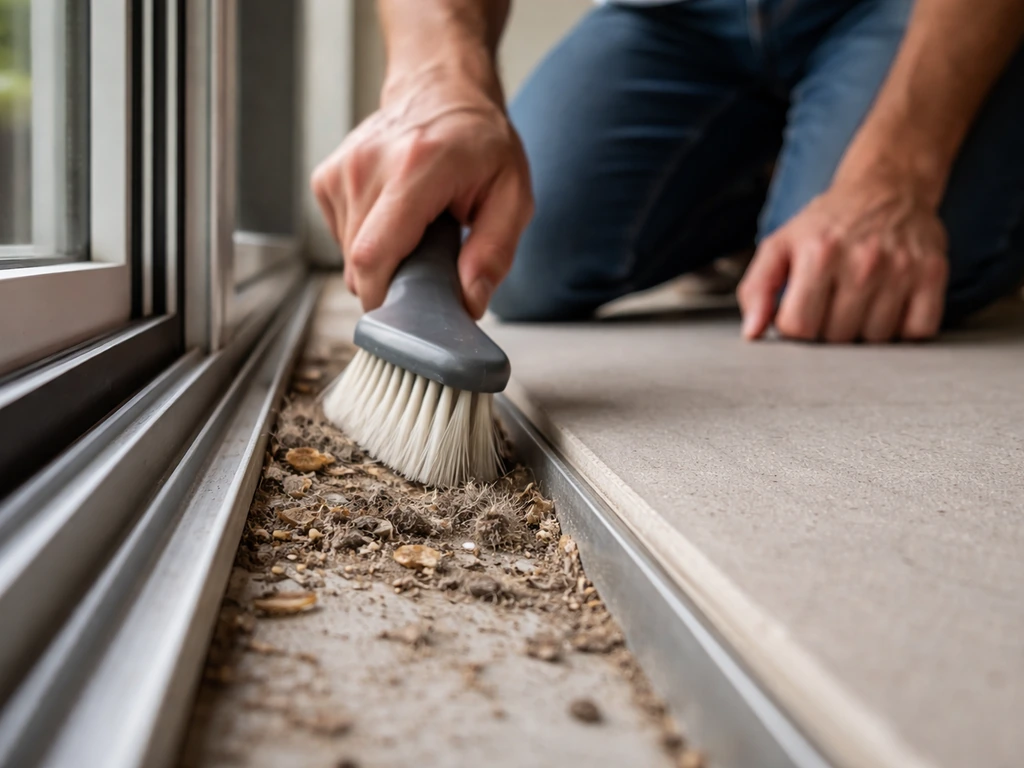
The diagnosis process is a little different depending on your door type, so run through the right checklist before touching any hardware.
Sliding patio doors
- Inspect the track: Kneel down and look along the bottom track. Hardened grit, pet hair, and leaf debris build up slowly, and the drag can feel identical to a roller height problem. Use a shop vacuum (not a wire brush or solvent, which can damage vinyl and rubber rollers) to clean the track thoroughly before assuming anything else is wrong.
- Check roller engagement: Open the door partway and look down at the bottom corners. The rollers should be sitting squarely on the track. A derailed roller is an obvious find and is the first thing to check when a door suddenly develops a bad gap.
- Test the reveal: With the door closed, look at the gap between the door panel and the vertical frame on both sides. If one side is tight at the top and wide at the bottom, the rollers need height adjustment.
- Test the latch: Close the door and engage the lock. If the latch doesn't click in cleanly, or the door feels loose even when locked, the door has dropped and the strike plate is no longer at the right height. That drop is what's also causing your bottom gap.
- Check the weep holes: Look at the exterior bottom of the frame for small drainage slots or holes. Poke a thin wire or toothpick into them. Blocked weep holes can cause water to back up in the track and appear as a leak at the threshold even when the seals are fine.
Hinged patio doors
- Check hinge screws: Open the door and inspect every hinge. Loose screws let the door sag on the hinge side, which opens a gap at the bottom latch corner. Tighten all screws fully; if a screw spins without biting, the hole is stripped and needs a longer screw or a wood filler repair.
- Look at the door frame: Close the door and look at the reveal (the gap between the door slab and the frame) all the way around. A consistent gap means the door is square. A diagonal gap — tight at the hinge top and wide at the latch bottom — means the door is racking and needs hinge adjustment or frame attention.
- Check the threshold and sweep: Run your hand along the bottom of the closed door. Feel for cold air or daylight. If the door is square but still drafty, the sweep or threshold seal is your problem, not the door position.
- Test the latch engagement: A hinged door that doesn't latch firmly often has a drooping strike plate or a sagging door — both of which create a gap at the bottom and compromise the seal.
Adjust and align the door to close the mechanical gap
If your diagnosis pointed to a positioning problem rather than a seal problem, this is where you start. Adjusting first makes everything else more effective, there's no point putting a perfect sweep on a door that's sitting crooked.
Adjusting sliding door rollers
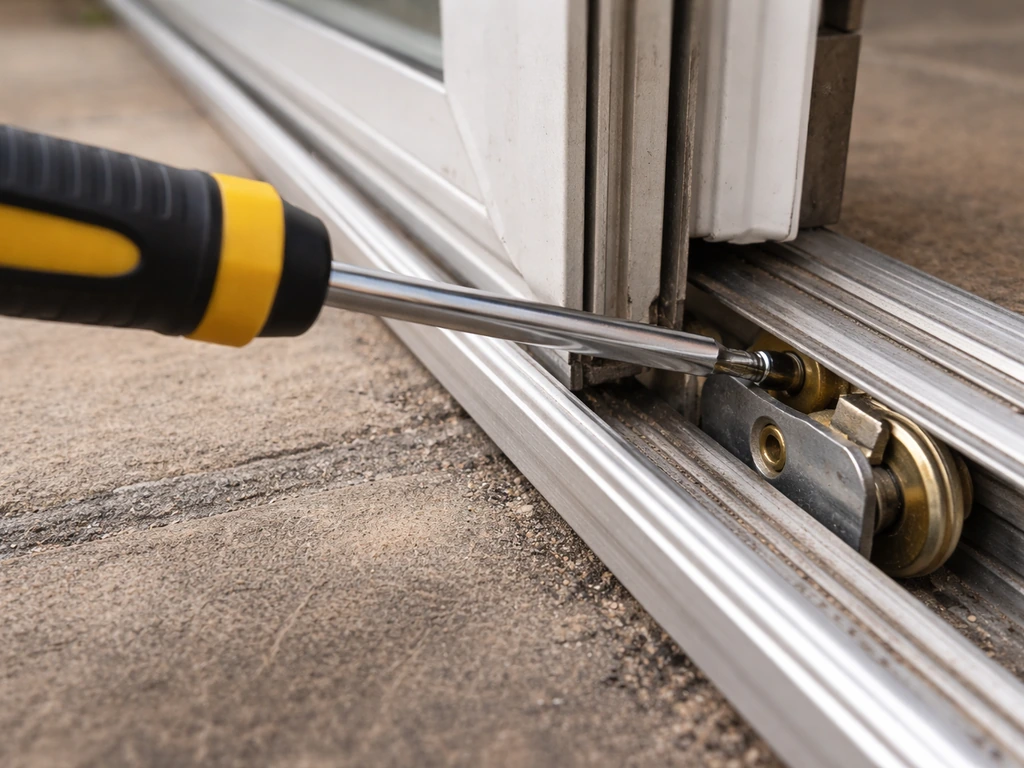
Sliding patio doors have two sets of rollers at the bottom, one at each corner. Each roller assembly has an adjustment screw, usually accessed through a small plug hole on the door's interior face near the bottom corners. Pop out those plugs with a flathead screwdriver, insert a Phillips screwdriver, and turn clockwise to raise the door, counterclockwise to lower it. Work in quarter-turn increments and check the reveal after each adjustment. You're aiming for an even gap between the door panel and the frame on both sides, and a clearance of roughly 1/8 to 1/4 inch between the bottom of the door and the track, enough for the rollers to run freely without leaving a draft gap.
One important caution: do not fully remove the adjustment screw. The rollers need to stay engaged with the track for the door to be safe. If a screw turns freely but nothing happens to the door height, the roller assembly is worn out and adjustment alone won't fix it (see the replacement section below).
Adjusting hinged door hinges
For a hinged patio door that's sagging, start by tightening all hinge screws. If the top hinge screws are stripped, replace them with 3-inch screws that reach into the wall framing, this is often enough to pull a sagging door back into square. If you’re dealing with a leak at the top of an upvc patio door, check the top hinge area and alignment next upvc patio door leaking at top. If the door still droops after tightening, some hinges have built-in adjustment slots that let you shift the door up/down or in/out slightly; check your door manufacturer's documentation. After any hinge adjustment, close the door and check the bottom gap again before moving on.
Adjust the strike plate
Once the door is sitting at the correct height, check the latch. If it still doesn't click in cleanly, the strike plate needs to be moved to match the new latch position. Loosen the strike plate screws, shift it up or down by a millimeter or two, and retest. Most strike plates have a little play in their mounting slots for exactly this reason. If the latch is hitting above or below the strike opening, the strike plate is the adjustment you need, not more roller changes.
Seal the remaining gap: sweeps, weatherstripping, and thresholds
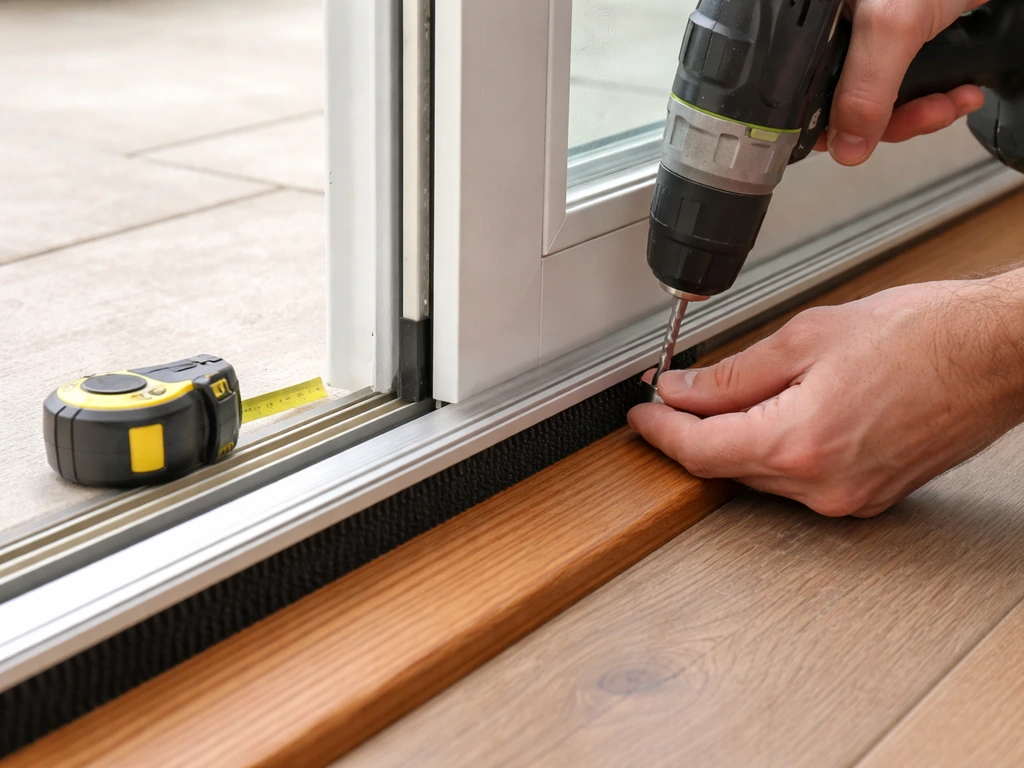
Even after a perfect alignment adjustment, there's almost always a small gap that needs a seal. This is normal, the door needs a little clearance to operate. Your job is to bridge that clearance without making the door hard to move.
Door sweeps
A door sweep is the most direct fix for a gap under a patio door. For sliding doors, the sweep typically attaches to the bottom rail of the moving panel or sits on the threshold itself. For hinged doors, it mounts to the bottom of the door slab. The right type depends on your door setup:
| Sweep Type | Best For | How It Attaches | Watch Out For |
|---|---|---|---|
| Adhesive-backed foam or rubber strip | Small gaps on hinged or sliding doors, light-duty use | Peel and stick to door bottom or threshold | Compresses over time; needs replacing every 1-2 years |
| Screw-on aluminum door sweep with rubber fin | Hinged outswing/inswing patio doors | Screws into door bottom face | Cut to exact door width with a fine-toothed hacksaw before installing |
| Kerf-in door bottom sweep | Hinged doors with a routed kerf slot in the bottom | Slides into the kerf cut in the door bottom | If it fits loosely, a small dab of adhesive locks it in place |
| Automatic drop seal | High-traffic hinged doors where drag is an issue | Mounts inside door bottom; drops when door closes | More expensive ($30-80); requires precise installation |
| Sliding door threshold brush or fin seal | Sliding patio doors at the track level | Attaches to the door panel bottom rail or the threshold frame | Don't size it so tall that it prevents the door from sliding |
Installation is straightforward for most sweep types. Close the door, hold the sweep against the bottom so it just touches the threshold with light contact, and mark the screw positions.
Fine Homebuilding advises that for outswing doors you should cut the sweep to length and hold it so the sweep just touches the threshold when the door is shut to eliminate air leakage while maintaining function cut the sweep to length for an outswing door so it just touches the threshold. The sweep should brush or lightly compress against the threshold, not drag hard.
If it drags, the door will be difficult to open and the sweep will wear out quickly. A gap of about 1. 5 mm or less is generally considered acceptable for a well-fitted sweep; anything more lets in drafts, insects, and moisture.
For EPDM rubber sweeps specifically: measure and cut to length with a fine-toothed hacksaw (a regular saw tears the rubber), close the door, position the sweep so it contacts the threshold evenly, mark the fixing holes, and fasten. Check the contact all the way across, a sweep that's perfectly sealed at the center but lifted at the corners is still letting air through.
Weatherstripping the bottom frame
If the gap is between the door panel and the threshold frame (rather than under the door slab itself), you may need to replace the weatherstripping that runs along the threshold or the bottom of the door frame channel. For sliding doors this is often a pile weatherstrip (the fuzzy strip that lines the track channel) or a rubber fin seal along the interior side of the track. Pull out the old material, clean the channel, and press in the replacement. Most door hardware stores and online suppliers sell replacement pile weatherstrip by the foot, measure the full run before ordering.
Threshold seals and adjustable thresholds
If drafts persist after installing a sweep, the problem is often the threshold itself rather than the sweep. Some thresholds have an adjustable seal strip on the top surface that can be raised or lowered with screws, worth checking before buying anything new. If the threshold seal is cracked, compressed, or missing entirely, replace just that component. Many replacement threshold seals are available as a clip-in or screw-in strip without replacing the whole threshold. If the threshold itself is damaged, warped, or worn down to bare metal or wood, full replacement is the right call, a new sweep won't seal well against a damaged surface.
Replace worn parts that keep causing the gap to return
Adjustment and seals are the first line of attack, but if the door keeps dropping back out of alignment, or if the adjustment screws turn without producing any change, the underlying hardware is worn out and needs to be replaced rather than tweaked.
Replacing sliding door rollers
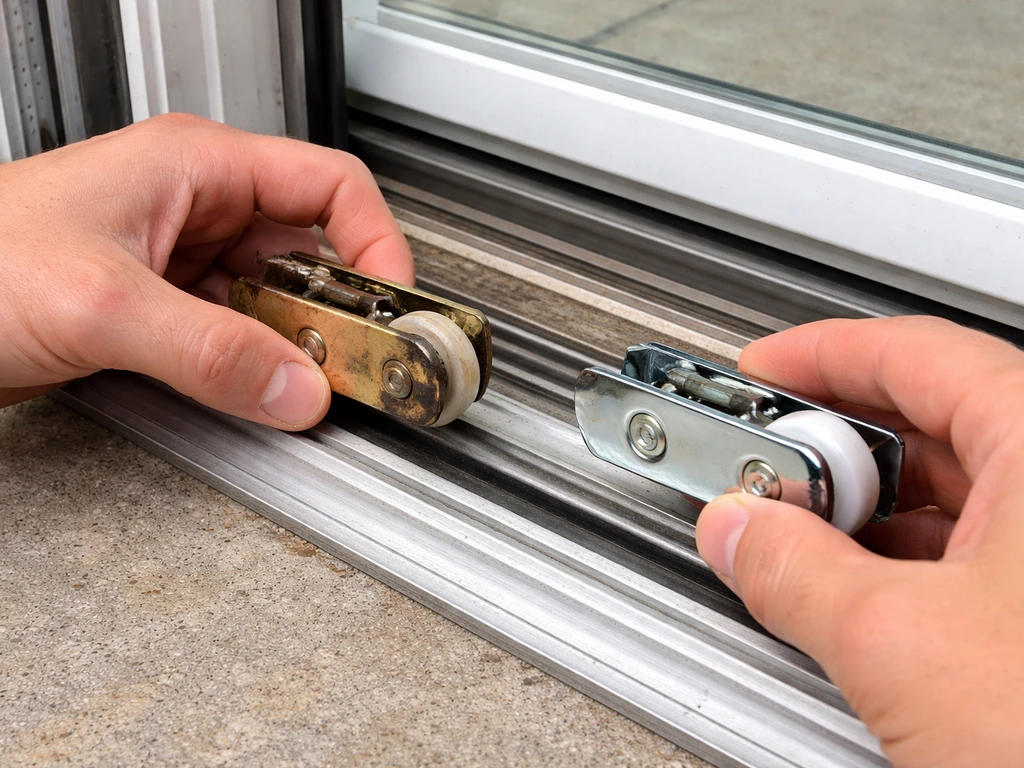
Worn rollers are the most common reason a sliding patio door develops a persistent bottom gap. When the roller wheel wears flat or the housing cracks, the door drops and no amount of screw adjustment recovers the lost height. Replacing them takes about an hour and rollers typically cost $15 to $40 for a set.
To remove the door, lift the panel vertically as high as it will go in the track, then angle the bottom outward and lift it free, most panels come out without tools. Note the roller size and wheel diameter before ordering replacements (take the old roller to the hardware store or photograph it). Snap or screw the new rollers into the bottom corners, rehang the door, and make your final height adjustments with the adjustment screw.
Replacing hinges on hinged patio doors
Bent or loose hinges that can't be corrected with tightening need to be replaced. Buy hinges that match the original size and screw pattern. If the hinge mortises (the recessed areas in the door and frame) are chewed out from stripped screws, fill them with epoxy wood filler, let it cure fully, then re-drill pilot holes before hanging new hinges. Skipping the filler step just means the new hinges strip out just as fast.
Renewing the strike plate and latch
A latch that doesn't engage positively isn't just an annoyance, it means the door isn't pulling tight against the weatherstripping, which leaves a gap even if the door looks closed. If moving the strike plate doesn't solve the latch engagement problem, check whether the latch itself is worn or damaged. On sliding doors, the latch hook wears over years of use and may need replacement. These are inexpensive parts ($10 to $25) available at most home centers or ordered directly from the door manufacturer using the model number stamped on the door hardware.
When to call a pro instead of DIYing it
Most gap problems are DIY-friendly, but a few situations genuinely call for a professional. Here's how to tell the difference:
- The frame isn't square and can't be shimmed: If your door was installed out of plumb, level, or square, no seal or roller adjustment will produce a consistent gap. A patio door must be installed level, plumb, and square for hardware to function correctly. Fixing this means pulling the door unit and reinstalling it — a job for an installer, not a DIYer.
- The rough opening or subfloor is damaged: Persistent water intrusion can rot the sill plate, subfloor, or framing around the threshold. If you're probing around the threshold and find soft or spongy wood, that structural damage needs to be addressed before any seal or hardware fix will last.
- The door frame is visibly warped or bowed: A vinyl or wood frame that has warped from heat or moisture exposure won't seal properly and can't be forced back into shape with hardware adjustments.
- You've adjusted everything correctly and the gap is still there: If the door is plumb and level, the rollers are new, the sweep is properly installed, and you still feel a draft or see daylight, there's likely a frame or installation gap that was never sealed during the original installation. A window and door installer can identify and address those hidden gaps.
- The door is under warranty: If your patio door is less than a few years old and has a persistent alignment or sealing issue, contact the manufacturer or original installer before attempting DIY repairs. Opening up the frame or removing hardware can void the warranty.
A drafty patio door that's part of a broader pattern of drafts throughout the home, or one paired with issues like a gap at the top of the frame or water intrusion at the head, may point to installation or structural problems beyond the bottom seal. If you’re dealing with a patio door gap at the top of the frame, it often indicates an installation or structural issue rather than a simple bottom seal problem. Those symptoms are worth having a professional assess, especially before winter.
Keep drafts from coming back: seasonal maintenance
The main reason gaps come back after you fix them is deferred maintenance. Rollers wear faster when they're running through grit. Sweeps fail sooner when they drag against a debris-covered threshold. These are five-minute checks that pay off in energy savings and avoided repairs.
- Clean the track twice a year (spring and fall): Vacuum out the bottom track with a shop vacuum, then wipe it down with a damp cloth. Avoid harsh solvents or wire brushes that damage vinyl and rubber components.
- Lubricate rollers and hinges annually: Use a silicone-based lubricant on roller wheels and hinge pins. Avoid WD-40 — it attracts dust and gums up over time. A light coat of silicone spray keeps everything running smoothly and reduces wear.
- Clear weep holes every fall: Use a toothpick or thin wire to poke through the exterior drainage slots at the bottom of the door frame. Blocked weep holes trap water in the track during rain and can cause apparent leaks at the threshold even when all your seals are intact.
- Inspect the sweep and threshold seal each fall before heating season: Compression seals and rubber fins flatten and crack over time. Run your finger along the installed sweep with the door closed and feel for gaps. A sweep that's visibly cracked or no longer making contact with the threshold needs to be replaced before winter.
- Check roller height adjustment in spring: Temperature changes cause door frames and tracks to shift slightly with the seasons. After a cold winter, take two minutes to check the reveal around your sliding door and make a small roller-height correction if needed.
- Tighten hinge screws on hinged doors each spring: Wood framing and door slabs move with seasonal humidity changes. A quick check and tighten of all hinge screws every spring catches sag before it becomes a gap.
A patio door that gets this basic attention twice a year should stay draft-free for years between major repairs. The gap under your door right now probably developed because one of these steps got skipped for a season or two, fix the immediate problem and get on a maintenance schedule, and it won't keep coming back.
FAQ
How do I tell if the gap is caused by the door being too low versus the weatherstripping being worn out?
Check whether the bottom clearance is physically present all the time, then compare corners. If both corners sit low compared to the frame and you can see misalignment, it is usually positioning. If the door height looks even but airflow increases after rain or the seal surface looks cracked or missing, it is usually a failed seal or threshold strip.
What gap size should I aim for after adjusting the door?
For most sliding patio doors, target about 1/8 to 1/4 inch of clearance at the bottom so rollers run freely, while keeping the visible draft line as small as possible. If you raise the door so the sweep drags hard or the door binds, the gap is effectively too small even if it looks sealed.
Can I use foam, caulk, or a weather sealant to fill the gap permanently?
Generally no. Sealants can block drainage paths and make it hard for the sweep or threshold seal to do its job, plus many gap-fill foams are not durable under door movement. Use the proper hardware fix (rollers, sweep, threshold seal, or frame weatherstrip) instead, then only use small, compatible sealing where the product is designed for it.
My patio door still leaks even after installing a new sweep, what should I check next?
Inspect the threshold itself and the weatherstrip surfaces it seals against. Many leaks persist because the threshold seal strip is cracked, the threshold top seal is misadjusted (on models with an adjustable strip), or debris prevents even sweep contact at the corners.
How can I prevent my new sweep from wearing out quickly?
Before fastening it, verify the sweep just lightly brushes or lightly compresses when the door is closed. If it drags because the door is too low or the sweep is positioned too high, it will wear rapidly and create a new gap over time.
What if the adjustment screws turn, but the door height never changes?
That usually means worn rollers or a stripped/failed roller assembly, not that you need more turning. If the screw rotates and the door does not lift or drop, plan to replace the roller set rather than continuing adjustments.
How do I know which replacement roller size I need for my sliding patio door?
Measure or confirm the old roller size by removing one roller and checking the wheel diameter, then match the housing and mounting style. Taking the old roller to a supplier (or using clear photos of the markings and dimensions) helps avoid buying a correct-looking but incompatible roller.
For an EPDM rubber sweep, what can go wrong if I cut it incorrectly?
If you use the wrong blade or leave a ragged cut, the sweep may not sit flat and can create corner leaks. Cut to length using a fine-toothed hacksaw, then re-check contact across the full width after installing and close the door gently to confirm it moves freely.
My hinged patio door has a bottom gap only at certain spots, what does that indicate?
Uneven contact along the bottom often indicates the door is not square on its hinges. Tighten hinge screws first, then check for built-in hinge adjustment slots or alignment features. If hinges are loose or worn beyond adjustment, replacement is usually the durable fix.
How do I adjust the strike plate after raising or lowering the door?
If the latch no longer engages cleanly, adjust the strike plate within its mounting slot range. Loosen the strike plate screws, shift it up or down by about a millimeter or two, then retest the latch, this prevents forcing the door closed and helps the weatherseal compress properly.
What maintenance checks stop gaps from coming back?
Twice yearly, inspect and clean the track area and corners where grit collects, then check sweep contact across the full width. Replace sweep pieces or threshold seal strips when they start to drag, crack, or lose contact, because worn parts tend to create the same bottom gap again.
When should I call a professional instead of continuing DIY?
If you have a pattern of drafts across multiple areas, water intrusion at the head or top frame, or you suspect the door opening or framing is out of square, a professional assessment can prevent repeated seal replacements that fail due to structural issues.
Next Article
How to Protect Patio Door from Rain: DIY Fixes, Steps & Costs
How to protect patio door from rain: step-by-step DIY fixes, tests, tools, seasonal tips, and when to call a pro.