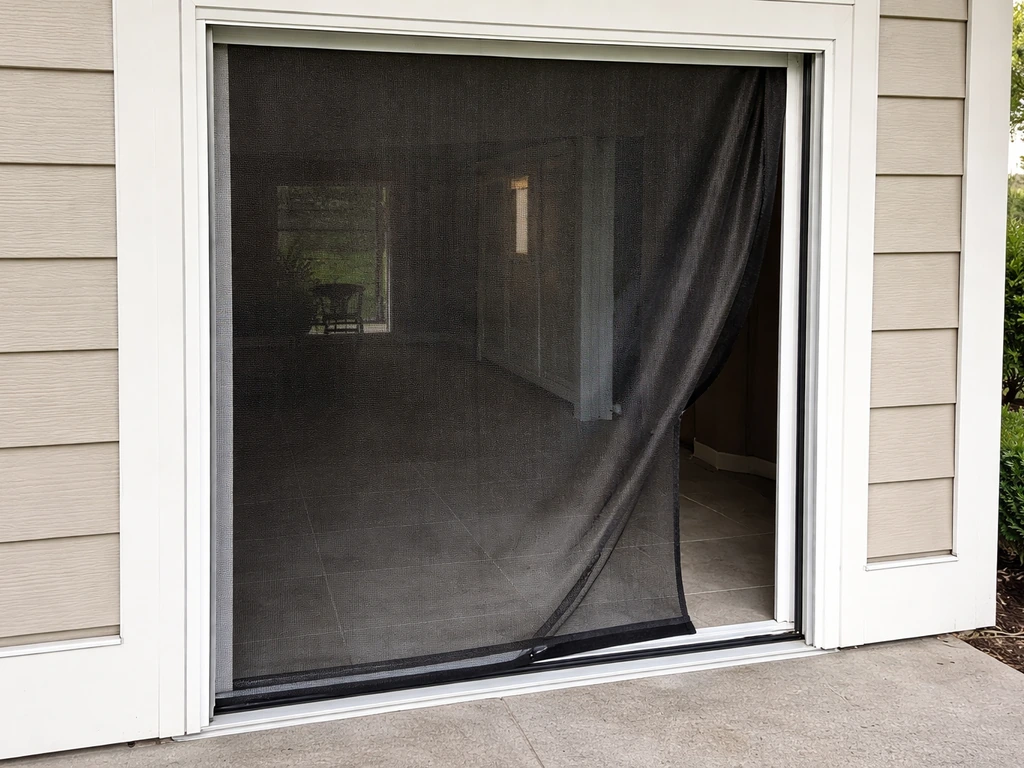
The right bug net for a patio door depends on whether you have a sliding glass door, a hinged door, or a door with an existing screen track. For most sliding patio doors, a replacement screen panel or a magnetic mesh screen is the fastest fix. For hinged or French doors, a magnetic curtain-style net is usually your best bet. Retractable cassette screens and DIY mesh kits fill the gap for unusual openings or custom setups. Pick the right type first, measure carefully, and the installation itself is straightforward.
Bug Net for Patio Door: Types, Measuring, and Installation

Jamie Archer
19 Jun 2026

What people actually mean by a bug net for a patio door
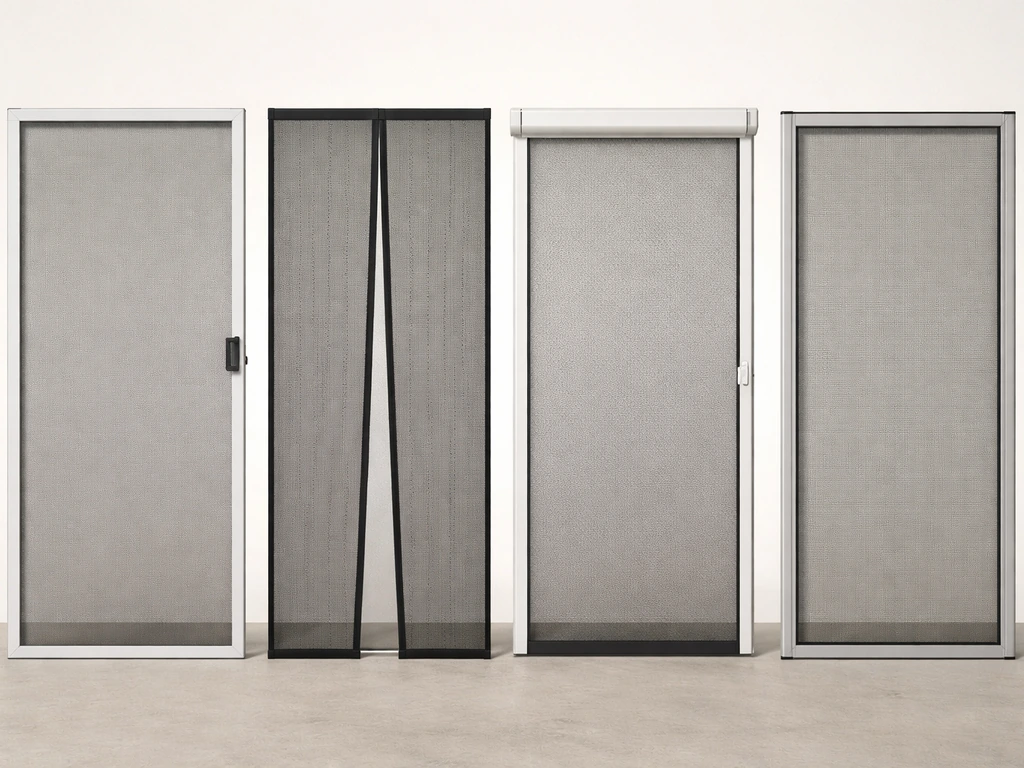
The phrase covers several very different products, and buying the wrong one wastes money and time. Here are the four main types and when each one makes sense.
| Type | Best For | How It Attaches | Rough Cost |
|---|---|---|---|
| Sliding screen door panel | Existing sliding door track with no screen or a damaged screen | Lifts into head channel, rests on sill roller track | $40–$150 |
| Magnetic mesh curtain | Hinged, French, or any door without a track; renters | Hook-and-loop tape or wood tacks on door frame | $15–$50 |
| Retractable/cassette screen | Clean look, frequent use, budget for a semi-permanent fix | Screws into door frame or adjacent wall | $80–$400+ |
| DIY mesh kit | Odd sizes, screen repair, budget builds | Spline roller and frame channel, or staple/tack to frame | $10–$40 |
A sliding screen door panel is the cleanest solution if your door frame already has a track. It glides the same way the glass door does and seals well on all four sides. Magnetic mesh curtains split down the middle and close with embedded magnets when you walk through; they work on almost any door but let in more air around the edges.
Retractable screens roll into a housing mounted to the frame and disappear when not in use, which is great if you want the door to look clean in winter. If you are dealing with the roll-down style, also make sure the screen fully retracts and does not snag on the door hardware retractable screens roll into a housing.
DIY mesh kits give you the most flexibility for unusual openings and cheap repairs, but they take more effort to seal properly.
If you already have a sliding screen door that just needs a better seal against bugs and drafts, that is a different problem and relates more closely to replacing the door's bug seal strip than buying a whole new net. Similarly, if you want a screen that rolls up into the ceiling or overhead, that falls into the pull-down or roll-down category rather than a standard sliding panel.
Measure your patio door before you buy anything
This is where most people go wrong. Buying a screen that is even half an inch too wide or too narrow causes fitting headaches that are completely avoidable. Take your measurements three times and write them down.
For a replacement sliding screen panel
Measure the inside width of the door frame opening from the left track channel wall to the right track channel wall. Then measure the height from the top of the sill roller track groove to the bottom of the head channel. Add about 1/4 inch to both dimensions to allow the door frame rails to overlap the top and bottom edges for a proper fit. Also check the depth of your head channel (usually 3/4 inch to 1 inch) to confirm a standard panel will seat correctly. If your existing panel is intact but damaged, pull it out and measure the frame itself rather than the opening, because the panel frame overlaps the opening slightly on each side.
For a magnetic mesh curtain

Measure the width and height of the door opening itself, not the frame. Most magnetic mesh curtains are sold by door opening size (typically 32x80, 36x80, or 36x96 inches). You want the mesh panel to be at least as wide as the opening so the hook-and-loop tape attaches to the flat face of the door stop or frame face, with the mesh fully covering the opening. If the mesh is too narrow, bugs get in around the sides immediately.
For a retractable screen
Measure the clear opening width and height. Most retractable screen manufacturers also want the width of the mounting surface beside the door (for the housing cassette) and the depth of the door stop. Check your sill carefully: if the threshold slopes steeply toward the outside, the bottom guide rail may not sit flat, and you will need to plan for shims. Genius Screens’ retractable screen FAQs explicitly address steep-slope threshold problems, noting that the bottom guide rail may not sit flat and may require planning during installation if the threshold slopes steeply toward the outside, the bottom guide rail may not sit flat. This is a recognized enough problem that some manufacturers sell sloped sill wedge shims specifically for it.
For a DIY mesh kit
Measure the opening and add about 4 inches to both width and height. You want roughly a 2-inch overlap on every side so you have enough material to seat into a spline channel or to fold and staple securely. Measure twice and cut once, mesh that is too short cannot be extended.
How to install each type
Sliding screen door panel
You will need: the replacement screen panel, a soft cloth, silicone spray lubricant, and a flathead screwdriver. Do not use oil-based lubricant on the sill track; it attracts dirt and debris that can cause the screen to stick and eventually jump the track.
- Clean the sill roller track and head channel thoroughly with a damp cloth. Remove all grit, old lubricant, and debris before installing the new panel.
- Spray a light coat of dry silicone lubricant along the sill track and let it dry for a minute.
- Lift the screen panel and angle it so the top edge goes into the head channel first. Push it all the way up until there is clearance at the bottom.
- Swing the bottom of the panel over the sill track so the rollers sit inside the track groove.
- Slide the panel back and forth a few times. It should glide smoothly. If it catches or feels stiff, check that the rollers are seated fully in the track groove.
- Check roller alignment: each roller has an adjustment screw on the side of the screen frame. Turn it clockwise to raise the roller, counterclockwise to lower it. The goal is even contact with the track along the whole travel path.
- For Andersen-style screens, confirm the roller or spring is making contact with the vinyl extruded rib inside the channel. If it is not, the screen is not properly seated and will pop off the track under load.
Magnetic mesh curtain
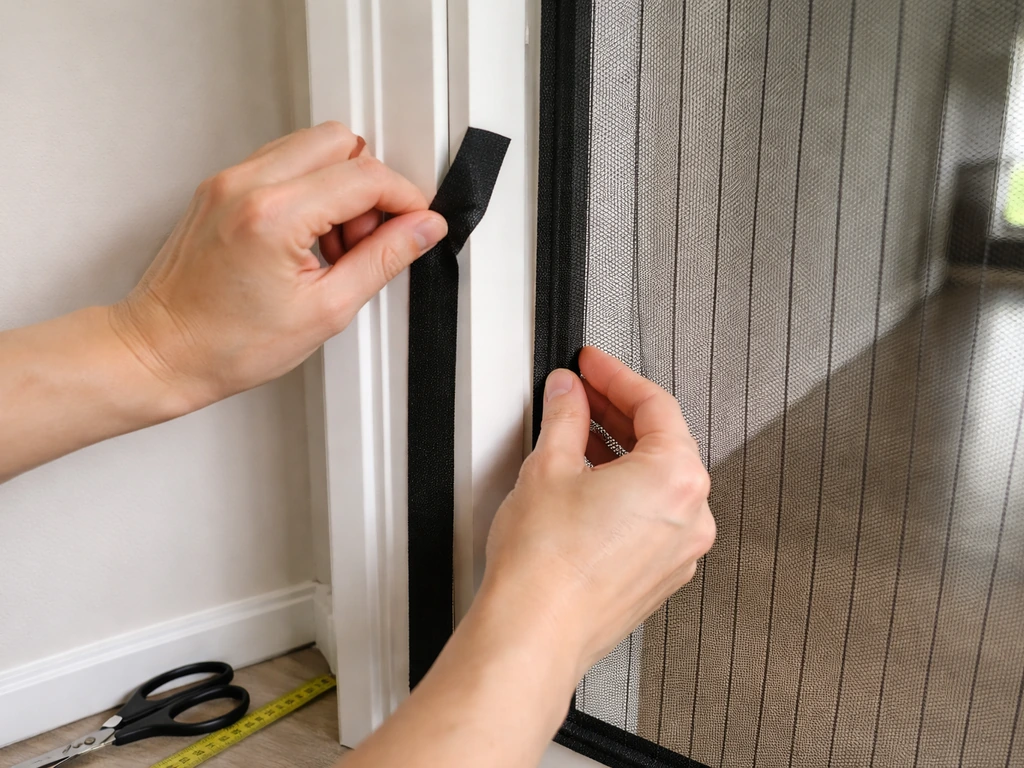
You will need: the mesh kit (which includes hook-and-loop tape), scissors, a tape measure, and optionally wood tacks for wood frames. This install takes about 20 minutes.
- Clean the door frame face thoroughly. The hook-and-loop adhesive needs a clean, dry surface to bond properly.
- Attach the hook-and-loop strip across the full width of the top of the door frame, then down both sides. Press firmly and hold for 30 seconds per section.
- If your frame is wood, add the included wood tacks through each strip at roughly 6-inch intervals. This dramatically improves hold and is worth the extra 10 minutes.
- Hang the mesh panel by pressing the opposite side of the hook-and-loop onto the strips. Start at the top center and work outward.
- Walk through the center split a couple of times to confirm the magnets re-engage cleanly after each pass. If they do not align, adjust the panel position slightly on the hook-and-loop before it fully sets.
Retractable cassette screen
You will need: the screen kit, a drill, screws (usually provided), a level, a tape measure, and possibly shims if your threshold slopes. Budget 45 to 90 minutes for a first-time install.
- Read the manufacturer's guide for bracket spacing. Andersen-style retractable screens, for example, place slide mounting brackets a specific measured distance past the top and bottom ends of the housing.
- Hold the housing cassette against the door frame (typically the latch-side jamb or adjacent wall), level it, and mark the screw hole positions.
- Drill pilot holes and secure the housing with the provided screws. Remove any masking tape from the track support before securing.
- Install the bottom guide rail across the sill. If the threshold slopes and the rail won't sit flat, use shims under the low end until the rail is level. A crooked bottom rail causes the screen to track unevenly and wear out faster.
- Extend the screen across the opening and seat the leading edge into its receiving channel or latch point on the opposite side.
- Test the retraction several times. The screen should retract smoothly without bunching. If it blows in or out excessively when the door is open, check that the screen is properly seated in the track on all sides.
DIY mesh kit
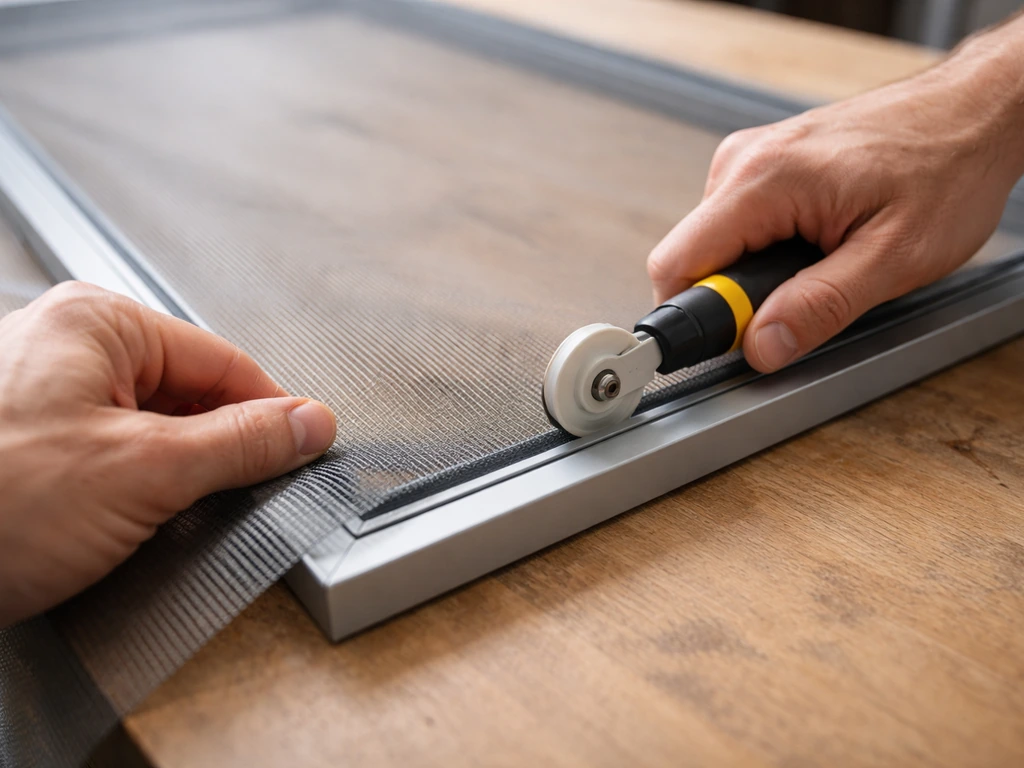
You will need: insect screen mesh (fiberglass or aluminum), a spline roller tool, spline cord, a utility knife, a straight edge, and screen frame material if building from scratch. If you are re-screening an existing frame, the frame is already your guide.
- Cut the mesh about 2 inches larger than the frame opening on all sides.
- Lay the mesh over the frame. Starting at one corner, use the spline roller to press the spline cord and mesh into the frame channel. Work across the top, then one side, pulling the mesh taut (not drum-tight) as you go.
- Do opposite sides last to keep tension even and avoid wrinkles.
- Trim excess mesh flush with the outside of the spline using a utility knife against a straight edge.
- If you are attaching mesh directly to a wood frame without channels, fold the edge over twice and secure with staples every 3 inches, then cover with a thin wood strip and screws for a clean, reinforced edge.
Keeping it secure and actually usable
A bug net that lets in air around the edges or that your dog blows through in three days is not doing its job. Here is how to make each type hold up to real daily use.
Sealing the edges
For sliding panels, the seal quality depends heavily on the door's brush or foam weatherstrip around the frame perimeter. If your screen door fits the track well but bugs still get in at the corners, check the corner seals on the screen frame itself and replace them if they are cracked or compressed. For magnetic mesh curtains, the hook-and-loop tape is the seal: if it gaps anywhere, bugs walk right in. Press it down firmly across the entire length and re-press any sections that have lifted.
Pets and kids
Magnetic curtains are the most pet-friendly option since dogs and cats can push through the center split without damaging anything. They are also easiest for young children to navigate independently. Sliding screen panels are more durable but a large dog running at full speed will pop one off the track. If that is your situation, consider a retractable screen with a secure bottom guide rail, which is harder to dislodge accidentally. For any mesh screen around kids and pets, fiberglass mesh is softer but tears more easily than aluminum or stainless steel mesh. If durability is the priority, use aluminum or pet-screen grade mesh.
Snag-proofing
The most common snag points are door handles, rollers, and the door frame edge. When installing a magnetic curtain, make sure the mesh hangs clear of the door handle hardware. For sliding panels, check that the screen panel clears the glass door handle as both panels slide past each other. If the screen snags, a small bump stop or rubber bumper on the glass door handle sometimes solves it. For retractable screens, confirm the screen mesh does not contact any part of the door when it is in the open/retracted position.
Maintenance and seasonal care
Cleaning schedule
Clean the sill track monthly during the season you use the screen. For patio openings with a sliding door style screen, you may also need a specific pull-down bug screen option designed to lower smoothly when you want insect protection pull down bug screen for patio. A stiff brush or vacuum attachment pulls out grit before it grinds against the rollers or bottom guide rail. Inspect hardware and lubricate the track quarterly. Wipe the mesh itself with a soft damp cloth every few weeks; a mild soap solution removes pollen and grime that reduces airflow and makes the mesh sag visually. Do not use a pressure washer on fine mesh, it distorts the weave.
Repairing small tears
A tear smaller than half an inch can be patched with a piece of matching mesh and a dab of clear screen repair adhesive. Anything larger than an inch is better re-screened entirely. Fiberglass mesh tends to sag over time even without damage, which is worth knowing before you buy it. If you are re-screening a frame that needs to last several years, aluminum mesh holds its shape better.
Winter storage
If you live somewhere with freezing winters, take down sliding screen panels and store them flat or standing upright in a protected spot. Leaving them in the track through winter exposes the rollers and frame to ice and freeze-thaw stress. Remove magnetic curtains and fold them loosely; avoid tight rolling which creases the mesh permanently. Retractable screens can usually stay in place if the housing is weatherproof, but retract the screen fully and latch it before the first freeze. Before reinstalling in spring, do a full track cleaning, roller inspection, and check the mesh for any winter damage.
Troubleshooting common problems
Screen won't stay in the track / keeps popping off
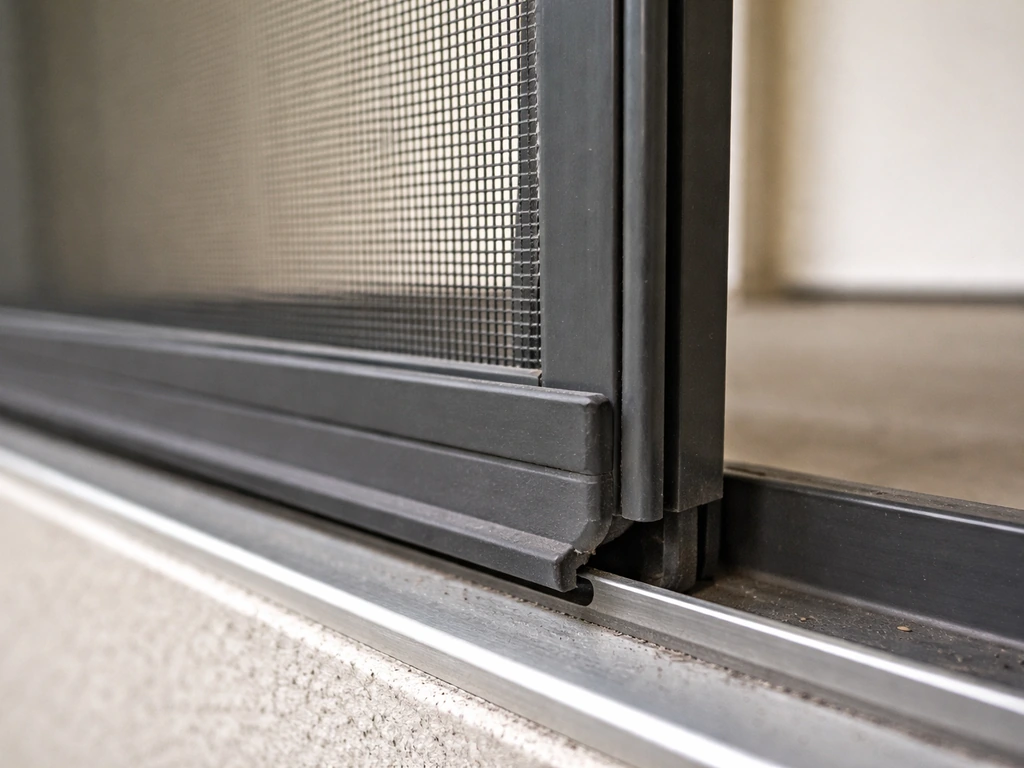
This is almost always a roller height issue. If your screen won’t stay in the track or keeps popping off, this guide’s roller-height checks are the same kind of steps you would use in how to fix patio net door problems. The rollers need to sit deep enough in the track groove that the panel cannot bounce out.
Check the adjustment screws on the side of the screen frame: turn them clockwise to raise the roller and deepen the engagement with the track. If the rollers are already at maximum height and the door still pops out, check whether the track itself is warped or has debris in it that is lifting the panel. Also confirm the panel is the right size; a panel that is too narrow will never track reliably.
Gaps at the corners letting bugs in
Corner gaps in sliding panels usually mean the panel is slightly undersized or the corner seals are worn. Replace the corner seals first as they are cheap and easy. For magnetic curtains, corner gaps mean the hook-and-loop is not making full contact with the frame at the corners; press it down firmly and add a tack at each corner. If the frame molding is irregular or rounded, the tape will never bond fully and you may need to attach the strip to a flat wood shim instead.
Magnets not holding / curtain blowing open
If the center magnets re-engage slowly or separate in a breeze, check that the two halves of the mesh are hanging symmetrically. An uneven hang means the magnets are offset and weaker than designed. Re-position the hook-and-loop attachment so both panels hang at the same height. Strong wind is always going to be a challenge for magnetic curtains; if your patio door faces a consistently windy exposure, a retractable screen or sliding panel is a better long-term choice.
Screen mesh sagging or wrinkling
Sagging in a re-screened frame usually means the mesh was not pulled taut enough during spline installation, or fiberglass mesh has relaxed over time. The fix is to remove the spline, re-tension the mesh, and re-seat the spline. For retractable screens, if the mesh bunches or has a visible fabric seam showing inside the ZIP track when retracted, the screen has been installed incorrectly and needs to be re-seated in the track from the beginning.
Retractable screen blowing in or out excessively
This almost always means the screen is not fully seated in its track on one or more sides. Extend the screen fully, confirm the leading edge is locked into its receiving channel, and check the bottom guide rail is secured flat against the threshold. If the bottom guide is on a slope and not shimmed level, the screen will not track evenly and will catch wind.
Poor fit due to uneven or out-of-square frame
Older patio door frames settle and rack slightly out of square over time. If your sliding panel binds or drags on one corner, measure the diagonal of the opening (corner to corner both ways). If the diagonals differ by more than 1/4 inch, the frame is racked. Roller adjustments can compensate for minor racking, but severe cases may need a frame shim or a custom-sized screen panel rather than a stock size.
Safety and security considerations
Emergency exit and accessibility
Any bug net on a patio door should not slow down an emergency exit. Magnetic curtains pass this test easily since they part with minimal force. Sliding panels slide out of the way normally. Where you need to be careful is with retractable screens that have a latch or lock mechanism: make sure everyone in the house knows how to release it quickly. Never install a screen or net in a way that obstructs the door latch or prevents the glass door from fully opening. If you have children or elderly family members using the door, test the operation with them before considering the install done.
Wind and storm risk
A magnetic mesh curtain left up in a storm will get shredded or pull the hook-and-loop tape off the frame. Take it down when wind picks up. Sliding screen panels and retractable screens are more wind-resistant but are not designed for storm conditions. Retract or close any screen before severe weather. Do not rely on a screen panel as any kind of structural barrier.
Burglary deterrence
A bug net is not a security barrier, and it should not be treated as one. A magnetic mesh curtain offers essentially zero deterrence. A heavy-gauge aluminum or stainless steel sliding screen panel slows an opportunistic intruder slightly, but any determined person will simply push it off the track in seconds. If you are leaving the glass door open and relying on the bug screen while you are away from home, understand that this is a ventilation choice, not a security choice. For real security with the door open, a door bar or pinlock on the glass door combined with the screen is a more sensible combination. Keep your focus on the glass door's lock and not the screen.
Screen visibility and trip hazards
Dark-colored mesh (charcoal or black) is significantly harder to walk into than bright aluminum or white mesh. This matters both for human adults and for birds. If your patio sees a lot of foot traffic, charcoal fiberglass or aluminum mesh is the right choice from a safety standpoint. A magnetic curtain with its visible center split is actually easier to identify as a barrier than a taut invisible mesh screen, which is one of its underrated advantages.
Picking your type and moving forward
If your sliding patio door already has a track, get a replacement sliding panel: it will look the best, seal the best, and last the longest with minimal upkeep. If you have a hinged or French door and just need something up fast, a magnetic mesh curtain will work fine for the season. If you want a clean, long-term solution and do not mind spending more upfront, a retractable cassette screen is worth the investment. DIY mesh kits make sense for repairs or truly custom openings where nothing off the shelf fits.
Measure carefully, pick your type, and get the installation right the first time. The troubleshooting in this guide covers the problems that actually come up after install, so bookmark it for the first week of use. Most issues, whether a panel popping off the track, magnets not holding, or a retractable screen blowing around, have a direct fix once you know what to look for.
FAQ
Should I buy a bug net based on the door opening size or the outside measurement of my frame?
Use the clear opening dimensions for mesh curtains (so the hook-and-loop sits on enough flat face to cover the opening). If you are installing a sliding replacement panel, measure the frame rails and track channels, because the panel size depends on how it sits and overlaps, not just the visible doorway opening.
Can I trim or cut a bug net after I buy it?
You can usually cut DIY mesh to size, but most magnetic curtains and framed sliding panels are not meant to be resized. Trimming can break the stitched edge, reduce magnet or attachment performance, and leave exposed edges that let insects through. If you must adjust, check whether the product offers a “trim allowance” for your model.
What should I do if my magnetic curtain has gaps even after pressing the hook-and-loop tape down?
First confirm the curtain is hanging symmetrically so both halves meet evenly at the center split. Then check the frame face itself, if it is rounded or has paint texture, the tape may not bond across corners. In that case, add tacks at each corner and consider attaching the tape to a thin flat shim to create a continuous bonding surface.
How tight should the spline and mesh be when re-screening a frame?
The mesh should be taut enough that it pulls flat, with no visible slack lines, but not so stretched that it distorts the frame or creates uneven tension. If you see sag later or the screen loosens, it usually means the spline was seated without fully tensioning the mesh during installation.
Why does my sliding screen keep popping off the track even when the rollers are adjusted?
If roller height is already at the adjustment limit, the most common causes are debris in the track, a warped track, or a slightly undersized panel that cannot stay seated along the full length. Clean the sill track thoroughly, then re-check panel size and engagement at the leading edge, the bottom guide rail also needs to sit flat.
Is fiberglass mesh or aluminum mesh better for patio door bug nets?
Fiberglass is softer and often more comfortable if pets or kids interact with it, but it tears sooner and can sag sooner over time. Aluminum or pet-screen grade mesh holds its shape better and is more durable if you expect frequent contact, pets, or windy conditions.
Will a bug net handle windy patios, especially with a breeze coming from the side?
Magnetic curtains are most affected by gusts because the seam and edge sealing can be challenged by uneven airflow. If your patio is consistently windy, a retractable screen or a sliding panel generally performs better. Also take down magnetic curtains during storms or high wind periods to prevent shredding or tape failure.
How do I protect my screen during freezing weather if I do not want to remove everything?
For sliding panels left in place, freezing can stress rollers and cause freeze-thaw binding. If you cannot remove them, at least clean the track before freezing season and keep the door area clear of ice buildup. Magnetic curtains should be removed and folded loosely to avoid permanent creases.
Does a bug net reduce airflow or trap more pollen?
Any fine mesh can slow airflow slightly and it will collect pollen. Wipe the mesh with a soft damp cloth periodically during use, using mild soap if needed, so grime does not cause visual sag and reduced airflow. Avoid pressure washing because it can distort the weave.
How can I tell if my screen is blocking an emergency exit or door latch?
Before finalizing, test the door as if escaping quickly, open it fully without fighting the screen, and verify no lock, handle, or latch is partially obstructed. For retractable screens, confirm the latch can be released quickly by everyone who uses the door, including children or elderly family members.
What is the fastest way to fix insects getting in at the corners on a sliding panel?
Start with the corner seals on the screen frame, they are usually inexpensive and simple to replace. If corner gaps persist, confirm the panel is fully seated and that the bottom guide is level, otherwise the panel can lift slightly at corners and bypass the seal.
Next Article
Roll Down Bug Screen for Patio: Fixing a Stuck or Off-Track Screen
Step-by-step fix for stuck or off-track roll down patio bug screens: clean tracks, adjust tension, realign rollers, rest